Showing posts with label aging. Show all posts
Saturday, January 20, 2018
Hello, Denial, My Old Friend
No one likes getting older, and most of us cling to denial and try to resist the inevitable as long as we can.
It is a losing proposition, of course.
I suppose there are some who shrug and accept the incessant march of time. They are probably the happiest of people, the ones who are more contented with the way things are than those who strive (or appear) to be forever young.
The latter takes a lot more effort. Besides, it is a fight that, ultimately, no one can win.
They say ignorance is bliss, and maybe that is true. In the long run, though, it really doesn't matter how one approaches aging. Time will always have its way. The sooner you reconcile yourself to that fact, the happier you will be.
That may have been at the heart of Archie's problem in the episode of All in the Family that aired on this night in 1973, "Oh Say Can You See." Archie (Carroll O'Connor) was resisting that aging thing. He clearly needed glasses, and his memory wasn't what it once was.
When Archie tried to read the paper and kept holding it farther and farther away, Mike (Rob Reiner) came up from behind and said, "Gettin' to be 'bout time to have your arms lengthened, huh, Arch?"
The conversation around the Bunker dinner table that evening wasn't settling too well with Archie. It was all about the aging issues he was trying to avoid so he made a beeline for the neighborhood bar — where he bumped into an old classmate (Larry Storch).
This classmate looked a lot younger. In fact, the bartender observed that Archie looked at least 10 years older. Maybe 15.
The whole age discussion led to some delightful dialogue exchanges — and not just at the neighborhood bar, either.
For example, when Mike talked about Madison Avenue selling people on a "phony youth culture," Gloria (Sally Struthers) observed that women were having all parts of their bodies lifted surgically to maintain their youthful appearances.
"Just last week in the paper," Gloria remarked, "a woman had her bottom lifted."
An incredulous Edith (Jean Stapleton) asked, "Wouldn't that make her too tall to sit down?"
Kudos to the writers — and now, back to the bar.
Archie bumped into his old friend again; this time he was meeting a young lady named Tina (Arlene Golonka) at the bar, and when Archie wanted to know his friend's secret for staying young, he told Archie that it was all about thinking young. That included acting young — pursuing much younger women.
Archie said he had heard that his friend was married, and his friend acknowledged that he was still married. He also contended that his extramarital flings were a favor to his wife because they kept him young for her. He found that incredibly amusing. Archie did not. But his friend did say some things that Archie found valuable.
He told Archie that he should be called Brad when Tina arrived. His real name was Bill, but Brad sounded younger. "Bill ain't got no pizzazz," he explained. "When people call you Brad, you feel like a Brad."
When Tina arrived and Archie's friend started to introduce them, Archie told Tina that his name was Greg.
Archie seemed impressed by — and a bit jealous of — Bill's success with young ladies until he had the opportunity to speak with Tina one on one, and he learned that the rendezvous was a business arrangement. Tina was a call girl. In those days I guess the popular term was escort.
"You ought to be ashamed of yourself! Does your mother know what you're doing?" Archie asked Tina.
"Yes, she does," Tina replied. "Does your mother know what you're doing?"
It was a real eye opener for Archie, and it made him appreciate what he had.
Sunday, October 15, 2017
On Aging and Making Commitments
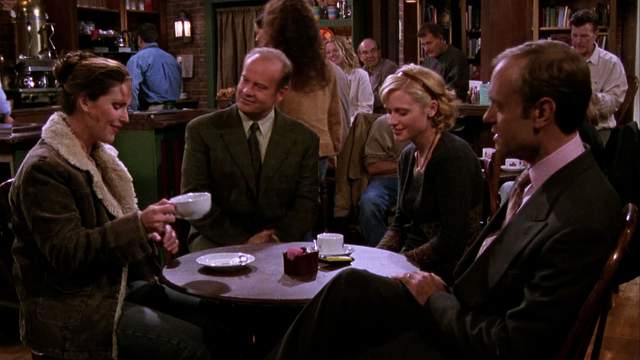
I'm not really sure why I like the episode of Frasier that first aired 15 years ago today.
Except that, as always, the writers for the show had a unique take on their theme — which, in this case, was the twin themes of aging and commitment.
Which, I suppose, are really just subsets of the more general topic of life, which is probably more accurately defined by the phrase "it's complicated."
Now, that's real reality programming — even if it is in a fictional context.
The episode — "Kissing Cousin" — centered on a visit from Roz's cousin Jen (played by Zooey Deschanel). Jen was a younger but just as free–spirited version of Roz (Peri Gilpin). In fact, Roz once babysat for Jen and took the opportunity to school her in Roz's rather bohemian ways. The two became close, and Jen, like many disciples of an avant–garde role model, took it to extremes.
Jen was negative about, well, just about everything, but all of it couldn't be explained simply by the mindset Roz had encouraged. Jen had that judgmental certainty of the rightness of every thought she had and every position she took that often seems to be the hallmark of youth.
And older viewers must have suspected that, had they been given the opportunity to watch Jen's character evolve as she got tossed around by life (as all lives inevitably must be), they would have seen her abandon most of her preconceived notions about how life is and should be.
But Jen never made another appearance on Frasier so viewers will never know what became of her. They can only speculate based on their own experiences and knowledge.
Frasier (Kelsey Grammer) put up with it longer than one might think his narcissistic personality could, but he finally had enough when Jen told him that Freud had been "proven wrong about everything." The strongly Freud–influenced Frasier could not resist the urge to set her straight.
Otherwise, Frasier was to be commended for an atypically restrained response that anyone who has had to contend with Millennials must admire.
But he could get some distance from Jen. He wasn't with her 24 hours a day the way Roz was, and Roz, who was 38 in the episode (Gilpin was actually 41 when it aired), couldn't keep up with her twentysomething cousin.
And the all–nighters with the globe–trotting Jen were wearing Roz down.
While Frasier seethed privately over Jen's attitudes, the perennially prissy Niles (David Hyde Pierce) was willing to chalk them off to youthful exuberance, ironically noting that "we were all that way" and "it passes."
To older observers, the young always seem to have everything, and that can be frustrating for those who have lost a step or two.
The truth is that no generation has it all, and Millennials, in spite of their reputation for being technology–savvy, have their own obstacles to overcome. Many are more resistant to rites of passage, like leaving their parents' homes, than their predecessors.
For many this is said to be an economic condition, heavily influenced by the Great Recession and related external factors, but that does little to explain the behavior of older Millennials like Jen, who had been living in places like London and Florence — and planning a trip to Vietnam because "Americans have never even heard of it" — years before the economy imploded.
I'll admit that most Millennials probably couldn't afford to live the way Jen did in 2002 — but her lifestyle seemed to have an appeal for the station manager, Kenny (Tom McGowan). Recently separated from his wife and still working in an office filled with boxes containing his possessions (because Kenny's experience had been that permanent jobs were temporary), Kenny had his issues with commitment. And Jen was free of such bonds.
Jen encouraged him to be more impulsive, but when he did so and then tried to arrange to travel with her to Vietnam, she revealed herself to have her own problems with commitment. She always traveled alone, she told Kenny, because of an experience she once had. The audience was left to guess about the nature of that experience, but one can reasonably imagine that it involved someone who had feelings for Jen that she did not return.
That seems to be at the heart of many such human conflicts.
That person was probably another Millennial, not as mature as Kenny, who handled Jen's rejection quite well, shrugging it off and expressing the hope that they would run into each other in Asia — and, after she left, he began to unpack the boxes in his office.
Labels:
2002,
aging,
commitment,
David Hyde Pierce,
episode,
Frasier,
Kelsey Grammer,
Kissing Cousin,
Peri Gilpin,
sitcom,
Tom McGowan,
TV,
Zooey Deschanel
Saturday, March 11, 2017
The Angel of Death
Norman (James Earl Jones): Are you here visiting somebody?
Frasier (Kelsey Grammer): Oh, no. I'm just here with a friend of mine, Roz. She's here doing some community service.
Norman: Ah, the Angel of Death. Nice girl.
It isn't easy to pick a single favorite episode from the Frasier series.
That is the way it is with any really good TV series, isn't it? If you can only think of one truly good episode during a series' run, my guess is that would be the exception, not the rule.
But, almost by definition, a truly good series must have generated several episodes that could qualify as the series' best. In such a case, usually the series' average episodes are better than most.
Frasier was such a series, and I can name several episodes that I would consider worthy of being the series' best. But ultimately I think I would always pick the episode that aired on this night in 1997 — "Roz's Krantz and Gouldenstein Are Dead" — as the cream of the crop.
When the episode began, Roz (Peri Gilpin) was performing some community service picking up trash along the road. She had been stopped for speeding and her options for punishment were to pay a fine or perform community service. She chose the latter but didn't like gathering trash along the road.
It just wasn't right for her so Frasier (Kelsey Grammer) recommended that she perform her community service at a retirement home. Roz was reluctant — like many people she had a fear of aging — but she did it, anyway.
What happened next didn't help.
Roz had the misfortune of being with a couple of the residents when they died. She was playing checkers with one and reading to another. As a result, the other residents started calling her "the Angel of Death." When they encountered Roz in hallways, they would turn around and go the other way.
Roz didn't want to go back, but Frasier insisted, and he went with her to provide moral support.
Roz went into a room where an elderly woman named Moira (Lois Smith) was sitting up in her bed. She told Roz to come in.
"How do you feel?" Roz asked.
"Fine," Moira replied. "Now hand me those cigarettes."
Roz did so but couldn't resist saying, "These things do come with a warning."
"So do you, darlin'," Moira replied. "I let you in."
The two went on to have a heart–to–heart conversation about growing old.
"Nobody likes to get older, but it doesn't mean you can't enjoy yourself."
Moira (Lois Smith)
Meanwhile, Frasier met a blind resident played by James Earl Jones, who knew Roz by reputation. They had a nice conversation, too, about how Frasier's advice to a caller had helped him. It was at a time when Jones' character had lost his wife and had been experiencing some problems. The caller had been having similar trouble adjusting to life after his wife died, and Frasier suggested that the caller keep pictures of his wife all over the house to help him through the transition.
Pictures, obviously, would be of no use to a blind man, but Jones explained that, when he and his wife were dating, she had made a life mask of herself for art class. He asked his daughter to look for it and she found it. He told Frasier that every night before he went to sleep he ran his fingers over the mask and was reminded of the old days.
"You really helped me," he told Frasier and showed him the mask.
Then while Jones was in the bathroom to take some medication, Frasier ran his fingers over the mask and lost his grip. The mask fell to the floor, and the nose was broken off. Unfortunately the last few minutes of the show were about Frasier trying to mend the mask without Jones finding out what had happened.
The rest of the episode was a bit slapstick, to be honest. In general, though, it was a nice commentary on aging.
That's not a bad cue to turn our attention to Smith, who probably isn't familiar to most people but has had an extensive career in movies and television and on the stage.
Among her movie credits are "East of Eden," "Five Easy Pieces" and "Fatal Attraction." There have been many others in more than 60 years — although you might not recognize her in her earlier movies if all you have seen are her later ones, like "Twister," for example, in which she played Helen Hunt's aunt.
Her television credits include, in addition to Frasier, appearances on ER and Route 66 as well as several made–for–TV movies.
Now 86, Smith is still active. She will appear in a documentary on the Gettysburg Address later this year.
Now that is how one should grow old.
Thursday, February 09, 2017
A Way of Looking at Things
"All kids play those games, and the minute they stop they begin to grow old. It's almost as though playing Kick the Can keeps them young."
Charles (Ernest Truex)
I suppose everyone — at some point and for some length of time, however brief — wishes it was possible to turn back the hands of time.
The writers for the Twilight Zone seemed to spend much of their creative energy focusing on this very concept. One of the most interesting twists on that theme aired on this night in 1962. Called "Kick the Can," the story was about the residents of a senior citizens' home. One of those residents (Ernest Truex) was convinced that the fountain of youth could be found in children's games like Kick the Can, and he persuaded most of the residents of the home that he was right.
The idea was inspired by watching the neighborhood children playing Kick the Can on summer evenings.
"Maybe there are people who stay young," Truex's character mused. "Maybe they know a secret that they keep from the rest of us. Maybe the fountain of youth isn't a fountain at all. Maybe it's a way of looking at things, a way of thinking."
One night he set out to find out. He assembled most of the residents in the home for a nocturnal game of Kick the Can. He insisted that he knew there was magic in the world, and most of them went along with him, perhaps more out of curiosity than conviction that he was right.
They had to get past the night nurse at the front desk so they lit some firecrackers and tossed them outside. The sound drew the nurse away, and she helpfully called out for the superintendent, leaving an unobstructed path to the outdoors.
Once outside the old folks began playing Kick the Can. And, lo and behold, Charles' "magic" really did exist. They were all transformed into the children they had once been. Older adults can't be magically transformed into children. Can they?
Obviously it was mere musing on the part of Twilight Zone's writer, George Clayton Johnson, who went on to co–write "Logan's Run," the novel upon which the movie of the same name was based.
Johnson also penned a few other episodes of the Twilight Zone — one of which, "Nothing in the Dark," I wrote about recently.
Labels:
1962,
aging,
episode,
George Clayton Johnson,
Kick the Can,
TV,
Twilight Zone,
youth
Subscribe to:
Posts (Atom)