"Remember the first rule of politics. The ballots don't make the results; the counters make the results. The counters. Keep counting."
Boss Tweed (Jim Broadbent)
"Gangs of New York," which premiered on this day in 2002, can be a difficult movie to watch. Apparently, it was also a difficult film to make. Costs overran the budget by 25%, ballooning to over $100 million.
It opened with hand–to–hand battle in the snow in the infamous 19th–century gang fight of Five Points between the Protestant "Natives" and the Irish Catholic "Dead Rabbits," a fight "recorded in American history,"wrote Roger Ebert, "but not underlined."
I don't know what the actual battle was like, but the movie depiction was grim. The combatants went at each other with clubs and hatchets, leaving red stains on the carpet of snow beneath them.
Actually, grim is a good word for "Gangs of New York."
It was a rough movie, full of violence and bloodshed.
Ebert acknowledged the film was a "triumph" for director Martin Scorsese "and yet I do not think this film is in the first rank of his masterpieces. It is very good but not great," he wrote.
"Scorsese's films usually leap joyfully onto the screen, the work of a master in command of his craft," Ebert continued. "Here there seems more struggle, more weight to overcome, more darkness. It is a story that Scorsese has filmed without entirely internalizing. The gangsters in his earlier films are motivated by greed, ego and power; they like nice cars, shoes, suits, dinners, women. They murder as a cost of doing business. The characters in 'Gangs of New York' kill because they like to and want to. They are bloodthirsty and motivated by hate. I think Scorsese liked the heroes of 'Goodfellas,' 'Casino' and 'Mean Streets,' but I'm not sure he likes this crowd."
Granted, there really wasn't a whole lot to like, but there were some worthwhile observations to be made.
For example, Ebert pointed out that the movie was loaded with Dickensian characters, and he compared the hero of the story, played by Leonardo DiCaprio, only five years removed from his heartthrob role in "Titanic," to David Copperfield or Oliver Twist. I had to wonder how the young girls who had flocked to theaters over and over again to see DiCaprio in "Titanic" felt when they saw Daniel Day–Lewis put a hot knife on DiCaprio's cheek, disfiguring his character. It was, to be sure, a different kind of role.
And Cameron Diaz, who played as volatile a love interest as the screen has ever seen, was compared to Nancy in Dickens' "Oliver Twist." Diaz was "a hellcat with a fierce loyalty to her man," Ebert wrote — not unlike Shani Wallis in "Oliver!" several decades before.
The movie also gave an unflinching look at democracy in America in the 19th century.
In 19th–century New York, that often meant the buying and selling of votes and the delivering of constituencies like lambs to a slaughter. Given the subject matter of the movie, that is probably a pretty good analogy.
"Gangs of New York" received 10 Oscar nominations but didn't win a single award.
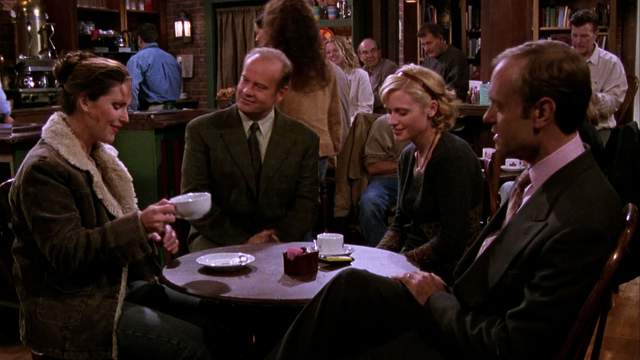
In "Rooms With a View," the episode of Frasier that first aired on this night in 2002, Niles (David Hyde Pierce) had been brought to the hospital for heart surgery — an event that had been set up nicely by the previous week's episode (in which the audience was introduced to a rarely discussed medical concept called referred pain).
Having spent more time in hospital rooms than I care to think about, I enjoyed this episode for its satirical treatment of the topic. The opening segment, in which the family was waiting with Niles for his surgeon to arrive to go over the procedure with them, was hilarious.
Frasier (Kelsey Grammer) had beaten the surgeon to it. He had researched Niles' condition, put his findings on paper and made copies for everyone. That was his way of coping. In another episode, Frasier had bragged about his lifelong prowess at homework. This proved it as far as he was concerned.
(Frasier made sure that everyone — especially the surgeon — knew he had consulted with a colleague from his alma mater, Harvard.)
Martin (John Mahoney), on the other hand, was engaged in his typical response to a medical crisis — denial. It was what he had been doing as long as Niles and Frasier could remember — pretending the problem didn't exist.
"Things always turned out all right, though," Frasier told Niles. "They will this time, too."
Daphne (Jane Leeves) was simply terrified. Nothing would reassure her until Niles was out of surgery — although Roz (Peri Gilpin) tried her best to be reassuring, suggesting things like thinking about fun things to do (like take a trip somewhere) when it was all over.
But it was the next segment, in which Niles was being wheeled to the operating room, that gave the episode its name — and poignancy. Under the strong influence of hospital–administered drugs, Niles imagined moments from his past that had been spent in hospitals.
Like the time he was in the hospital with a broken leg, suffered when Frasier allegedly pushed him down the stairs (although Niles confessed that he hadn't been pushed; he had jumped because he wanted to fly like a Valkyrie). Niles recalled the scene in his hospital room when Martin brought him an Archie comic book to help him pass the time.
And the time he visited a heavily bandaged Maris following plastic surgery.
And the moment that had just occurred seconds earlier — when Daphne promised Niles she would be waiting for him when he came out of surgery.
In a few minutes, Frasier displayed the kinds of moments that hospital personnel have probably seen countless times.
But one of the best moments was one Niles couldn't possibly have remembered. It was the scene in his mother's hospital room after she gave birth to him. Neither mother nor baby could be seen — only a young Martin holding a small Frasier.
When Martin told Frasier that was his new brother in the crib next to his mother's bed, Frasier, in a typically honest child's response, replied, "I don't like him."
While the family was in the waiting room, Frasier remarked on how life was played out within the walls of the hospital. And there is no disputing that. People are born in the hospital, they recover from injuries and illnesses in the hospital — and sometimes they die in the hospital.
For most people that is probably where it all ends. Speaking of which, Martin's hospital flashback concerned the time the doctor shared a dire prognosis for his wife.
It didn't end that way for Niles, though. At least, not yet.
And as she was leaving his room, Daphne walked past another room and had her own flashback — or should that be flash forward? In it were Niles and Daphne — Niles held a small child and Daphne, in her hospital bed, held a newborn.
At the time, Daphne and Niles had been married a short time and had no children yet. The clear implication was that life would go on.
I'm not really sure why I like the episode of Frasier that first aired 15 years ago today.
Except that, as always, the writers for the show had a unique take on their theme — which, in this case, was the twin themes of aging and commitment.
Which, I suppose, are really just subsets of the more general topic of life, which is probably more accurately defined by the phrase "it's complicated."
Now, that's real reality programming — even if it is in a fictional context.
The episode — "Kissing Cousin" — centered on a visit from Roz's cousin Jen (played by Zooey Deschanel). Jen was a younger but just as free–spirited version of Roz (Peri Gilpin). In fact, Roz once babysat for Jen and took the opportunity to school her in Roz's rather bohemian ways. The two became close, and Jen, like many disciples of an avant–garde role model, took it to extremes.
Jen was negative about, well, just about everything, but all of it couldn't be explained simply by the mindset Roz had encouraged. Jen had that judgmental certainty of the rightness of every thought she had and every position she took that often seems to be the hallmark of youth.
And older viewers must have suspected that, had they been given the opportunity to watch Jen's character evolve as she got tossed around by life (as all lives inevitably must be), they would have seen her abandon most of her preconceived notions about how life is and should be.
But Jen never made another appearance on Frasier so viewers will never know what became of her. They can only speculate based on their own experiences and knowledge.
Frasier (Kelsey Grammer) put up with it longer than one might think his narcissistic personality could, but he finally had enough when Jen told him that Freud had been "proven wrong about everything." The strongly Freud–influenced Frasier could not resist the urge to set her straight.
Otherwise, Frasier was to be commended for an atypically restrained response that anyone who has had to contend with Millennials must admire.
But he could get some distance from Jen. He wasn't with her 24 hours a day the way Roz was, and Roz, who was 38 in the episode (Gilpin was actually 41 when it aired), couldn't keep up with her twentysomething cousin.
And the all–nighters with the globe–trotting Jen were wearing Roz down.
While Frasier seethed privately over Jen's attitudes, the perennially prissy Niles (David Hyde Pierce) was willing to chalk them off to youthful exuberance, ironically noting that "we were all that way" and "it passes."
To older observers, the young always seem to have everything, and that can be frustrating for those who have lost a step or two.
The truth is that no generation has it all, and Millennials, in spite of their reputation for being technology–savvy, have their own obstacles to overcome. Many are more resistant to rites of passage, like leaving their parents' homes, than their predecessors.
For many this is said to be an economic condition, heavily influenced by the Great Recession and related external factors, but that does little to explain the behavior of older Millennials like Jen, who had been living in places like London and Florence — and planning a trip to Vietnam because "Americans have never even heard of it" — years before the economy imploded.
I'll admit that most Millennials probably couldn't afford to live the way Jen did in 2002 — but her lifestyle seemed to have an appeal for the station manager, Kenny (Tom McGowan). Recently separated from his wife and still working in an office filled with boxes containing his possessions (because Kenny's experience had been that permanent jobs were temporary), Kenny had his issues with commitment. And Jen was free of such bonds.
Jen encouraged him to be more impulsive, but when he did so and then tried to arrange to travel with her to Vietnam, she revealed herself to have her own problems with commitment. She always traveled alone, she told Kenny, because of an experience she once had. The audience was left to guess about the nature of that experience, but one can reasonably imagine that it involved someone who had feelings for Jen that she did not return.
That seems to be at the heart of many such human conflicts.
That person was probably another Millennial, not as mature as Kenny, who handled Jen's rejection quite well, shrugging it off and expressing the hope that they would run into each other in Asia — and, after she left, he began to unpack the boxes in his office.
"No one ever takes a photograph of something they want to forget."
Sy (Robin Williams)
Most people probably remember Robin Williams for his many comic and semi–comic roles. Nothing wrong with that. He was a gifted man in that department.
But what is often overlooked is the fact that Williams could do other things, too, as he proved in "One Hour Photo," which premiered on this day in 2002. It just might have been Williams' finest performance — even though it wasn't nominated for an Oscar.
You have heard, I presume, of an actor playing against type? Well, Williams' performance in "One Hour Photo" was the definition of playing against type. Most people, as I say, remember Williams as a zany character who sometimes played dramatic roles — but he never, as far as I can recall, ever played a character like Sy, an introverted film processor at a one–hour photo lab in a shopping mall. Sy was one of those faceless and nameless people who surround us daily, and most live their lives without drawing attention to themselves or causing others harm.
(I know. Robin Williams? Introverted?)
Sy was somewhat given to obsession. He was obsessed with his work and, through it, he became obsessed with a young family. He had been developing their photos for years and had been secretly copying their photos and decorating his apartment with them.
Truth be told, Sy was emotionally involved with everyone who brought in their film to be processed — but he was particularly obsessed with this family, primarily the mother (Connie Nielsen) and her son (Dylan Smith) since they were always the ones who dropped off the film and picked up the prints. The father (Michael Vartan) was only known to Sy through the photographs in the rolls of film he developed.
In his mind they were his family. I suppose a lot of people who live alone are like that. OK, they don't process film anymore, but fantasy utilizes whatever one's reality is and embellishes it. Sy's reality was the solitude of the dark room and his cramped apartment. That was his life ... such as it was.
In Sy's case, his work was his life. It wasn't so odd, really, that the two should merge. If only in his mind.
He didn't really have much of a life, anyway, so he projected his expectations of the perfect life and the perfect family on this young family with whom he was so obsessed. You don't need to be an expert to know that isn't healthy.
But Sy was seen as harmless enough so his ham–handed attempts to get closer to the young family were politely and discreetly brushed aside.
And I guess you don't need to be a trained psychologist to know that when someone is obsessed with someone else and a blemish arises, it can be a shattering experience. So it was with Sy and this young family.
The young husband was having an extramarital affair, and that didn't set well with Sy when he discovered it.
Now, Sy was clearly a disturbed individual, but I wondered when I first saw this movie whether someone like Sy would have done what he did if he had not been dismissed from his job by the store manager (Gary Cole).
Sy's habit of making prints for himself for which he had not paid caught up with him along with some other transgressions. Cole fired him — and that really was the catalyst for a string of events.
Sy tracked down the young husband and his mistress in a hotel and forced them, at knife point, to perform sex acts while he photographed them.
Later, when being interrogated, Sy's remarks strongly implied that he had been sexually abused by his father and perhaps ordered to perform sex acts as a child while being photographed by his father.
That scene has always made me think of Anthony Perkins in the final scene of "Psycho". The stories were different, but they were essentially indictments of what the fathers had done with their children were young.
The sins of the father.
It was a character — and a performance — worthy of Hitchcock.
It reminded me of when I was a young reporter covering the police and crime beats at my first newspaper job. Although the county in which I lived and worked was rather sparsely populated, it had about half a dozen murder trials while I was there — and I covered them all.
On one occasion I covered a murder trial in which the defendant was found guilty — but then, during the punishment phase of the trial, the defense presented evidence of something even the defendant knew nothing about — his mother had been mentally retarded and had been incapable of defending him when his father abused him.
Apparently the mother had been aware that something bad was happening, but the defendant did not understand that she could not come to his defense, and it had planted a seed of resentment within him that was manifested in many complicated ways when he became an adult — one of which was his brutal rape and murder of a young girl.
He was overcome with emotion after hearing testimony about his mother during his penalty phase, and the jury was moved to sentence him to life in prison instead of execution.
Sy didn't commit a violent act, but if his conversation with the detective at the end of the movie said nothing else, it bore witness to the lasting — and tragic — consequences of physical and emotional abuse.
Graham (Mel Gibson):I suppose it would depend on its usage.
Tracy:How about 'John, you're a douche bag for kissing Barbara'?
Graham:It's a curse.
I found "Signs," which premiered on this day in 2002, to be entertaining — even though it came perilously close to violating my plausibility standard for science fiction movies. I suppose credit for that should go mostly to director M. Night Shyamalan, who seems to have a knack for making science fiction films that manage to entertain even nonscience fiction types like myself.
But his films are not created equal. "The Sixth Sense" was a remarkably good film, especially when you consider that it was only Shyamalan's third directorial effort. He's had some pretty good efforts in his career, but none of his succeeding films (at least, none that I have seen) have come close to matching that one.
He was in the ballpark with "Signs," though.
And speaking of ballparks, Joaquin Phoenix, who played Mel Gibson's younger brother, was a former minor–league ballplayer. It is important to know that — but it didn't seem important at first. Kind of like some of the details in "The Sixth Sense."
In the tradition of the great directors of thrillers, Shyamalan gives the viewers all the pieces they need to solve the puzzle — but he lets them assemble the pieces without knowing what the puzzle is ultimately supposed to look like. And then suddenly he reveals the whole picture, and the viewers begin to realize the things they got right — and the things they got wrong.
I like what film critic Roger Ebert wrote in his review of the movie.
"In a time when Hollywood mistakes volume for action," Ebert wrote, "Shyamalan makes quiet films. In a time when incessant action is a style, he persuades us to pay close attention to the smallest nuances."
The core of this story was the sudden appearance of "crop circles," those geometric designs in fields that pop up in the news from time to time. The more conspiracy theory–minded among us tend to believe that they are created by aliens, but probably most people — and certainly most scientists — even those who fervently wish the existence of aliens could be proven tend to dismiss them as likely hoaxes.
Gibson's character had once been an ordained priest, but he had given it up after his wife's death in a car accident.
That didn't prevent the locals from asking him faith–based questions, though, and he constantly had to tell them that he had no faith.
But then these crop circles appeared in his field, and they began showing up all over the world, too, and other phenomena began to occur, like reports of strange lights over Mexico.
Phoenix and his young niece (Abigail Breslin) and asthmatic nephew (Rory Culkin), who became convinced early that aliens were real and hiding in plain sight, fashioned caps out of tin foil to prevent the aliens from reading their minds. That was one of those "nuances" to which Ebert referred.
And Gibson's character wasn't convinced — initially.
As the movie progressed, though, viewers discovered that the aliens did exist and had been responsible for those crop circles.
And Gibson and his family took all sorts of precautions to keep the aliens from entering their home, but they were unsuccessful.
When they were first seen, the aliens appeared as shadows or reflections on a TV screen. Later on, though, Shyamalan brought them into the light of day.
And it was under such circumstances that Phoenix, who hit a lot of home runs during his minor–league career but also struck out a lot, used his longball–hitting skill to take on the unwelcome guests.
Gibson's loss of faith, while mostly underplayed through the movie, was nevertheless a constant theme and restoring his faith was his character's purpose. In the end, he appeared to have regained his faith as a result of his extremely close encounter.
In fact, the whole family seemed to be doing better.
Frasier (Kelsey Grammer) was always a fascinating character study. Maybe that is why Grammer had to play the character for 20 years — and even that wasn't enough to peel away all the layers of his personality.
He was always an elitist, and he reveled in that knowledge. He enjoyed being part of the upper crust, of being (as he once put it) "unapproachable."
But Frasier was also a psychiatrist, and a psychiatrist must have a certain amount of empathy for his patients. To his credit, Frasier did have his principles, his ethics. He enjoyed the lifestyle his profession brought him, but he was also motivated by a sincere desire to help those he treated, regardless of their stations in life or whether (as was sometimes the case) the advice he gave could have repercussions in his own life.
That, I suppose, can create something of a conflict for someone like Frasier — who, in addition to his elitist inclinations, also had great ambitions to be a prominent radio psychiatrist with a large and loyal national audience.
He seemed to be about to take a step in that direction in the episode of Frasier that aired on this night in 2002, "Frasier Has Spokane." Frasier and his producer Roz (Peri Gilpin) were going to be broadcasting their show from a remote location — Spokane. It wasn't really all that remote. Spokane is about as far from Seattle as Kansas City is from St. Louis, roughly a four–hour drive, but on the "Frasier Crane Radio Network," as Frasier called it, it was his immediate listening universe. Frasier had been added as an on–air personality for the radio station in Spokane, and he believed that if he could demonstrate that his radio program traveled well, it could lead to bigger things.
Things got off to a rocky start when, at an introductory press conference, Frasier found the local media were not receptive to him but all warm and fuzzy for his predecessor, a fellow affectionately known by the locals as Sully, who interrupted the press conference ostensibly to wish Frasier luck. Sully had been part of Spokane's radio community for three decades, and he was clearly leaving extraordinarily large shoes to fill.
The Spokane listeners weren't too helpful in the transition, either. They actively resisted Frasier as Sully's successor.
Callers from Seattle supposedly were being routed to Spokane, and Frasier thought they could show the Spokane listeners what he and Roz did, but there was a problem with the transmitting equipment. No calls from Seattle were getting through.
So Frasier asked Roz to to pose as a caller. She could give him any problem she wanted, he told her. He just needed to take a call that did not express an opinion about his predecessor. Roz agreed to do that and, posing as Roberta, told Frasier she was afraid of the dark.
That seemed like a rather elementary problem for Frasier, whose degrees from Harvard and Oxford fueled his elitist self–image, but he began to explore it with Roz on the air.
And, in the process, Frasier uncovered what he had been unable to uncover previously — an idea of what Roz had been going through since breaking up with her boyfriend — who, by the way, had been a rather likable fellow with the decidedly blue–collar job of garbage collector.
Frasier told a teary Roz that relationships can be painful, and love can be risky, but it's a chance that has to be taken. While the pain was fresh, he advised her to seek the comfort of friends who loved her and cared for her.
The on–air conversation had the desired effect on Spokane's listeners. They responded with supportive suggestions for Roberta and breakup stories of their own — and Sully was forgotten for the time being.
Oh, sure, there were some I would read when I was a kid — but not regularly. I could take 'em or leave 'em.
I always preferred the comic books that made me laugh as opposed to the ones that I judged to be dramatic, more serious in nature.
It was in that category that I would put characters like Superman, Spider–Man, etc. It seems to me that superheroes are, almost by definition, about serious stuff, and their fans are deadly serious about them. I've known people who were really into the superhero thing. I even worked with a guy once who was petrified of spiders but loved the character Spider–Man. Go figure.
That might explain why I liked the "Super–Man" movie that made its debut on this date in 2002 — even though many people seem to prefer the version from 2012. I've never seen that one, though, so I can't be making any kind of comparison except based on what I've heard from others.
That wouldn't be a satisfactory answer, either, though, because the general consensus seems to be that the 2012 version was better. And it may well have been.
I just felt thoroughly entertained by the version that premiered 15 years ago today. It may not have had the special effects that were available a decade later, but movies have always been that way. They've always had to compensate for the things they didn't have or couldn't do.
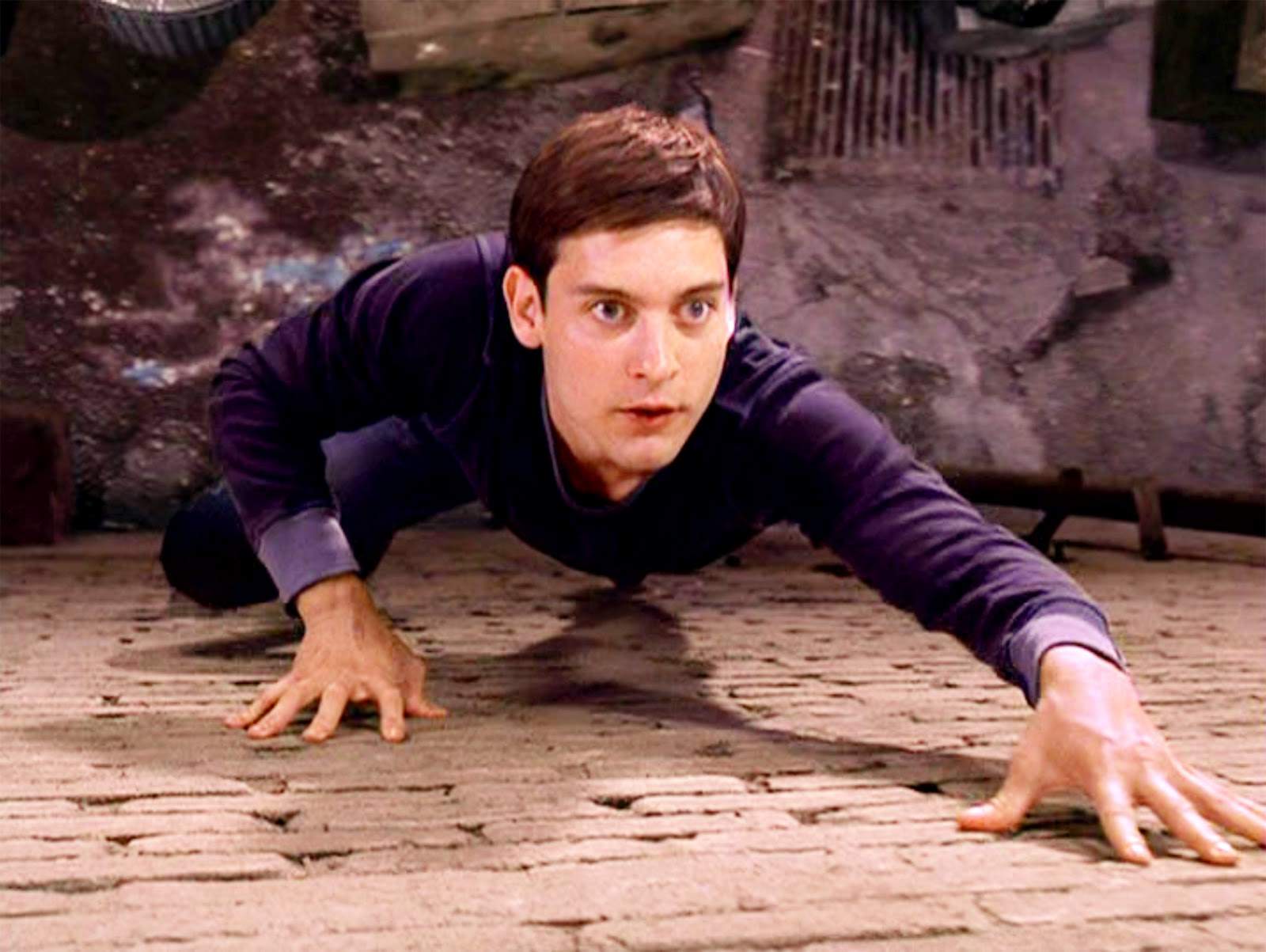
"Spider–Man" told a good story. That always makes up for a lot with me. It was like watching a comic book, frame by frame, on the movie screen. I could almost see the balloon dialogue between the characters.
Except there was a difference.
Comic books have always seemed scripted to me. In real life, people aren't usually as quick on their feet as they appear to be in a book, comic or otherwise. In real life, humans sometimes (often, in fact) need at least a little time to absorb what they have heard or seen before making a response — which is rarely as impressive as what appears in print. Books, comic or otherwise, may be intended to appear spontaneous, and many may succeed even though they almost certainly went through several lengthy revisions.
But the acting in "Spider–Man" always had just enough of those human pauses for entirely plausible intervals to make things seem spontaneous — even though the movie was just as scripted as the book(s), comic and otherwise.
Although it might have lacked as much action as Millennials prefer, I thought it was a good call to spend the first half of the movie essentially exploring the character of Peter Parker (Tobey Maguire) rather than assuming that everyone who saw the movie already was familiar with his story. It helped to establish that he had been a neighbor of Mary Jane (Kirsten Dunst) since he was 6 and, by his own admission, had been in love with her all that time.
It was certainly a good call as far as Maguire was concerned. It was the movie that made him a star.
Film critic Roger Ebert and I frequently agreed in our assessments of movies, but we never saw eye to eye on the "Spider–Man" franchise.
Ebert, for example, thought Maguire was miscast. I did not.
"Imagine 'Superman' with a Clark Kent more charismatic than the Man of Steel," Ebert wrote, "and you'll understand how 'Spider–Man' goes wrong. Tobey Maguire is pitch–perfect as the socially retarded Peter Parker, but when he becomes Spider–Man, the film turns to action sequences that zip along like perfunctory cartoons."
I suppose that was the quality I liked best. I always see comic books when I see suuperheroperhero movies, anyway. For me, that made Maguire ideal for the role.
And, although their roles were supporting, Cliff Robertson and Rosemary Harris were well cast as Maguire's aunt and uncle.
Willem Dafoe was perfect as Norman Osborn, the father of Maguire's best friend and a bit of a mad scientist who became Spider–Man's nemesis, the Green Goblin.
I guess the thing about the movie to which I objected was the portrayal of the newspaper editor. Now, I like J.K. Simmons, who played the part. I especially like him in his television role in the Farmers Insurance commercials.
It is likely that he had little input into the character, but I thought it was an unrealistic portrayal. I have worked for several newspapers — and, as a result, several editors. They all had their shortcomings, but they had their redeeming qualities, too. Simmons' character did not.
Nearly every actor and actress from Cheers! made an appearance on the hugely successful spinoff, Frasier. Lilith (Bebe Neuwirth) made the most appearances, but Sam (Ted Danson), Woody (Woody Harrelson) and Diane (Shelley Long) showed up, too, just not as often.
For nearly everyone else, the episode that first aired on this night in 2002, "Cheerful Goodbyes," was their single shot — and it was a real treat for anyone who ever watched Cheers! in the '80s.
I guess the only ones who weren't on Frasier at some point were Coach (Nicholas Colasanto), who died not long after Frasier joined the Cheers! cast, and Rebecca (Kirstie Alley).
The premise of the story was simple. Frasier (Kelsey Grammer) was being honored at a conference in his old Boston stomping grounds, and he brought his family with him for the occasion. Niles (David Hyde Pierce) had been recruited to give Frasier's introduction but was angry at Frasier for outing him on Frasier's radio program as a child bed wetter. Daphne (Jane Leeves) came along because she wanted to see Boston, and Martin (John Mahoney) was there, too.
Upon their arrival at the airport in Boston, Frasier happened to cross paths with verbose postman Cliff Clavin (John Ratzenberger), who was boring an airport bartender with the kind of story he frequently told on Cheers!
Cliff thought Frasier was in town to surprise him at his retirement party, which was scheduled for that evening. Cliff was at the airport to pick up his mother — who, it turned out, had boarded "the wrong plane" and gone to Bosnia, not Boston.
Nevertheless, Cliff later provided a batch of deviled eggs for the party. He said he followed his mother's recipe — substituting water for mayo.
Frasier didn't want to disappoint his old friend so he agreed to come to the party — which was being held somewhere other than Cheers because Sam was throwing a Red Sox reunion that night.
Clearly Sam wasn't there, but just about everyone else was — especially Carla (Rhea Perlman), who could hardly wait to see Cliff leave. She didn't care if he enjoyed his retirement; she just wanted him gone. The knowledge that he was leaving made her feel that "life is good" even though, by her own account, everything else in her life was falling apart.
Pity poor Daphne. Unaware of Cliff's windbag ways, she found herself being bombarded by his nuggets of wisdom.
More's the pity — she actually believed him when he told her that Winston Churchill was the inventor of the English muffin. You'd think a girl from Manchester would know better.
As the evening neared its conclusion, Cliff was having a crisis. None of his friends seemed to be sorry he was leaving — so Frasier tried to intervene, talking the gang into giving Cliff a rousing sendoff.
It was going pretty well, but Carla, of all people, overplayed her hand and, unintentionally, persuaded Cliff to stay in Boston.
And life — for Carla, at least — wasn't so good anymore.
One of the recurring themes of the Frasier sitcom was the sibling relationship between Frasier (Kelsey Grammer) and Niles (David Hyde Pierce).
Frequently the emphasis was on sibling rivalry, which has been a staple of sitcoms for decades, but Frasier showed that behind a sibling rivalry is a unique relationship between the siblings, and Frasier told the Crane brothers' story best when it incorporated younger versions of Niles and Frasier into the story. It provided a context, an insight into both of their personalities.
And that is precisely what was done in the episode that first aired on this night in 2002 — "Deathtrap."
When the episode began, the viewers saw a young Niles and a young Frasier sneaking into a science classroom at their prep school to take a skull that they intended to use in a backyard production of "Hamlet." But young Niles dropped it, and it sustained a fracture.
Fast forward about 40 years or so.
As they were drinking coffee in the cafe one day, Niles told Frasier that the house in which they grew up was listed for sale. The neighborhood was being revitalized, and that sparked an idea. Frasier and Niles thought of buying the house and turning it into a B&B. They decided to look it over with their father Martin (John Mahoney) in tow.
It was a nice stroll down Memory Lane, but it turned out the house wasn't as big as they remembered — probably because they were small when they lived there. I have visited places as an adult that I remember being much bigger when I was a child. It's a matter of perspective.
The house wouldn't be adequate to be a B&B, but as they were leaving Frasier recalled that they had left a metal box — a "time capsule," he called it — beneath some loose floorboards in the living room. He wondered if the owner would let them retrieve their box. The owner of the property said that wasn't possible; concluding that they were not interested in buying the house after all, the owner escorted the Cranes out of the house and locked it up.
But Frasier and Niles returned under cover of darkness. Frasier just knew that box was beneath the floor — even though the owner of the house insisted there were no loose boards in the floor. And Frasier proceeded to pry some boards loose. Then he reached into the darkness beneath the floor to search for the box.
Frasier didn't find the box — but, speaking of skulls, he found one beneath the floor, and Niles and Frasier began wildly speculating about whose skull it could be.
Inspired, no doubt, by their presence in the house where they had co–authored the Crane Boys Mysteries, a series of unpublished crime fiction stories.
Anyway, they concluded that the skull belonged to the landlord's wife, who had disappeared mysteriously, and Frasier began salivating at the idea of getting those Crane Boys Mysteries published to capitalize on the notoriety of their discovery.
Their assumption at the time had been that the landlord and his wife had split up. In light of what the Cranes had just discovered, the new assumption was that he had split her up.
Death was a big topic on Frasier 15 years ago tonight.
Roz (Peri Gilpin) was wrestling with talking to her daughter Alice about their hamster, who had met an untimely end. Martin had a little conversation with her about death and heaven when Roz was gone. Before that conversation, Alice thought the hamster was lost.
Alice seemed to take it in stride, and she left with her mother and a new hamster Roz had purchased. That was when, wordlessly, Martin and his dog Eddie showed everyone the bond between man and dog.
Meanwhile, back at the ranch ...
The Cranes had torn up the floor of their old home and found their box. The owner was brought to the house by the police, who apparently had been summoned by Frasier or Niles, and was indignant about what they had done. But Frasier and Niles simply shrugged it off and told him that the police had some questions for him.
Then they decided to open the memory box.
They found a copy of their program from their backyard production of "Hamlet," and they put two and two together.
"You know, Niles," Frasier remarked, "we may owe Mr. Lasskopf an apology."
President (Martin Sheen):You have a lot of help. You listen to everybody and then you call the play. Sam, you're going to run for president one day. Don't be scared. You can do it. I believe in you. [moves chess piece] That's checkmate.
I was a fan of West Wing when it was on the air, seldom missed an episode. I liked them all, but the episode that was first shown on this night in 2002, "Hartsfield's Landing," has always been a special favorite of mine, probably because it was so cerebral.
After 15 years, I would say it has aged well.
West Wing was always a cerebral show, but the episode "Hartsfield's Landing" was especially so. It was also a great illustration of how effective presidents gather information to make decisions.
Presidents don't do that in the same way, of course. Each president has been an individual and thus has had his own way of doing things. America being the diverse country it is, no president's approach is going to be favored by everyone — nor will one president's approach necessarily work for another president — and, of course, times change, circumstances change, people change. Still there are always lessons to be learned from presidencies that are judged to have been successes — as well as presidencies that are judged to have been failures.
Jed Bartlet (Martin Sheen) was a complex president, and he used a variety of methods to make decisions, but they always boiled down to what he told Sam (Rob Lowe) in this episode: "You listen to everybody and then you call the play."
He picked Sam's brain and Toby's (Richard Schiff) over a couple of games of chess in this episode. He had just returned from a trip to India, where he had been given some chess boards. He had decided to give them to the staffers as gifts and proposed to play them simultaneously, Sam in his office and Toby in the Oval Office.
As I say, the president picked their brains but on different matters. It kept him aware of things he may have forgotten. It was his way of "seeing the whole board" — a good chess analogy. With Sam, he discussed a standoff between China and Taiwan. With Toby, he discussed their recent conversation about whether the president was still trying to live up to his deceased father's expectations.
Seen from the perspective of the 2016 election and its aftermath, this episode that was written more than a decade earlier offered some bad advice to future Democrats, particularly those who may have heeded it last year.
As they discussed the president's likely opponents in the upcoming general election, Toby told Bartlet, "Make this election about smart and not. Make it about engaged and not, qualified and not."
In general, that is good advice, but, with the benefit of recent hindsight, I would add to that, "Don't think for a second that excuses you from having to put forth an agenda for the future."
The West Wing was a busy place, as I have no doubt the real one is, and there were always minor stories going on. "Hartsfield's Landing" was no exception.
While the president was having these power chess games with Sam and Toby, Josh (Bradley Whitford) was aware of the fact that New Hampshire was holding its first–in–the–nation primary that day, and a tiny town called Hartsfield's Landing (clearly inspired by Dixville Notch) would be announcing its vote total shortly after midnight. The handful of votes cast in that tiny hamlet would dominate the national news for more than 20 hours — until the votes in the rest of New Hampshire were counted.
With New Hampshire being the president's home state, Josh wanted the president to score a comfortable victory in Hartsfield's Landing so he instructed his assistant Donna (Janel Moloney) to call a couple she knew who had been supporters of the president the first time but were against him this time. He wanted them to change their votes to improve the president's showing in Hartsfield's Landing.
Donna couldn't call from the West Wing since it was federal property so she took a cell phone out into the freezing February night and called New Hampshire from the park across the street, lobbying for the president right up until the time the couple left to cast their midnight votes.
In the end, Josh gave in. "Let 'em vote," he came outside to tell Donna, and they went back to the White House to await the returns from Hartsfield's Landing.
There was also a feud between C.J. (Allison Janney) and Charlie (Dule Hill) over a missing copy of the presidential schedule that is better watched than described. If you haven't seen it, do so. Trust me.
Speaking of C.J. ...
One of the things I really liked about the West Wing was its devotion to detail. Oh, it was always possible to nitpick, but it was usually on tiny points that wouldn't be obvious to most people. For example, in this episode, which featured chess so prominently, only chess experts would have been able to tell if Bartlet referred to chess moves that were real or fictional or if he used terminology that was real or fictional. To a non–aficionado, if it sounds legitimate, that is enough.
My father loves to play chess, but he wouldn't know if the "Evans Gambit" is real (it is) or if there is such a thing as the "Fibonacci opening" (there isn't). For that matter, I didn't either until I did some research — and Dad was the one who taught me to play.
Sometimes when I was watching West Wing I couldn't tell if I was watching a dramatization or a documentary. None of the events on the West Wing were real, of course, but the show's depictions of events and TV broadcasts were always perfect.
"Hartsfield's Landing" provided an ideal example at the very end, one that was foretold by C.J. earlier in the episode when she spoke of how she liked the tradition of the people of that little town gathering together to cast their votes at midnight.
"They all gather at once ... it's nice. There's a registrar of voters. The names are called in alphabetical order. They put a folded piece of paper into a box. ... Those 42 people are teaching us something about ourselves, that freedom is the glory of God, that democracy is its birthright and that our vote matters."
As the activity continued to swirl and percolate in the West Wing, even at midnight, the television monitors showed the proceedings in Hartsfield's Landing.
On the screen the name of an obviously young woman was called by the registrar. As she brought forth her ballot, the onlookers were told that she was 18 and was voting for the first time. The room burst into applause.
"He's Lilith's half–brother, the curse of the family. What does it say when Lilith is the good one?"
Frasier (Kelsey Grammer)
I usually enjoy Michael Keaton movies. I can't say I have liked them all, but I have liked many of them.
I also enjoy his guest appearances on TV, and the best of those may have been the one that aired 15 years ago tonight on Frasier. Keaton played the half–brother of Frasier's ex–wife, a con man who had scammed Frasier on many occasions, in "Wheels of Fortune."
When the episode began, Roz (Peri Gilpin) gave Frasier a telephone message from Blaine at the end of Frasier's radio show one day. Frasier observed that the telephone number was local. "The beast walks among us," he said.
It turned out Frasier was nursing a couple of grudges. Apparently Blaine had taken Frasier's valuable antique salt server, and he had sold Frasier some kelp futures. Frasier was determined not to be taken in again.
But when Blaine came to visit he was in a wheelchair, claiming to be paralyzed from the waist down and professing to be a changed man.
Just prior to his visit, a package from Blaine had arrived. In it was Frasier's salt server. He and Niles (David Hyde Pierce) were overcome by the sight.
"I've heard you speak of it," Niles said, "but I had no idea it was so magnificent."
A note that came with the salt server explained that Blaine wanted to make amends and hoped for Frasier's forgiveness. But Frasier was resolute in his belief that Blaine was up to no good.
When Blaine arrived, Frasier wanted to know how much it would cost to get him out of there. Blaine admitted that he was there because he wanted something from Frasier, but what he wanted was for Frasier to pray with him.
He had been in a terrible automobile accident, Blaine said, and he had had a religious experience. Now he was on a ministry "to save souls the way the Lord saved mine."
Frasier remained skeptical.
"What genius!" he said. "The Lord — a credible partner who doesn't take a cut."
Daphne (Jane Leeves) protested that Blaine's was an inspirational story.
Blaine invited the Cranes to come hear him preach the following Sunday in a facility he had rented for the occasion. Everyone but Frasier liked the idea. Then Blaine mentioned that the advertising had been more expensive than he had expected, and he was about $1,000 short of what he needed.
Frasier pounced. "Aha! The other shoe comes cascading from the sky!" But Blaine insisted that what he was going to say was "the Lord will provide."
In the end, though, it was Daphne who provided, which made Frasier even more determined to expose Blaine so he began trying to contact the doctor who had treated him after his accident to confirm whether Blaine really was paralyzed. But multiple attempts to reach him failed.
When the family attended Blaine's service, Frasier was fuming. He didn't believe the doctor existed, and he was frustrated by what he saw as the sheep mentality of the audience.
Frasier threw Blaine from the wheelchair, told the onlookers not to help him up, then told Blaine to get up on his own. At that point, Frasier's phone rang. It was the doctor, and he confirmed Blaine's story.
The humbled Frasier urged the onlookers to help Blaine into his chair and pledged to match all contributions that were made that day dollar for dollar.
Frasier couldn't stop doing things for Blaine. He even gave him the antique salt server — right after he gave him the promised contribution in cash.
"Well," Frasier said after Blaine left the apartment and, when last seen, was rolling to the elevators, "that's a lesson learned."
"Yeah," Martin (John Mahoney) replied. "Don't throw a guy out of a wheelchair. Who knew?"
Then, as Martin and Frasier talked, Frasier heard things he had said to Blaine coming from Martin's mouth, and he realized that Blaine had, indeed, been up to his old tricks. Dashing to the door, Frasier found Blaine's empty wheelchair.
As Frasier so presciently observed earlier in the episode when he spoke of the Blaine Sternin long con: "He sets you up, sucks you in and then bam! Kelp futures!"
"I don't remember having to explain to Italians that our problem wasn't with them but with Mussolini. Why does the U.S. have to take every Arab country out for an ice cream cone? They'll like us when we win."
Toby (Richard Schiff)
Regular viewers of the West Wing must have recognized Adam Arkin's character when he appeared in the opening scene of the episode that first aired on this night in 2002, "Night Five." He was the psychiatrist who treated Josh (Bradley Whitford) for his post–traumatic stress disorder brought about by the assassination attempt that was the cliffhanger conclusion of Season 1.
Arkin (and the audience) assumed he had been summoned to the White House to help Josh through a personal crisis. But, as he was led around the White House, it dawned on him that there was more to it than that. A lot more.
He wasn't there to see Josh. He was there to see the president (Martin Sheen).
The president was having trouble sleeping. He hadn't slept in four nights. Arkin's character wasn't a specialist in sleep disorders, but the president knew he had helped Josh, and the president was dealing with some ticklish matters at the time — the recent disclosure of his multiple sclerosis and his re–election campaign were foremost among them — so he had decided to consult the psychiatrist. He believed Arkin's character could be counted upon to be discreet.
They went through potential factors — physical, environment, lifestyle — and eliminated everything but psychological factors.
While they were zeroing in on the source of the problem, there were other issues going on. C.J. (Allison Janney) was trying to find a reporter who had gone missing and was feared dead in the Congo. Toby the speech writer (Richard Schiff) was facing brushback over a speech he had written that the president was to deliver at the U.N. One of Toby's harshest critics was his ex–wife, a liberal congresswoman, over the phrase "Islamic fanaticism."
In other words, an average chaos–filled week at the West Wing.
In their conversation, the president and Arkin got closer to identifying the root of the president's sleeping issues. Turned out that he had unresolved issues with his father. It had been a tumultuous relationship and some issues had been stirred up by the president's conversation with Toby on the night of the Iowa caucuses.
Toby had told him that he was still seeking the approval of his father, who was long dead and had been abusive to his son in life.
Arkin wrapped up the session and assured the president that he was ready to help in any way he could — but it was clear that more sessions would be needed.
In the seasons ahead, there would be other occasions to explore the president's relationship with his father — which I always felt produced some of the series' most impressive and insightful exchanges — but that was due to existing conditions with which viewers were aware. There were some times, though, when the West Wing seemed to be prescient, exploring issues that weren't issues when the episodes were filmed. The West Wing has been off the air for more than a decade, and some of those issues have emerged.
It is time to give credit where credit is due.
This episode, for example, mentioned Islamic fanaticism, which is a red–flag phrase for some folks today, but 15 years ago, with the 9–11 attacks still fresh in everyone's minds, I don't think it received nearly the same response.
Perhaps the story of Sam (Rob Lowe), White House counsel Ainsley Hayes (Emily Procter) and a temp in the West Wing would have. When Ainsley came in one night in a gown she had worn to a Washington party, Sam remarked that she could "make a good dog break his leash." The temp took offense and told Sam so. Sam spent the rest of the episode trying to prove that he was not a sexist; I don't recall a reaction to the dialogue, but it was designed to make people think. I know it made me think.
Sexism, though, has been an issue in this country for decades while Islamic fanaticism is something of a newcomer to the debate.
In the episode of Frasier that first aired on this night in 2002, Niles (David Hyde Pierce) was planning to pop the question to Daphne (Jane Leeves). As I have mentioned before, I thought at the time that they made perhaps the most implausible TV couple ever. I have changed my opinion since then.
But that wasn't the obstacle facing the couple. The greatest obstacle was Daphne's mother (Millicent Martin) was in town, and Daphne had been trying to keep her mother from learning that she was no longer a virgin. To support the deception, Daphne, who had been living with Niles, moved back in with Martin (John Mahoney) and Frasier (Kelsey Grammer); meanwhile, Niles had been acting as the host for Daphne's mother — an arrangement that was causing considerable stress.
Well, eventually, Mrs. Moon learned that Daphne and Niles were living together, and the three of them settled in to live in Niles' spacious condo. But when Niles decide to propose to Daphne, he wanted his future mother–in–law to be elsewhere — so he recruited his reluctant father to take her out for the evening.
Getting Martin to do it, though, required some trickery. Niles and Frasier started by pretending that Martin was helping them select the right wine for the wedding. In reality, they were trying to get him drunk enough to agree to take Gertrude Moon out for the evening.
Ultimately Martin agreed to do it for Niles, but it was no treat for him. All the Moons were manipulators, and Martin had to spend the evening warding off Gertrude's advances, finally resorting to some manipulation of his own. A recent love interest of Martin's overheard his conversation with Gertrude, though, and the future of that relationship seemed to be in considerable doubt.
In his trademark fastidious fashion, Niles had made all kinds of special arrangements for the big night. He bought a ring. He hired celebrity chef Wolfgang Puck to prepare a special dinner. He hired a choir, a string quartet and a trumpet player to perform.
Frasier had contributed the idea of having doves on hand for the occasion.
There were a few things to overcome. Niles had composed a proposal speech that made him so emotional he couldn't get through it when he tried to rehearse it in front of Roz (Peri Gilpin) — who, in turn, got choked up when she told Niles that all a woman really wants is for a man to get on one knee and say, "Will you marry me?"
But sometimes you can't be prepared for everything. Daphne came home with the flu, and Niles decided to postpone his proposal. He took Daphne to the guest room to get her out of the way while Frasier ushered out the musicians and singers, all of whom had been hiding until Niles summoned them.
Their performances apparently would be postponed until Daphne felt better. Frasier assured them they would still be paid for their time that evening.
But in the end, Niles and Daphne returned to the living area and sat in front of the fireplace — and Niles, in a spontaneous moment of passion, proposed anyway without the musicians and the choir and the gourmet meal.
I guess the moral of the story was that you don't need a gourmet chef or a string quartet — or doves — to make an evening special or memorable.
You know, that wasn't a bad reminder a week and a half before Valentine's Day.
"In 1940 our armed forces weren't among the 12 most formidable in the world, but obviously we were going to fight a big war. And Roosevelt said the U.S. would produce 50,000 planes in the next four years. Everyone thought it was a joke — and it was 'cause we produced 100,000 planes. Gave our armed forces an armada that would block out the sun."
Sam (Rob Lowe)
I always enjoyed the West Wing, in large part because it usually managed to educate as it entertained, especially in its first three or four seasons. People who watched the West Wing regularly — in the third season, during which "100,000 Airplanes" premiered on this night in 2002, the show ranked #10 — were frequently exposed to things that most people don't know.
Often that knowledge focused on American history, how things are done and why they are done that way, but the information didn't come exclusively from history or politics. For example, when the time came for the president (Martin Sheen) to acknowledge that he had multiple sclerosis, many viewers learned things about that medical condition that they did not know.
But on this night in 2002, "100,000 Airplanes" stayed on topic, you might say. It gave viewers some insight into the annual rite of creating the president's state of the union address — with a dollop of history on top.
Basically the episode took place on the night of the president's state of the union address, framed by his recent congressional censure for his handling of his medical condition and his upcoming campaign for re–election. The viewers watched Sam (Rob Lowe), one of the president's speechwriters, as he observed what was happening and reflected on the process of creating the speech for a Vanity Fair reporter who had been assigned to cover him that night. The reporter (Traylor Howard) happened to be a young woman with whom Sam had once been engaged.
To say it was an awkward evening at times is being charitable.
But it gave Sam the chance to talk about a tidbit from the original speech that didn't make the cut — a call to cure cancer within 10 years. The president seemed sincere in his desire to challenge his fellow Americans to commit themselves to that goal — but the West Wing staff almost unanimously believed that it was an attempt to deflect attention from the president's problems and would be perceived that way by the voters.
All except Sam. He told the president that he thought it was a good idea for several reasons, among them that government "should be optimistic," that it should be about more than entitlement checks and budgets.
And that is a worthy concept — that government's priority should be to serve the people, not itself. If you look at the 2016 election results, from the presidential race on down, I think you will see that the majority of Americans agree.
But ultimately the idea was scrapped because the administration couldn't provide a realistic monetary figure that would be necessary to fund such an endeavor. In fact, they really couldn't answer many questions at all.
Oh, that dollop of history I mentioned earlier was the comment Sam made about FDR that you can find at the top of this post.
Billy Flynn (Richard Gere):This is Chicago, kid. You can't beat fresh blood on the walls.
It probably isn't obvious to modern movie viewers, but, for awhile, movie musicals were frequently recognized as the best movies of the year — at least by the Academy of Motion Picture Arts and Sciences.
But, after "Oliver!" won Best Picture in 1969, no musical won Best Picture again until 2003, when "Chicago," the film that was released 10 years ago today, beat, among others, the second installment in the "Lord of the Rings" film trilogy.
And, as a matter of fact, "Chicago" is the most recent musical to be nominated for Best Picture. (That isn't surprising, really. Musicals represent a much smaller segment of filmmaking than they once did.)
(As a one–time newspaper copy editor, I get a kick out of the way that newspaper front pages in movies always have banner headlines for the very story that the movie happens to be about. It will be that way in the filmmakers' universe even if the president is assassinated at the same time or nuclear tensions reach an all–time high.)
Renée Zellweger, who played Roxie, a housewife who coveted a career in show biz, and Catherine Zeta–Jones, whose character, Velma, already had a career in vaudeville, were the focal points of what was a truly satirical story.
Both women were accused of murder. Initially, Zellweger killed her lover after learning that he did not have the show business connections he told her he had, that he had only told her that in order to sleep with her. She convinced her husband (played by John C. Reilly), who showed up after the fact, to take the fall for her, claiming that the man was a burglar.
But Reilly's character got cold feet, and Zellweger was taken to the county jail, where she crossed paths with Zeta–Jones, who was in custody for killing her husband and her sister, and Queen Latifah, the jail's unethical matron who lived by one rule — when you're good to Mama, she's good to you.
Enter Richard Gere, who played Billy Flynn, a smooth operator of a lawyer of whom it was said he had never lost a case in which he represented a female client.
[BILLY (as Roxie)] Oh yes, oh yes, oh yes we both
Oh yes we both
Oh yes, we both reached for
The gun, the gun, the gun, the gun
Oh yes, we both reached for the gun
For the gun.
[BILLY and REPORTERS] Oh yes, oh yes, oh yes they both
Oh yes, they both
Oh yes, they both reached for
The gun, the gun, the gun, the gun,
Oh yes, they both reached for the gun
For the gun.
Of course, it helped if the client did and said everything as Billy instructed.
And Roxie was eager to do precisely that.
The story was clearly told with one tongue pressed firmly against the cheek. With music titles like "Cell Block Tango," "Mister Cellophane" and "Funny Honey," what would you expect?
If your answer was "bawdy musical," I'd say you were right.
If you haven't seen the movie, I will try not to let any cats out of the bag.
Let's just leave it at this:
When the final credits rolled and the last notes of the last song faded away, Roxie and Velma had patched up their jailhouse differences and appeared ready to take on the world together.
Roxie was skeptical until Velma observed that "there's only one business in the world where that's not a problem at all: show business."
Roxie couldn't argue with that. A partnership had been born.
And the groundwork for a possible sequel (although, whether that was ever a realistic possibility, no sequel has materialized in the last 10 years) had been laid.
"Alas, that these evil days should be mine. The young perish and the old linger. That I should live to see the last days of my house."
King Theoden (Bernard Hill)
I remember reading J.R.R. Tolkien's "Lord of the Rings" trilogy when I was in high school. And I remember seeing an animated version of the prequel to that story, "The Hobbit," around the same time.
And I remember hearing virtually everyone say that it would never be possible to bring the trilogy to the screen with live actors. It might be possible, some conceded, to do an animated version — but even that would be a tremendous undertaking, and success would hardly be assured.
Director Peter Jackson proved them wrong.
He began doing so in 2001 with the release of the film that was based on the first volume in the trilogy, "The Fellowship of the Ring."
If it wasn't clear to most by that time, Jackson had achieved what had been thought for so long to be beyond mortal man's grasp. He solidified that status to such a degree with the release of the second film in the trilogy 10 years ago today, in fact, that I remember everyone talking about how the expected release of the final movie in the trilogy the following year was certain to earn Jackson more than mere nominations for Oscars — and so it did.
"The Two Towers" didn't do so badly as it was. After "Fellowship of the Ring" blazed the trail, "The Two Towers" was nominated for six Oscars — and won two.
Jackson wasn't nominated for Best Director, but he made up for it the next year.
I think perhaps the best thing about a great work of fiction is that each person who reads it forms in his/her own mind an image of what he/she thinks a particular character should look like or sound like.
Sometimes those images tend to resemble each other. Other times, they are wildly at odds.
I guess my image of Gandalf the wizard was probably like most people's. Jackson clearly picked up on that, casting Ian McKellen. He was precisely what I had always imagined Gandalf to be. (Of course, I suppose that was helped along by his designation in the trilogy as "Gandalf the Grey.")
Well, except for one thing, I guess. In the trilogy's prequel, Gandalf was described as a "little old man" — not exactly a dwarf but not tall, either.
In the trilogy itself, he was described as being more man–sized but still not taller than the other wizards.
But in the film he appeared to be a towering presence. Of course, that may have been in comparison to the hobbits with whom he was surrounded. After all, Tolkien did describe hobbits as being humanlike creatures but distinguished from men by their shorter stature. They were called Little People (average height about 3½ feet).
There was really no question, though, that the middle volume of the trilogy had darker, more ominous overtones than the first and third volumes — not unlike the middle film in the original "Star Wars" trilogy, "The Empire Strikes Back."
And that makes sense, I suppose. The dual purpose of the middle volume of any good trilogy is to resolve as many issues from the first volume as possible while presenting the reader/viewer with a new set of conflicts that must be resolved in the third volume.
The first volume is almost always an upper for the reader/viewer — until near the end, when some sort of cliffhanger is presented to lure the reader/viewer back. The original "Star Wars" movie didn't exactly do that — I always felt that it could have stood alone in the annals of filmmaking and probably would have if unexpectedly strong public support for it had not encouraged the making of a second film ... and a third ... and, eventually, a fourth, fifth and sixth.
My point is that there was a certain amount of ambiguity in the late '70s about whether a "Star Wars" sequel would be made. The original had no real cliffhanger — other than whether Princess Leia would choose Han Solo or Luke Skywalker.
There was no such ambiguity when Jackson made his "Lord of the Rings" trilogy. He shot all three films simultaneously, then released each individually on an annual basis over a three–year span.
He knew, when he was making the movies, that "The Two Towers" would be a dark and forbidding kind of film and, just as it was in the original books, a bridge to the brighter and more positive finale.
I've often heard it said that "The Two Towers" was the most challenging of the three movies to make, and it's not hard to understand why. It began in the middle of the story and offered no resolution at the end beyond the promise of a third installment a year later. Yet, "The Two Towers" grossed more than $900 million worldwide — more than the first movie and more than all but 19 other films ever made.
I remember reading "The Two Towers" as a teenager and being confused by the many stories that were being told. The fellowship of the ring had been split up at the end of the first book. In "The Two Towers," Frodo and Sam were continuing their journey to Mordor while the other members of the fellowship had scattered in other directions. It was easier to follow the various threads of the story when the visual element was added.
It was in "The Two Towers" that movie viewers also got their first extended look at Gollum. He was mostly a shadowy presence in the first movie, spotted and/or heard momentarily by several characters, but in the second he emerged to lead Frodo and Sam safely to the gates of Mordor, where the battle over the One Ring would be waged in the trilogy's conclusion.
Gollum's portrayal by British actor Andy Serkis perfectly captured the character in my mind. He was precisely as I had imagined when I read those books all those years ago.
Well, I suppose there were variations on the theme. But Gollum's trademark phrase — "My precious" — certainly rang true.
And "The Two Towers" performed its dual tasks well, for Gollum made the transition from being a somewhat neutral character in it to becoming a principal antagonist in the final installment the next year.
It was the successful implementation of the middle film's critical role in a trilogy, and it was best summed up, I believe, by a remark I heard a woman make as we all left the theater at the movie's conclusion:
"What a wonderful movie that was!" she said. "I can't wait to see how it ends."
I got my bachelor's degree in journalism from the University of Arkansas, and I got my master's degree in journalism from the University of North Texas. Most of my adult life has been dedicated to writing and editing in one form or another. Most recently I have taught writing (news and developmental) as an adjunct journalism professor at Richland College, where I advise the student newspaper staff. Go, Thunderducks!