Showing posts with label 1934. Show all posts

Sunday, December 28, 2014

The First Ride on the Good Ship Lollipop


Shirley Blake (Shirley Temple): My daddy could fly better than anyone in the whole world, couldn't he?

James "Loop" Merritt (James Dunn): That's right, better than anyone in the whole world. You know, your daddy and I were pals ever since we were about as big as you are. That's why I'm your godfather.

Shirley Blake: And then one day he cracked up and went away to Heaven, didn't he?

James "Loop" Merritt: That's right.

Shirley Blake: I'll bet when I'm a pilot, I won't crack up.

James "Loop" Merritt: When you're ready to be a pilot, we'll get you a big non–crackable ship.

Shirley Temple was 6 years old when "Bright Eyes" premiered on this day in 1934. She had already made more than two dozen movies, many of them one– and two–reelers, but 1934 was her breakthrough year as a featured performer.

"Bright Eyes" wasn't her breakthrough movie — that was "Stand Up and Cheer!" which made its debut nearly eight months earlier — but it did introduce the public to the song with which Temple was most closely associated, "On the Good Ship Lollipop."

The movie began with Shirley and her movie mom (Lois Wilson) living in an affluent household. Shirley's mom wasn't a member of the family. She was a maid, widow of an airplane pilot who "cracked up." Most of the family members were insufferable snobs — except for wheelchair–bound Uncle Ned (Charles Sellon), the wealthy patriarch.

Shirley and her mom were still close to the other pilots, especially Loop (James Dunn), who was Shirley's godfather, and it was while riding in an airplane with those pilots that Shirley first sang "On the Good Ship Lollipop."

The story took place around Christmas. Shirley went off with her pilot friends; the plan was for her mother to join them later, but she was hit by a car while crossing a street and died. Loop took Shirley up in an airplane and broke the news to her in the clouds.

I haven't seen all of Temple's movies. But I gather it was a rather familiar formula that may well have been introduced for the first time in "Bright Eyes." Temple was cute and endearing while the other children around her were, well, less so.

There was only one other child in "Bright Eyes," a bratty little girl named Joy.

She was played by an actress named Jane Withers, who went on to a pretty lucrative adult career as Josephine the Plumber pitching Comet cleanser on TV in the 1960s and 1970s.

As I understand it, Withers was quite popular as a child star, too. She had bit parts in about half a dozen movies in the early 1930s, then she landed a part in "Bright Eyes."

My understanding is that she was reluctant to take the part because she had to be so hateful to Temple's character. It was her big break, though; she went on to make more than two dozen movies in the 1930s and another 16 in the 1940s, usually playing characters that were friendier and more innocent than the one she played in "Bright Eyes."

Sounds like a real Hollywood success story, doesn't it? Well, don't make the mistake of thinking that Withers has led a completely charmed life. She has had her difficult days, too. She lost her husband in a plane crash and her son to cancer.

She and Temple were not exactly friends when they made "Bright Eyes," but they did become friends later and remained friends throughout their adult lives.

When Temple died in February, Withers told The Hollywood Reporter that "[i]f it hadn't been for Shirley Temple being the cutest, most adorable little girl in the world, and they needed an opposite — and, boy, I sure was it — in Bright Eyes, I might've ended up selling hats in Atlanta, Georgia, my hometown, or something else. ... I can't say enough good things about her."

Sunday, December 14, 2014

'The Gay Bride' Was Carole Lombard's Niche


Daniel (Sam Hardy): Mary, how about a little kiss?

Mary (Carole Lombard): Mr. Dingle, you forget I'm in mourning!

Daniel: What's that got to do with it?

Mary: Well, how would you feel if you were dead, and I kissed somebody else?

"The Gay Bride," a screwball comedy that made its debut on this date in 1934, wasn't the best movie Carole Lombard ever made. In fact, I have heard that she regarded it as her worst movie.

But Carole Lombard made it better than it would have been with anyone else playing her role. She played a chorus girl who was determined to marry a man of considerable means. Then as now, money was at the top of many a girl's list of desirable qualities in a potential mate.

(Interesting trivia point here: Lombard's future real–life husband, Clark Gable, was considered for the male lead.)

There was an earthy quality to Lombard's performances — perfect for screwball comedies — in the early to mid–'30s that disappeared a few years later when she appears to have been aiming for Oscar's recognition that she was an actress of substance. Her characters were blunt in their approaches to their lives. They knew what they wanted, and they weren't bashful about going for it.

Even if the odds were against them.

I guess that was how Lombard approached her own life.

Lombard almost certainly had her life under better control than the character she played in "The Gay Bride." I mean, even if she neglected her own life for extended periods, she would still have things under better control than Mary the chorus girl. Men were dying around her, right and left.

Of course, I guess it didn't help that she was engaged to a rum–running gangster whose livelihood was threatened by the repeal of Prohibition — and she had been warned that that type didn't tend to have long lives.

As I say, Lombard is said to have considered it her worst movie. I don't really think it was her worst, but it was a lot closer to her worst than to her best.

It wasn't a problem with the story. In general, it was a pretty good story, but the movie was indecisive. It couldn't commit to being a screwball comedy, which is how it was perceived at the time and how it is still seen today, or quasi–drama so it tried to walk a tightrope between the two and never really managed to become either.

Still, it is pretty clear when you watch "The Gay Bride" today that Lombard really was meant for screwball comedy. She tried to get more dramatic roles later in her career when she was trying to get Oscar to legitimize her skill as an actress — but it was her skill at screwball comedy that made her the highest–paid actress in Hollywood in the late 1930s.

And it is for that skill that she is mostly remembered today.

Wednesday, October 15, 2014

'Lady By Choice' Was Frivolous But Funny


Patsy (May Robson): Old people are respectable in spite of themselves.

My guess is that May Robson was the prime attraction when "Lady By Choice" premiered on this day in 1934.

Robson was in her 70s. She was born before Abe Lincoln was elected president; she started her career on the stage, and, by 1934, she was playing crusty old ladies with hearts of gold on the screen.

Her co–star, Carole Lombard, was popular, too, though; in fact, 1934 is widely viewed as her breakthrough year. I just wonder if her following matched Robson's at that time. Besides, the movie that is often remembered as her best, "Hands Across the Table" with Fred MacMurray, premiered the next year.

Well, anyway, "Lady By Choice" was commercially successful and well received by critics. Personally, I thought it was kind of corny and predictable. It was silly at times — well, frequently, actually. But, I suppose, movies that were made 80 years ago are bound to be seen that way by 21st–century viewers.

I think it is always worth watching, though, to see Lombard's comic skills in action.

Lombard played a fan dancer named Alabam who was convicted of violating local ethics codes. Robson played a drunken vagrant who was asked to pose as Lombard's mother. Lombard was in it for the publicity — a mother figure would give her image a boost — but Robson's character took the assignment seriously and set about nudging Lombard's character toward a career as a serious actress.

They made an enjoyable team, Lombard and Robson. Unfortunately, I don't think they made another film together, either before or after making "Lady By Choice." That was truly a missed opportunity. Only eight years after "Lady By Choice" was in the theaters, both Lombard and Robson were deceased.

I suppose it is anyone's guess whether Lombard, who made six movies in 1934, could have competed in the Best Actress category against Bette Davis or the eventual winner, Claudette Colbert. In fact, though, I have always been inclined to believe that Robson might well have won Best Supporting Actress at the then–fledgling Oscars — but the category didn't exist until two years later.

"Lady By Choice" received no Oscar nominations. Perhaps it was viewed as too frivolous, and there might have been something to that. I've noticed a tendency by the Oscar committee to be sparing in its nominations of comedies. It's one thing if the comedy's humor makes a point in the process, but some comedies are just written for laughs with no thought given to any sort of broader implication.

In its day, giving "Lady By Choice" an Oscar nomination might have been comparable to giving one to "Porky's" half a century later.

Then again, "It Happened One Night" was a sensation at the Oscars that year, winning the five major awards — Best Picture, Best Director, Best Actor, Best Actress and Best Adapted Screenplay.

Clearly, the Academy was receptive to comedies.

Sunday, October 05, 2014

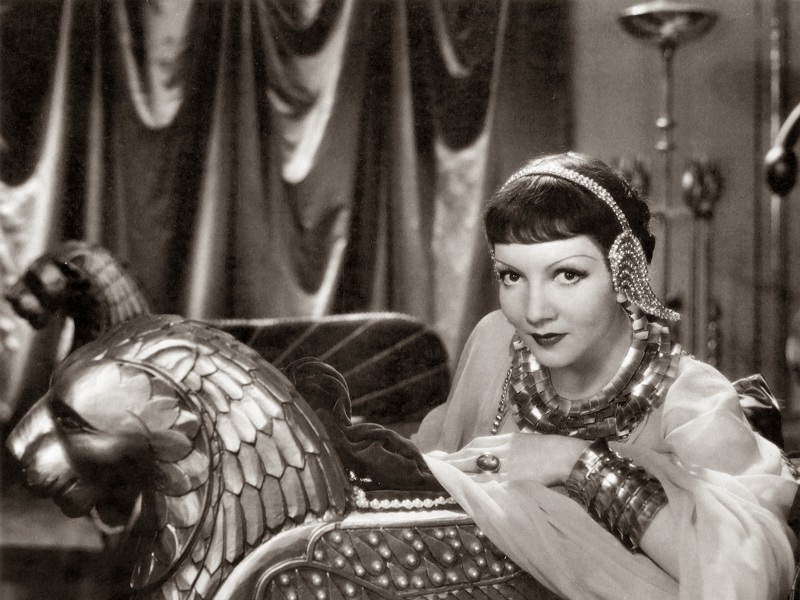
'Cleopatra' Was a Defining Role for Colbert


"Women should be but toys for the great. It becomes them both."

Cleopatra (Claudette Colbert)

For all intents and purposes, Cleopatra was the last pharaoh of ancient Egypt. She was survived by her teenage son for about a week and a half. That made him the last pharaoh — technically — but his rule was spent in captivity and ended with his apparent execution.

More than 2,000 years after her death, Cleopatra is still a fascinating figure in the West. She has been portrayed countless times on the stage in Shakespeare's play "Antony and Cleopatra" and Jules Massenet's opera "Cléopâtre," and she has been portrayed in numerous films, TV productions and video games. She is regarded as one of history's great beauties; she was seen that way by her contemporaries, too.

Thus, it wasn't surprising when one of the big screen's great beauties, Elizabeth Taylor, was cast as Cleopatra in 20th Century Fox's lavish 1963 production.

But I felt that Claudette Colbert's version of "Cleopatra," which was released 80 years ago today, was as good as — if not better than — Taylor's. Just, well, different.

I know I will get arguments about that, but hear me out. As nearly as I could tell, both movies told the same story and emphasized mostly the same events; the '63 version took a lot longer to do it and, when adjusted for current dollars, may have been the most expensive movie ever made.

The role of Cleopatra may well have defined Colbert more than her role in any other movie.

The '34 version may have been guilty of focusing strictly on Cleopatra and not paying as much attention to the men around her — or some of the facts — as the '63 version did. It was Colbert's movie — whereas Taylor, who had already won an Oscar, shared the screen and the credits with two other well–known actors, Richard Burton and Rex Harrison.

I don't know if Colbert is considered one of the screen's great beauties (or even if she was seen as such in her own time), but I do know some of her roles made her something of an early sex symbol.

(That includes her performance in "Cleopatra," although, personally, I have always thought she resembled Lilith Sternin from Cheers! and Frasier in that one.)

Although I have never seen it, I have heard that Colbert's bare breasts could be seen briefly in 1932's "The Sign of the Cross" in a scene that I have heard was a primary catalyst for the strict enforcement of the Hays Code.

When it asserted itself as the authority over movies in the United States, the Motion Pictures Producers and Distributors of America (MPPDA) prohibited, among several other things, "licentious or suggestive nudity — in fact or in silhouette; and any lecherous or licentious notice thereof by other characters."

Colbert's "Cleopatra" was made when the Hays Code was just beginning to flex its muscles — and producer/director Cecil B. DeMille pushed some boundaries.

Colbert was dressed in skimpy costumes that might not have been permitted if the movie had been made only a few months later.

Was that historically accurate? I don't know. I doubt it, just as I doubt that the decor of ancient Rome was as art deco as it was in DeMille's "Cleopatra."

Certain concessions do seem to have been made to the moviegoers of 1934.

In another instance of pushing the envelope, a seemingly naked slave girl holding two incense burners could be seen in the opening credits. The indistinct lighting left much to the imagination.

Nudity was not the focus of "Cleopatra." Sex, however, was.

The emphasis really was on Colbert. The men were mostly props; none would be recognizable to modern movie watchers. Some were regarded as being among the best actors of their time, but they were really only there because Cleopatra needed a Marc Antony and a Julius Caesar — and she couldn't play all the roles.

As I say, I don't know if Colbert had a reputation as a sex symbol in 1934, but she was quite popular. She won an Oscar for her performance in "It Happened One Night," and that movie certainly featured the kinds of things that would seldom, if ever, be permitted on the big screen for another 35 years.

Colbert had quite a range as an actress, and playing Cleopatra was only one style of which she was capable — if the role can be confined to a single style. In one scene, Colbert's Cleopatra could be playful and flirtatious; in the next, she might well be cold and calculating.

If Colbert is remembered for anything, I suppose it is her flair for screwball comedy, and there were elements of that to be seen in her portrayal of Cleopatra.

If nothing else, I thought Colbert was having a lot of fun. Perhaps I was mistaken.

"Cleopatra" definitely was not a screwball comedy. But, when it was done, Colbert resolved never to be typecast in overtly sexual roles again.

That might have been the wisest career move for her. Colbert was nominated for two other Oscars but lost both (the first time to Bette Davis, the second time to Ingrid Bergman). She might not have been nominated at all if she had felt demeaned by her roles.

Did her role in "Cleopatra" demean her? Judge for yourself.

Wednesday, July 02, 2014

When the Hays Code Started Enforcing Movie Censorship


If "It Happened One Night" had been made a few months later, Claudette Colbert
might not have been able to get away with making this iconic scene.


Eighty years ago, the motion picture industry began enforcing the Hays Code, a production code informally named after Hollywood's chief censor, Will Hays.

The Motion Pictures Producers and Distributors of America (MPPDA), later the Motion Picture Association of America (MPAA), adopted the code in 1930, began enforcing it in 1934 and dropped it entirely in 1968 in favor of a ratings system, but, for nearly 35 years, the Hays Code acted as censor for motion pictures. What was acceptable (by implication) and what was not acceptable was spelled out in two lists — the "Don'ts" and the "Be Carefuls."

The Production Code was written by a Catholic layman and a Jesuit priest. As a result, it had decidedly Catholic undertones.

The "Don'ts" were 11 things that "shall not appear in pictures ... irrespective of the manner in which they are treated:"
Pointed profanity — by either title or lip — this includes the words 'God,' 'Lord,' 'Jesus,' 'Christ' (unless they be used reverently in connection with proper religious ceremonies), 'hell,' 'damn,' 'Gawd,' and every other profane and vulgar expression however it may be spelled;
Any licentious or suggestive nudity — in fact or in silhouette; and any lecherous or licentious notice thereof by other characters in the picture;
The illegal traffic in drugs;
Any inference of sex perversion;
White slavery;
Miscegenation (sex relationships between the white and black races);
Sex hygiene and venereal diseases;
Scenes of actual childbirth — in fact or in silhouette;
Children's sex organs;
Ridicule of the clergy;
Willful offense to any nation, race or creed.

Those were the things that were not allowed under any circumstances. Some probably were rarely, if ever, included in pre–1934 movies, but the Hayes Code went ahead and spelled it out, anyway.

The items on the "Be Careful" list could be permitted, but movie producers had to be very careful. Hence, the title. There were more than twice as many of those:
The use of the flag;
International relations (avoiding picturizing [sic] in an unfavorable light another country's religion, history, institutions, prominent people, and citizenry);
Arson;
The use of firearms;
Theft, robbery, safe–cracking, and dynamiting of trains, mines, buildings, etc. (having in mind the effect which a too–detailed description of these may have upon the moron);
Brutality and possible gruesomeness;
Technique of committing murder by whatever method;
Methods of smuggling;
Third–degree methods;
Actual hangings or electrocutions as legal punishment for crime;
Sympathy for criminals;
Attitude toward public characters and institutions;
Sedition;
Apparent cruelty to children and animals;
Branding of people or animals;
The sale of women, or of a woman selling her virtue;
Rape or attempted rape;
First–night scenes;
Man and woman in bed together;
Deliberate seduction of girls;
The institution of marriage;
Surgical operations;
The use of drugs;
Titles or scenes having to do with law enforcement or law–enforcing officers;
Excessive or lustful kissing.

By the late 1960s, the Hays Code had simply become unenforceable.

I majored in journalism. I worked for newspapers and a trade magazine. I have taught and am teaching journalism students.

And I have very strong opinions about censorship.

I understand that there are times when it is a necessary evil, but it should be severely restricted. If an exception to a general censorship policy is to be made, it should favor the one being censored, not the one doing the censoring.

Freedom of speech and freedom of the press were mentioned in the First Amendment to the Constitution for a pretty good reason. The Founding Fathers knew that those freedoms were — and are — essential.

Saturday, June 28, 2014

The Ties That Bind


"You cad, you dirty swine! I never cared for you, not once! I was always makin' a fool of ya! Ya bored me stiff; I hated ya! It made me sick when I had to let ya kiss me. I only did it because ya begged me, ya hounded me and drove me crazy! And after ya kissed me, I always used to wipe my mouth! Wipe my mouth!"

Mildred (Bette Davis)

"Of Human Bondage," the movie based on the W. Somerset Maugham novel that premiered 80 years ago today, was the movie that really made Bette Davis a star.

Some people will point to her Oscar–winning turns in "Dangerous" or "Jezebel," and they did confirm her status as a star, but it was her performance as Mildred the waitress in "Of Human Bondage" that put her squarely in the public spotlight.

(She was well established by the time she said, "What a dump!" the line that was really made famous when it was quoted by Elizabeth Taylor in "Who's Afraid of Virginia Woolf?" Davis uttered that line in the '40s.)

The role Davis played was so challenging that some of the most noted actresses in Hollywood turned it down — and understandably so. It was a callous character.

But Davis saw it as a chance to showcase the range of her skills as an actress. She did such a good job of playing Mildred that, when Leslie Howard's character "finally expressed his contempt for Mildred's behavior, applause was heard from all sides [of the theater]," wrote Mordaunt Hall in the New York Times.

I gather, from what I heard from people who were there, that audiences applauded movies (even if only politely) much more routinely in the '30s and '40s — as if they were watching a play. That was long before my time. My experience has been that audiences seldom applaud movies unless they are truly moved to do so.

Nevertheless, Hall was impressed by the applause he heard in 1934. Based on that, I can only conclude that the applause he heard must have been quite enthusiastic for him to feel compelled to comment on it.

Maybe it was because Davis exceeded his expectations — and the audience's. Her co–star was certainly impressed.

Howard had been unimpressed with Davis prior to the filming of the movie, but he spoke highly of her after he had seen what she could do.

(Personally, I was unimpressed with Howard. Perhaps it wasn't his fault. His characters always seemed to wear their hearts on their sleeves, but almost never as much as he did in the role of Philip, the delicate, club–footed medical student — not even when he played Ashley Wilkes in "Gone With the Wind."

(On the other hand, maybe it was the way he played them. Philip struck me as being the same wuss that Alan was in "The Petrified Forest" and that Holger was in "Intermezzo.")

Director John Cromwell gave Davis considerable freedom in the role of the quarrelsome Mildred, and she really used it to her advantage.

If you're an early bird, you can see "Of Human Bondage" next Saturday at 5:30 a.m. (Central) on Turner Classic Movies.

Friday, May 23, 2014

Introducing the Thin Man


Nick (William Powell): Now how did you ever remember me?

Dorothy (Maureen O'Sullivan): Oh, you used to fascinate me. A real live detective. You used to tell me the most wonderful stories. Were they true?

Nick: Probably not.

Dashiell Hammett was a great mystery writer. He created some of the great characters to be adapted for the big screen, including Sam Spade, the detective in "The Maltese Falcon."

But Sam was a rather somber sort. Hammett's most entertaining detectives, Nick and Nora Charles, made their screen debut in "The Thin Man" 80 years ago today.

Nick and Nora were a married couple who solved mysteries together. Their boozy banter ("The Thin Man" was rated #32 among the comedies by the American Film Institute) was part of their charm — which they parlayed into six movies between 1934 and 1947.

They had a pet terrier, Asta, who accompanied them in all six of the "Thin Man" movies — although, like the dog from the Frasier TV series, the character wasn't played by the same dog from start to finish.

All six of the titles included "the thin man," and I assumed (until I saw the first one) that it was a reference to William Powell, who played Nick Charles — but, in fact, it was a reference to the man Charles was originally hired to find.

Actually, Powell and Loy appeared in 14 movies together. "The Thin Man" was only the second of three movies they were in together in 1934, but it was the best.

In fact, "The Thin Man" may have been the best of the six–movie series. It was nominated for four Oscars, including Best Picture, Best Director and Best Actor, but lost all four to "It Happened One Night."

("The Thin Man" series of movies kind of reminds me of the "Rocky" series or the "Star Wars" series. The original "Thin Man" movie was a sleeper. It was made in a couple of weeks for less than a quarter of a million dollars. Not much was expected from it, but it ended up inspiring not only five big–screen sequels but radio and TV programs as well.)

About halfway through the movie, Charles referred to the missing man as a "thin man with white hair." The missing man turned out to be dead — a fact that was revealed before the movie ended — but the titles of sequels to the original always mentioned "the thin man." I don't think I was the only one who was confused by that — Powell was rather lanky — and Metro–Goldwyn–Mayer, I am certain, did what it could to encourage that confusion among moviegoers of the time.

Anyway, when moviegoers first met them in 1934, Nick was a retired detective and Nora was a wealthy socialite. Nick was pressed back into service when an industrialist friend (the thin man, played by Edward Ellis) vanished.

Nick Charles: The important thing is the rhythm. Always have rhythm in your shaking. Now a Manhattan you shake to fox–trot time, a Bronx to two–step time, a dry martini you always shake to waltz time.

And that took Nick and Nora (Myrna Loy) down a twisting path that ultimately led to the revelation Nick shared with the suspects who were gathered together for a dinner party in the final scene.

Four decades later, Neil Simon lampooned Nick and Nora — as well as Sam Spade and other classic movie detectives — with David Niven and Maggie Smith in "Murder By Death." Much of the humor focused on a spoof of the old gathering–the–suspects–in–one–place scene.

In 1934, it wasn't the cliche it has become. In fact, it was a rather effective device — 80 years ago.

Too bad there wasn't a butler in "The Thin Man." That cliche originated elsewhere.

Saturday, February 22, 2014

The First Movie to Sweep the Major Oscars


"I want to see what love looks like when it's triumphant. I haven't had a good laugh in a week."

Peter (Clark Gable)

There may have been movies that premiered before this date in 1934 that could be classified as screwball comedies.

But the genre really began to gain popularity when "It Happened One Night" premiered on this date in 1934. For all intents and purposes, I suppose, the screwball comedy was born 80 years ago today. (As a comedy, the American Film Institute ranks it eighth all time.)

And its influence can be seen in numerous movies in the decades that followed, even though the screwball comedy's heyday was in the 1930s. The blueprint for the genre — a headstrong, runaway heiress gets hooked up with someone, frequently a reporter, who can gain something from the relationship — has shown up in various forms over the years.

"Roman Holiday," for instance, had a runaway princess (Audrey Hepburn) in the company of a reporter (Gregory Peck) who needed a scoop to revive his career.

That, in a nutshell, was the plot of "It Happened One Night." (There were a few differences, but not many.)

But, because it was so different from other movies in the still–emerging motion picture art form, it didn't enjoy the enthusiastic support of some of its principal participants. Claudette Colbert, for example, had worked with director Frank Capra before, and the experience had not been pleasant. She wasn't going to work with him again, but she relented on the conditions that her pay be doubled and that her work on the project be done in time for her to take a planned vacation.

Capra claimed that Clark Gable was hesitant to participate in the project as well.

And Capra himself reportedly said it was "the worst picture in the world."

Ellie (Claudette Colbert): I'll stop a car, and I won't use my thumb!

Peter (Clark Gable): What're you gonna do?

Ellie: It's a system all my own.

Thus, it caught just about everyone by surprise when "It Happened One Night" became the first movie to sweep Best Picture, Best Actor (Gable), Best Actress (Colbert), Best Director (Capra) and Best Adapted Screenplay (Robert Riskin) at the Academy Awards. It was a feat that would not be duplicated for more than 40 years — until 1975, when "One Flew Over the Cuckoo's Nest" won all five Oscars.

Modern movie viewers who have watched other movies from the 1930s undoubtedly will notice that "It Happened One Night" was more daring than its contemporaries, and there is a good reason for that. "It Happened One Night" was made just before enforcement of the Motion Picture Production Code (also known as the Hays Code for Will Hays, Hollywood's censor–in–chief of the day) began.

Consequently, there was more of a sense of freedom in "It Happened One Night" than there was in most of the screwball comedies of the 1930s. Certainly, there was more bare skin than one sees in most movies from that decade. No nudity, but scenes in which skin — like Gable's bare chest and Colbert's bare leg — was shown.

In other movies of the '30s (and for decades after), you rarely, if ever, saw an unmarried couple sleeping in the same room, much less the same bed (even married movie couples didn't do that).

Gable and Colbert didn't sleep in the same bed, but they did sleep in the same room.

And they used a clever strategy for maintaining their individual privacy — they hung a blanket between the beds.

Peter (Clark Gable): Remember me? I'm the fellow you slept on last night.

Ellie (Claudette Colbert): You needn't concern yourself about me. I can take care of myself.

Peter: You'll never get away with it, Miss Andrews.

I never understood the objections that some actors had to the quality of the script. I thought it was smart, clever.

To be fair, some movie stars who turned down the roles that ultimately went to Gable and Colbert claimed that the actual script in the movie was not the same script they had been shown.

Be that as it may, there was an undeniable chemistry between Gable and Colbert in "It Happened One Night," and that more than anything else made it such an appealing movie.

The story transcended global politics — both Josef Stalin and Adolf Hitler were said to be fans of "It Happened One Night."

They weren't the only ones. Before "It Happened One Night" swept the Oscars, it swept the country. It was a smash hit for Columbia Pictures. Made for an investment of $325,000, it earned $2.5 million at the box office.

It's hard to imagine a better return on your investment in 1934.

Wednesday, January 01, 2014

A Ride on the Orient Express


Agatha Christie's "Murder on the Orient Express," which was published 80 years ago today, wasn't the first Agatha Christie book I ever read.

But it was one of the first, and it remains one of the best.

(It was the first Agatha Christie novel–inspired movie I ever saw, and I was, in turn, inspired to read the book after I saw the movie.)

Its primary inspiration was the kidnapping and murder of Charles Lindbergh's infant son in the spring of 1933. When Christie wrote the novel, the case was very much in the news. In the hands of a talented writer, such a case provided the revenge motive for the murderers.

Christie also was influenced in "Murder on the Orient Express" by another real–life event — the winter of 1928–29, said to have been the harshest winter Europe had experienced in decades. Blizzards and gale–force winds hammered the continent for weeks. Transportation was brought to a virtual halt by all the snow and ice.

The Orient Express was sort of a land version of the Titanic. It boasted luxurious accommodations and was believed to be infallible so, in spite of warnings from stations all along the train's route, its owners unhesitatingly gave the go–ahead to proceed from Paris to Turkey in late January; it was hindered all the way by snow and ice on the tracks. It did make it across the Turkish border but was stopped by huge snowdrifts. The passengers were trapped for days before realizing that help was not on its way, and they tunneled their way out, then crossed the snowy Turkish countryside in search of food and a place to sleep until help did come for them.

This was fairly typical of Christie — she often used real events as the basis for her stories but rarely as well. She made some changes to the facts, enough to make it her own story, and then threw in her usual twists and turns, just to keep the reader guessing.

And there was plenty of guesswork for the reader in "Murder on the Orient Express." Each of the passengers aboard the Orient Express had some kind of connection to the Armstrong family, which had lost its little girl, Daisy, and then suffered additional tragedies as a result of the initial crime.

Poirot, who happened to be on board the train, conducted the investigation and concluded that there were two possible resolutions: either a stranger had entered the train while it was stopped by snowdrifts and committed the murder, or everyone on the train (with the exception of Poirot) had participated.

The former was too easy for Christie's creative mind, so, for one of the few times in her writing career, Christie took an option that would permit the guilty to escape justice. All of the passengers on the train (including the conductor) wanted vengeance, and Poirot, having solved the case, permitted them to have it. He told the authorities that he had concluded that a stranger was responsible for the murder.

It was an interesting twist on the usual formula for a Christie novel. More often than not, she arranged for the least likely suspect to be the actual guilty party.

I guess a least likely suspect would be hard to choose in this case. There were several plausible candidates.