Showing posts with label Roger Ebert. Show all posts

Tuesday, May 22, 2018

Revelations of a First Love


"First loves are always the same and always different," Roger Ebert wrote after French film "Blue Is the Warmest Color" premiered at the Cannes Film Festival five years ago on May 23. That may be the most truthful statement Ebert ever wrote.

I experienced my first real love when I was 17, which is roughly the age of Adèle (Adèle Exarchopoulos), but it was not as confusing as Adèle's experience. I knew I was attracted to the opposite sex. Adèle did not, and she experimented with a young man from her school but found that unsatisfying.

Then, after sharing a kiss with a female student and fantasizing about an older girl with blue hair whose name, the audience would learn, was Emma (Léa Seydoux), she began to question her sexuality. The movie was about the relationship between Adèle and Emma — told, as Ebert wrote, in "epic detail."

It had to be told that way, I suppose, because, by their very nature, same–sex relationships are learn–as–you–go types of things. There is no shortage of advice books about heterosexual relationships because the vast majority of relationships are heterosexual. When I was a teenager — and I presume it is still that way — there were few if any books on same–sex relationships that could answer the myriad of questions that accompany them.

Emma was more experienced than Adèle and had already found answers to her questions. In fact, when Adèle first encountered Emma, Emma was with another female and, the audience would learn, had had previous same–sex relationships.

As Ebert said, first loves are always the same and always different. In the unlikely event that the viewer had not experienced a first love, there is much truth in that. To tell the story of a first love, it is necessary, as Ebert observed, to do so in "epic detail."

That includes all the awkward moments and the sexual exploration, which are the same for all and yet different. Awkward moments will always be awkward, and — considering how much of the population is estimated to be heterosexual — it must be a real challenge for homosexuals when it comes to those initial sexual experiences.

I remember when I was a teenager, and all the males in my junior high were herded into the auditorium for a lecture on sex. The emphasis was entirely on heterosexual sex. I presume it was the same for the girls. Those students who were homosexuals — or, at least, had concluded that they had homosexual tendencies — probably found those assemblies boring — as, I am sure, any heterosexually active students, did.

The assemblies really only addressed the physical aspects of sexual relationships, not the emotional ones.

I was one of the rare ones, I guess. When I was in junior high, my sexual activity was, at best, flirtation with girls I found attractive. Even through my high school years, it never went any further than that.

Which proves Ebert's point. Many of my classmates — I didn't know which ones then, and I don't know today, either — had already engaged in some sexual experimentation, even if they hadn't yet experienced their first loves.

I was very naive as a boy. I tended to believe just about anything my classmates told me, assuming they had more experience than I did, and teenage boys are always eager to take credit for sexual exploits whether they happened or not. Looking back, I would have to say that my faith was misplaced. Most probably had the same experience level I did — although everyone's experiences are different.

Anyway, to a certain extent, I suppose some critics' complaints that "Blue Is the Warmest Color" was a pornographic film were justified. There was considerable nudity in the movie. And some critics complained that it was pedophilic, given the fact that Adèle was under 18.

But it had to be that way because most people, it seems to me, have their first sexual experiences in their teen years. Sometimes they are 18 or older, but often they are not. I wasn't.

I knew a girl in college who suspected, back in high school, that she was homosexual, but she didn't have her first physical homosexual experience until she was over 18.

Like Ebert said: "First loves are always the same and always different."

Monday, February 05, 2018

The Need to Know


"To me, to kill is not the worst thing you can imagine. There is more."

Barney (Jeff Bridges)

I have never seen the original version of "The Vanishing" that premiered in 1988. I have only seen the remake that was released on this day five years later — and when I saw it, I had no idea it was a remake.

I have heard the remake was thoroughly inferior to the original — which doesn't surprise me since I have yet to see a remake of any movie that I thought was an improvement on the original.

(Speaking of the original, film critic Roger Ebert wrote that it was "one of the most intelligent thrillers I've seen.")

Nothing that I have read suggests that the '93 remake of "The Vanishing" was an exception to that rule — but since I had nothing to compare, I thought it was OK. Not the best thriller I have ever seen but certainly not the worst.

It isn't uncommon for movies to be remade, of course, but "The Vanishing" was an odd exception to the rule. Normally, a remake is done by a different director, but the same man — George Sluizer — directed both.

Weird, huh?

Apparently, the primary sticking point between the two is that the original, which was primarily shown in Europe, was uncompromising in its conclusion whereas the remake seems to have been watered down to suit American audiences' preference for happy endings.

I still haven't seen the original, although I would like to, but I have read comparisons of the movies, and I have concluded that, while I liked the acting in the version I saw, I almost certainly would prefer the original movie. That isn't surprising, either, given that the remake starred Jeff Bridges and Kiefer Sutherland, two actors whose work I admire. It co–starred Sandra Bullock and Nancy Travis. To be candid, I have long believed that Bullock is overrated, but I do like Travis' work.

Bridges played Barney, a chemistry teacher who was obsessed with the concept of free will. He was endlessly plotting to abduct and kill someone, and he conducted numerous trial runs, which always failed.

More than anything it was an intellectual pursuit, a kind of mind game. His character was driven by a memory from his childhood — when he had leaped from a balcony and injured himself. At the time, he knew that most people do not do certain things because that is how they have been conditioned, but he reasoned that there was nothing more than that to keep them from doing those things.

In other words, it was still a matter of free will, even if choosing to do something was sure to lead to an unpleasant outcome like injury or death.

The act of killing another human being, therefore, was also a matter of free will.

Then one day an opportunity just fell into his lap. Jeff (Sutherland) and Diane (Bullock), a young couple on vacation, stopped at an all–purpose roadside convenience store/gas station. Diane went in to get some cold drinks — and was never seen again.

The audience knew what had happened, of course, but Sutherland did not, and that began his personal quest to find out. It grew into an obsession that Bridges' character would one day use against him.

The audience knew that Bridges had seen the "missing" posters that Sutherland's character kept putting up around town and even expressed his admiration for Sutherland's persistence.

Ultimately he was moved to seek out Sutherland and confess that "I am the man you're looking for." He said Sutherland could learn what had happened to his girlfriend, but Bridges warned Sutherland that he would have to be willing to go through precisely what his girlfriend had gone through in order to learn what he sought.

Jeff balked at that.

"You don't care if she is alive or dead anymore," Barney asserted.

"Yes, I do," Jeff insisted.

"No, you don't," Barney replied. "You're just scared that without the search you won't know who you are. Who is Jeff Harriman if he's not the guy looking for Diane? Can you really walk away from finally knowing the answer?"

After serious deliberation, Sutherland decided he had to know what had happened — which proved the truth of what Bridges' character had told him. "Your obsession is my weapon."

I'll leave it at that — except to note a few other things.

Travis' role was an interesting one — and a big part of the reason why I would like to see the original version of the movie. Travis played Sutherland's new girlfriend.

"In the earlier film, he takes a new girlfriend, who finally leaves him because she cannot compete with the memory of the vanished woman," Ebert wrote. "In this version, his new girlfriend sticks around because she'll be needed for the ending."

Ebert's position was that the first movie made sense because it remained true to its original premise however ugly it became. The compromised conclusion made a lot of changes necessary in the remake that veered from that premise, resulting in a movie that was, in Ebert's eyes, "laughable, stupid and crude."

"The first movie was existential in its merciless unfolding," Ebert wrote. "This one turns into a slasher movie with a cheap joke at the end."

Now I am willing to concede — without even having seen both movies — that the first version was probably superior to the remake. That isn't much of a stretch for me, really. If you read back over this blog, you will find many times when I have spoken disparagingly of remakes, and I am sure this remake is no exception — although to make such a judgment it really is necessary to see both movies, isn't it?

No, I do not doubt that the original was better — and I hope to see the original someday — but I really don't see how the role of the villain could be played better than it was by Jeff Bridges, who sent a series of chills down my spine simply because he was so clinical in his approach to taking another life. It was the same to him as an experiment in one of his chemistry classes.

Bridges was very effective, even managing to be sympathetic at first. For awhile I kind of liked the guy — even though I knew that, ultimately, he would be the bad guy, which he was.

A creepier villain has seldom been seen in the movies.

Monday, January 22, 2018

Walking in the Clouds


"Life should be lived on the edge of life. You have to exercise rebellion: to refuse to tape yourself to rules, to refuse your own success, to refuse to repeat yourself, to see every day, every year, every idea as a true challenge — and then you are going to live your life on a tightrope."

Philippe Petit

The news of Philippe Petit's tightrope walk between the twin towers of the World Trade Center on Aug. 7, 1974, didn't pass without notice. The New York Times, for example, devoted a fair amount of space to the story the next day.

But it was overshadowed by bigger news. What could be bigger? Well, Richard Nixon resigned the presidency a couple of days later. The buildup to that really dwarfed everything else.

But enough photos and films were made that, when combined with interviews and re–enacted scenes, they formed a solid foundation for a documentary on the event, "Man On Wire," that premiered at the Sundance Film Festival 10 years ago today.

Unless you're talking about Michael Moore's films, which are in a category of their own, most documentaries — no matter how well done or informative — don't tend to be financially successful. "Man On Wire" was no exception, earning less than $3 million at the box office in a year when the 10 highest–grossing movies raked in at least $419 million apiece.

In terms of revenue, "Man On Wire" was way down the list.

"Man On Wire" wasn't financially successful, but it did succeed at telling a compelling story by which film critic Roger Ebert admitted to being "helplessly engrossed."

Ebert also acknowledged having a fear of heights.

Not being a wirewalker, I appreciated the fact that the movie went over the extensive preparation that Petit and his team undertook. They constructed a rehearsal wire in a country field that Petit used frequently, then he practiced in real places — the bell towers of Notre Dame and the towers of Australia's Sydney Harbour Bridge.

Those walks were harrowing enough to watch, but then Petit was ready to move on to the World Trade Center, which was still being built when he first decided to take his walk.

But, as Ebert observed, Petit "never just 'walked' on a wire. He lay down, knelt, juggled, ran." Things you wouldn't think a human could do on a wire at any height, much less dangling some 1,300 feet above the ground — especially someone with no formal training for that. He taught himself how to walk on a wire.

Petit was meticulous in his preparation, though. The practice wire in that field, while only a few feet above the ground, had been approximately the same distance he would later walk between the twin towers. To simulate the precarious winds that could pop up without warning and cause all kinds of movement, he had his colleagues tug at the wire during his rehearsals.

All the details of that walk were laid out for the viewers in the movie — including how the wire was strung between the buildings.

Petit was taken into police custody after his walk was completed, and the title of the movie was taken from the police report.

"It may have been illegal," one of Petit's colleagues said, "but it wasn't wicked or mean."

As I watched the movie, especially the parts that showed the World Trade Center, I couldn't help thinking of the post–9/11 attack scenes I saw of the towers' facade, all twisted amid the smoldering wreckage.

But director James Marsh wisely chose not to so much as mention what would happen to the towers nearly three decades after Petit's walk. It was a separate story. A native New Yorker, Marsh said his movie was a gift to the city and that he believed it would be wrong to mix the wirewalker's triumphant tale with the one about the terrorists.

I couldn't control the direction my thoughts took when I watched the movie, and I was powerless to block memories of that awful day, but I have to agree that Marsh's decision was the right one.

"Man On Wire" won an Oscar for Best Documentary.

Wednesday, December 20, 2017

Gangbangin' in the 19th Century


"Remember the first rule of politics. The ballots don't make the results; the counters make the results. The counters. Keep counting."

Boss Tweed (Jim Broadbent)

"Gangs of New York," which premiered on this day in 2002, can be a difficult movie to watch. Apparently, it was also a difficult film to make. Costs overran the budget by 25%, ballooning to over $100 million.

It opened with hand–to–hand battle in the snow in the infamous 19th–century gang fight of Five Points between the Protestant "Natives" and the Irish Catholic "Dead Rabbits," a fight "recorded in American history," wrote Roger Ebert, "but not underlined."

I don't know what the actual battle was like, but the movie depiction was grim. The combatants went at each other with clubs and hatchets, leaving red stains on the carpet of snow beneath them.

Actually, grim is a good word for "Gangs of New York."

It was a rough movie, full of violence and bloodshed.

Ebert acknowledged the film was a "triumph" for director Martin Scorsese "and yet I do not think this film is in the first rank of his masterpieces. It is very good but not great," he wrote.

"Scorsese's films usually leap joyfully onto the screen, the work of a master in command of his craft," Ebert continued. "Here there seems more struggle, more weight to overcome, more darkness. It is a story that Scorsese has filmed without entirely internalizing. The gangsters in his earlier films are motivated by greed, ego and power; they like nice cars, shoes, suits, dinners, women. They murder as a cost of doing business. The characters in 'Gangs of New York' kill because they like to and want to. They are bloodthirsty and motivated by hate. I think Scorsese liked the heroes of 'Goodfellas,' 'Casino' and 'Mean Streets,' but I'm not sure he likes this crowd."

Granted, there really wasn't a whole lot to like, but there were some worthwhile observations to be made.

For example, Ebert pointed out that the movie was loaded with Dickensian characters, and he compared the hero of the story, played by Leonardo DiCaprio, only five years removed from his heartthrob role in "Titanic," to David Copperfield or Oliver Twist. I had to wonder how the young girls who had flocked to theaters over and over again to see DiCaprio in "Titanic" felt when they saw Daniel Day–Lewis put a hot knife on DiCaprio's cheek, disfiguring his character. It was, to be sure, a different kind of role.

And Cameron Diaz, who played as volatile a love interest as the screen has ever seen, was compared to Nancy in Dickens' "Oliver Twist." Diaz was "a hellcat with a fierce loyalty to her man," Ebert wrote — not unlike Shani Wallis in "Oliver!" several decades before.

The movie also gave an unflinching look at democracy in America in the 19th century.

In 19th–century New York, that often meant the buying and selling of votes and the delivering of constituencies like lambs to a slaughter. Given the subject matter of the movie, that is probably a pretty good analogy.

"Gangs of New York" received 10 Oscar nominations but didn't win a single award.

Saturday, December 16, 2017

When There's a Full Moon Over Brooklyn


"Love don't make things nice — it ruins everything. It breaks your heart. It makes things a mess. We aren't here to make things perfect. The snowflakes are perfect. The stars are perfect. Not us. Not us! We are here to ruin ourselves and to break our hearts and love the wrong people and die."

Ronny (Nicolas Cage)

Love triangles are, by their nature, complicated.

They become more complicated when all the parties are friends — and even more complicated when some are related. Most of the time, I suppose some of the parties are related by marriage, but sometimes they are related by blood.

Norman Jewison's "Moonstruck," which premiered in New York on this day in 1987, had both — well, kinda. There were several romances going on, and sometimes they overlapped. And all that got complicated, too.

The primary love story in "Moonstruck" involved a widow named Loretta (Cher), her boneheaded fiancé Johnny (Danny Aiello) and Johnny's brother (Nicolas Cage).

I liked a description that film critic Roger Ebert wrote several years ago. The story, Ebert wrote, "exists in a Brooklyn that has never existed, a Brooklyn where the full moon makes the night like day and drives people crazy with amore, when the moon–a hits their eyes like a big–a pizza pie. The soundtrack is equal parts 'La Boheme' and Dean Martin, and Ronny Cammareri's feelings are like those of an operatic hero, larger than life and more dramatic, as when he tells Loretta why he hates his brother Johnny."

So there's that.

Johnny proposed to Loretta before departing for Sicily to be with his dying mother. Loretta accepted the proposal but said she wanted to be sure they followed tradition. It was her failure to do so the first time, she believed, that put the curse on her first marriage, leading to her first husband's death. Following tradition was OK with Johnny, and he told Loretta to be sure Ronny was invited to the wedding.

Loretta did not love Johnny; convinced that she was unlucky in love, Loretta was content to marry him even though she did not love him, but everything changed when she met Ronny.

Life can be funny that way, you know?

Further complicating things were a couple of extramarital affairs in Loretta's own family.

Her father (Vincent Gardenia) was having an affair and so was her mother (Olympia Dukakis).

Cher and Dukakis took home Oscars for their performances. Jewison was nominated for Best Director, and Gardenia was nominated for Best Supporting Actor. And the movie was nominated for Best Picture.

Wednesday, October 25, 2017

Don't Let It Be Forgot ...


"Merlyn told me once: Never be too disturbed if you don't understand what a woman is thinking. They don't do it often."

King Arthur (Richard Harris)

"Camelot," which premiered 50 years ago today, was hindered from the start by the movie's times.

A few years earlier, in an interview, former first lady Jackie Kennedy equated her husband's presidency to Camelot. The recording of the songs from the musical had been one of his favorites, she told historian Theodore H. White, saying that she wanted her husband to be remembered by the standards of Camelot — "well–meaning, fallibly human but ultimately idealistic."

I don't know if that is how people, more than 50 years after the president's assassination, think of the Kennedy years, but the connection didn't exist when he was assassinated in 1963. At that time, "Camelot" was a successful Broadway musical, but most Americans had probably never seen it.

That probably wasn't important, though. As film critic Roger Ebert pointed out in his review of the movie, "Camelot never really existed, so everybody can invent his own."

Ebert also pointed out that Richard Harris and Vanessa Redgrave were "just about the best King Arthur and Queen Guenevere I can imagine."

As I say, most Americans had probably never seen the musical, but lots of folks saw the movie. It was the 11th highest–grossing movie of 1967 — but, ironically, the theatrical rentals were insufficient to show a profit. I guess the rental charge was so high many theaters had trouble making the money back on ticket sales — of which there obviously were many.

After all, it cleared more than $31 million at the box office, which is a lot of money today but was an awful lot of money in 1967. Clearly, the public was interested in it — an interest that could be explained, in part, by how much airplay songs from the musical had received, and, again in part, by the star power of the cast.

But I think it was probably fueled mostly by the link between the story and the slain president — and all the emotions that stirred up. Oh, sure, there were some who were drawn by the music — which received an Oscar — but I have long believed most of the interest stemmed from Jackie Kennedy's interview.

Incidentally "Camelot" won a couple of other Oscars, too, but none for acting. In fact, none of the actors were even nominated.

While the music might have been inspirational for a Kennedy legacy, it probably was best for Kennedy's admirers not to pay close attention to the details of the story — which featured a love triangle that involved the king, the queen and Sir Lancelot (Franco Nero).

Given the stories about the president, his brother and Marilyn Monroe, that might not have gone over well if it had been discussed at any length.

I have long believed that Jackie Kennedy, like Priscilla Presley, was responsible for much of her husband's public image after his death.

Anyway ...

I'll not spend time and space discussing the story — which was already rich with ironies before the theatrical rentals failed to turn a profit — because I think most of us already know the story of King Arthur and his knights of the Round Table.

What I will say, though, is that some of those things that you might not necessarily notice in other films — like costume design and art direction — you will notice in "Camelot." The Academy certainly did, rewarding both with Oscars.

"Don't let it be forgot
That once there was a spot
For one brief shining moment
That was known as Camelot."

Thursday, August 17, 2017

'Invasion' Proved My Point About Remakes


I have a definite opinion about remakes.

Usually, they aren't improvements on the originals. Quite the opposite, in fact.

Oh, I concede that technical advances in filmmaking have made it possible for a remake to be better than the original. But even in the 21st century, remakes are rarely, if ever, improvements.

I offer, as Exhibit A, "The Invasion," which premiered on this day in 2007.

Film critic Roger Ebert wrote that "The Invasion" was "the fourth, and the least, of the movies made from Jack Finney's classic science fiction novel." I don't feel qualified to agree or disagree with that statement since I haven't seen all three of the previous incarnations. But Ebert's assessment surely affirms my own of remakes.

I also have a definite opinion about Nicole Kidman, the female lead of "The Invasion." I like her. I liked her the first time I can remember seeing her — in "Dead Calm." And I have liked other movies in which she appeared — "To Die For," "The Others" and "Eyes Wide Shut" come to mind. So does "Moulin Rouge," for that matter.

But Kidman has had about as many misses as hits in her career, especially in recent years, and I would put "The Invasion" on that list.

And it isn't necessary to see the other three film versions of the story to reach that conclusion, either.

All four movies do have a few things in common — primarily, the extraterrestrial invasion. The first couple of movies were transparently titled "Invasion of the Body Snatchers." The third was named, simply, "Body Snatchers."

(Returning — ever so briefly — to the plausibility angle, Ebert asked, "Do you expect a movie titled 'Invasion of the Body Snatchers' to be plausible?" It is a fair question, and my answer, after careful reflection, would be, "Yes. It doesn't have to be completely plausible — which is good since it is hard to imagine how it could be. But there needs to be enough plausibility to allow the viewers to suspend considerable disbelief.")

As I presume it was with each movie version of Finney's novel, "The Invasion" opened with the arrival of alien spores on Earth. In the only version I saw previously (and I have heard it was the same in the other two), these spores took the form of pods that encased their victims. They changed that a bit in "The Invasion" — the spores apparently attached themselves to a space shuttle that crashed following re–entry and scattered its debris from Dallas to Washington (that's a pretty impressive debris field). The debris was contaminated, and anyone who touched it became infected. When the victims fell into deep sleep, the infection seized control of them entirely.

Replacing the pods in "The Invasion" was a kind of film that covered the victim while he/she slept.

No one really seemed to notice what was happening at first. Oh, there were reports in the news of some strange virus in the U.S., and there were more dire reports from abroad. But, like most people, Kidman (a Washington–area psychiatrist in the movie) went about her daily routine, oblivious to what was happening until one of her patients, a victim of domestic abuse (Veronica Cartwright, who appeared in the 1978 version of the story), told her, "My husband just isn't my husband anymore."

Now, given the conversations those two were sure to have had in the past, it would be plausible for Kidman not to understand that Cartwright wasn't discussing abusive behavior — but rather the zombie–like behavior of those under the influence of the aliens. Her husband was one of them. The viewers never saw that character when he wasn't under the aliens' influence, but they knew it the first time they saw him sitting in Kidman's waiting room.

He had the look.

If you ever saw "The Stepford Wives," you would recognize the look — flat, dull, emotionless. Bloodless. Soulless. Measured in words and actions.

Kidman's character had to become proficient at the look, pretending to be one of them in order to maneuver around the city without drawing attention. That required her to maintain total outward neutrality no matter what was happening around her.

Absent any real plausibility, "The Invasion" suffered when it asked viewers to accept some pretty preposterous things.

Like, for example, the fact that a medical researcher (played by underrated actor Jeffrey Wright), a colleague of Kidman's love interest (played by Daniel Craig), was able to discern all kinds of information about this previously unknown virus from a single sample — in a couple of days. He was also able to determine how to eradicate the virus. Cancer researchers who watched this movie must have been jealous.

That would have been enough as far as I was concerned, but then there was a scene when Kidman and her young son were trying to get away in a car that was set afire by a Molotov cocktail. After it was struck the car could be seen virtually engulfed in flames, and I am pretty sure the windshield was broken when the vehicle was hit, but the car kept going, even seemed to accelerate, toward the occupants' appointed rendezvous with a helicopter.

I had to wonder how would it be plausible for someone to keep driving with flames all around like that? I mean, I was never any great shakes at science when I was in school, but you don't have to be a physics major to imagine what would happen to someone who tried to keep driving under those conditions.

Sorta like someone trying to continue driving with one flat tire. Common sense tells you it won't end well.

Then there were things that required specific knowledge of how they do things in Washington to comprehend how off the charts the plausibility factor had become.

For example, in Washington the law prohibits any building in the city from being taller than the Capitol — yet the movie clearly showed the helicopter landing on top of a (nonexistent) D.C. skyscraper.

I know how Hollywood loves to run a good thing into the ground, but trust me, this story has been driven deep into the ground. Let's move on to something new, shall we?

Sunday, August 13, 2017

Growing Pains and Growing Up


"Not all the obstacles that can trip you up are on this base. Let me tell you something about the local girls. Ever since there's been a base here, there's been what you'd call the Puget Sound Debs. The poor girls come across the sound on the ferry every weekend with just one thing in mind, and that's to marry themselves a naval aviator. A Puget Deb will tell you, 'Don't you worry about contraceptives. I've got that all taken care of.' Don't believe it, sweet pea. A Puget Deb will do anything and say anything to trap you. I know this sounds silly, especially in this so–called modern age, but you scuzzy college pukes should watch out because they're out there, and you, sweet peas, are the answer to their dream!"

Foley (Louis Gossett Jr.)

Film critic Roger Ebert wrote this about "An Officer and a Gentleman," which premiered on this day in 1982:
"'An Officer and a Gentleman' is the best movie about love that I've seen in a long time. Maybe that's because it's not about 'love' as a Hollywood concept, but about love as growth as learning to accept other people for who and what they are."

Perhaps Ebert was right about that. I don't know.

All I know is how I felt about it when I saw it for the first time. I thought it was overly melodramatic. I thought it was probably a pretty accurate portrayal of the behavior of some single women in military base towns — but probably an exaggeration as well.

And loaded with cliches. So how come Ebert said it was "the best movie about love that I've seen in a long time"?

Perhaps I, like the pilot candidates, simply refused to believe a woman could be that conniving. I was young and naïve, and perhaps I was prone to give women the benefits of more doubts than they deserved. (The flip side of that is that there are guys who give women the benefits of too few doubts.)

I'm older now, though, and I have had experiences that I hadn't had when I first saw "An Officer and a Gentleman," and I have concluded, in hindsight, that it was better — and probably a lot more accurate — than I originally thought. At the very least, it was entertaining.

And, OK, it was kinda schmaltzy, too. But I suppose that is inevitable when the subject is growing pains and growing up. It is a universal experience, as old as human life. Is there anything new left to say about it — except that, like death, it is a personal experience and different for everyone?

Only the circumstances are different, really — and the times when these profound changes occur. For some it happens in their teens. Others are in their 20s. In rare cases, it is later.

At this point, I guess I am more inclined to give the story the benefit of the doubt. People? Not so much.

(Perhaps, as the announcer in "A League of Their Own" said, "I have seen enough to know I have seen too much.")

Anyway ...

I would say the young men who were the focus of the story — Richard Gere and David Keith — were inclined to put women on a pedestal, which probably made it easier for Puget Sound Debs, as they were called in the movie, to achieve their objective.

That changed.

The change was tragic, brought about by Keith. His character withdrew from the pilot training program, and his girlfriend broke up with him. Still believing it was the real thing, he proposed to her, but she refused. "I don't want to marry you," she told him. "I really like you, and we've had ourselves some really great times, but I thought you understood. I want to marry a pilot. I want to live my life overseas — the wife of an aviator."

Keith's character hanged himself.

But it was the real thing for Gere and his girlfriend, Debra Winger. Things were rocky near the end of the movie, but, ultimately, in a big–screen moment that has been parodied frequently in the intervening years, Gere literally swept Winger off her feet at the factory where she worked and carried her off.

Louis Gossett Jr., in the role of Sgt. Foley, became the first black actor to win Best Supporting Actor. "An Officer and a Gentleman" received five other nominations, including a Best Actress nomination for Winger, and won for Best Original Song ("Up Where We Belong").

Wednesday, August 02, 2017

Connecting the Dots


Tracy (Merritt Wever): Is 'douche bag' a curse?

Graham (Mel Gibson): I suppose it would depend on its usage.

Tracy: How about 'John, you're a douche bag for kissing Barbara'?

Graham: It's a curse.

I found "Signs," which premiered on this day in 2002, to be entertaining — even though it came perilously close to violating my plausibility standard for science fiction movies. I suppose credit for that should go mostly to director M. Night Shyamalan, who seems to have a knack for making science fiction films that manage to entertain even nonscience fiction types like myself.

But his films are not created equal. "The Sixth Sense" was a remarkably good film, especially when you consider that it was only Shyamalan's third directorial effort. He's had some pretty good efforts in his career, but none of his succeeding films (at least, none that I have seen) have come close to matching that one.

He was in the ballpark with "Signs," though.

And speaking of ballparks, Joaquin Phoenix, who played Mel Gibson's younger brother, was a former minor–league ballplayer. It is important to know that — but it didn't seem important at first. Kind of like some of the details in "The Sixth Sense."

In the tradition of the great directors of thrillers, Shyamalan gives the viewers all the pieces they need to solve the puzzle — but he lets them assemble the pieces without knowing what the puzzle is ultimately supposed to look like. And then suddenly he reveals the whole picture, and the viewers begin to realize the things they got right — and the things they got wrong.

I like what film critic Roger Ebert wrote in his review of the movie.

"In a time when Hollywood mistakes volume for action," Ebert wrote, "Shyamalan makes quiet films. In a time when incessant action is a style, he persuades us to pay close attention to the smallest nuances."

The core of this story was the sudden appearance of "crop circles," those geometric designs in fields that pop up in the news from time to time. The more conspiracy theory–minded among us tend to believe that they are created by aliens, but probably most people — and certainly most scientists — even those who fervently wish the existence of aliens could be proven tend to dismiss them as likely hoaxes.

Gibson's character had once been an ordained priest, but he had given it up after his wife's death in a car accident.

That didn't prevent the locals from asking him faith–based questions, though, and he constantly had to tell them that he had no faith.

But then these crop circles appeared in his field, and they began showing up all over the world, too, and other phenomena began to occur, like reports of strange lights over Mexico.

Phoenix and his young niece (Abigail Breslin) and asthmatic nephew (Rory Culkin), who became convinced early that aliens were real and hiding in plain sight, fashioned caps out of tin foil to prevent the aliens from reading their minds. That was one of those "nuances" to which Ebert referred.

And Gibson's character wasn't convinced — initially.

As the movie progressed, though, viewers discovered that the aliens did exist and had been responsible for those crop circles.

And Gibson and his family took all sorts of precautions to keep the aliens from entering their home, but they were unsuccessful.

When they were first seen, the aliens appeared as shadows or reflections on a TV screen. Later on, though, Shyamalan brought them into the light of day.

And it was under such circumstances that Phoenix, who hit a lot of home runs during his minor–league career but also struck out a lot, used his longball–hitting skill to take on the unwelcome guests.

Gibson's loss of faith, while mostly underplayed through the movie, was nevertheless a constant theme and restoring his faith was his character's purpose. In the end, he appeared to have regained his faith as a result of his extremely close encounter.

In fact, the whole family seemed to be doing better.

A happy ending.

Tuesday, July 11, 2017

Is There Anybody Out There?


"The universe is a pretty big place. It's bigger than anything anyone has ever dreamed of before. So if it's just us, seems like an awful waste of space. Right?"

Ellie (Jodie Foster)

I am not a science fiction fan. That is something I have said frequently — but I do like good stories, which is something I also say frequently, and I feel that, if you're going to make a science fiction movie, make it plausible.

In my mind, implausible science fiction is something like "Sharknado" or some similar monster wreaking havoc on civilization. Such sci–fi stories are entertaining but not once will you think that it is something that could really happen.

I like science fiction that makes a clear connection to the actual human experience. Violence and destruction need not be part of the equation, particularly if they originate with a make–believe monster. In fact, I prefer it if they do not.

See, I don't believe that a good story needs splashy special effects. And a science fiction story doesn't need to promote the worst kind of fear. The best science fiction stories explore ideas.

Film critic Roger Ebert made an interesting observation after he watched "Contact" again many years after seeing it for the first time. "'Contact' is a film that takes place at the intersection of science, politics and faith," he wrote. "Those are three subjects that don't always fit easily together."

No, they don't, and especially not today when we are so sharply divided along those very lines.

For that reason, I tend to think that "Contact" could not be made today. Too many groups would be offended by something that was said or done — or both — in the story. Any director who took on such a cinematic challenge would almost certainly end up with something that, at best, faintly resembled his/her original vision.

I have always felt that movies were a special kind of free speech, of self–expression. To be intimidated into not doing or saying something in a movie is a denial of one's free speech. As always, of course, there are limits to free speech. One cannot, after all, do the theatrical version of yelling "Fire!" in a crowded public place.

But as long as that line is not crossed, filmmakers should be permitted freedom of expression.

I agreed with Ebert; the movie was a lot bolder than I first thought.

The main character was Foster, who played a scientist searching for evidence of extraterrestrial life. Foster's character was an atheist who pursued an interest she had cultivated since childhood, inspired by her father who reasoned that, in the vastness of space, it would be a waste if the only intelligent life to be found existed on our planet. Beyond science she had no apparent faith in anything.

Representing faith was Matthew McConaughey, a Christian philosopher and member of a panel charged with selecting someone to travel in a space transport, the schematics for which had been provided to the Earth by aliens many light–years away. He was looking for much the same thing Foster was, but he readily admitted that whoever was sent to explore the heavens had to have faith in God — and that, as far as he was concerned, disqualified Foster.

The political part was represented by Tom Skerritt, the president's science adviser who wanted to halt the funding for the SETI (Search for Extraterrestrial Intelligence) program for which Foster's character worked because he believed the objective was pointless.

Ebert described Skerritt's character and his ilk as "see[ing] aliens, God and messages from space all in cynical political terms. They justify their politics with the catch–all motive of 'national defense.'"

There was a time — not really so long ago — when discussions of religion or politics simply weren't done in public settings and comparatively rarely in private — at least not in the sense of whether one was good or evil for holding certain beliefs. But that time had gone long before "Contact" was made, and whereas, as Ebert wrote, "Hollywood treat[ed] movies like a polite dinner party: Don't bring up religion or politics," the subjects had been raised routinely in the movies for years before "Contact." If anything, the animosity between religion and politics has grown more intense in the intervening years.

In short, "Contact" is a movie that still has relevance to new audiences. And, in the tradition of the best science fiction movies I have seen, it raised questions as it entertained. It retains its ability to challenge once deeply held convictions.

In the movie, Skerritt was originally chosen to pilot the space vehicle, but a terrorist leveled it. A second vehicle, about which the public had known nothing, was revealed, and Foster's character was given an opportunity to operate it in space.

Then, after Foster experienced what seemed to be a remarkably revealing journey but may only have been an hallucination, she was forced to concede that, contrary to her earlier public remarks, maybe she did have some kind of faith in something after all.

An incredulous panel member said to her, "You come to us with no evidence, no record, no artifacts. Only a story that to put it mildly strains credibility. Over half a trillion dollars was spent, dozens of lives were lost. Are you really going to sit there and tell us we should just take this all on faith?"

Foster replied, "Is it possible that it didn't happen? Yes. As a scientist, I must concede that, I must volunteer that."

Under questioning from a panel member (James Woods), Foster admitted that she had no evidence to support her story, that she might have hallucinated the whole thing and that, if she had been on the panel, she too would be skeptical.

"Why don't you simply withdraw your testimony," Woods demanded, "and concede that this 'journey to the center of the galaxy' in fact never took place?"

"Because I can't," Foster replied. "I had an experience. I can't prove it, I can't even explain it, but everything that I know as a human being, everything that I am tells me that it was real! I was given something wonderful, something that changed me forever, a vision of the universe that tells us, undeniably, how tiny and insignificant and how rare and precious we all are! A vision that tells us that we belong to something that is greater than ourselves, that we are not, that none of us are alone! I wish I could share that. I wish that everyone, if only for one moment, could feel that awe and humility and hope. That continues to be my wish."

In other words, science and faith are not mutually exclusive. Perhaps they have been explaining the same things in different ways.

A word or two must be said about the movie's director, Robert Zemeckis — although those thoughts have mostly been expressed by Ebert, who wrote that Zemeckis' work "often employs daring technical methods."

Ebert observed that Zemeckis mixed animation and live action in "Who Framed Roger Rabbit?" years before computer–generated imagery progressed from short to feature–length films and seamlessly inserted Forrest Gump into historic footage (something Woody Allen did in "Zelig" more than a decade earlier).

In "Contact," Zemeckis did something similar, inserting actual news anchors from CNN into the movie, reporting on this development in space travel. Zemeckis even inserted footage of then–President Bill Clinton into the story. Clinton's part was real. He wasn't performing in the movie; his words weren't about what the audience had just seen, but what he said certainly made sense within the context of the story.

Consequently it seemed real — until you remembered that you had seen nothing of this in the news.

Zemeckis didn't just break the fabled "fourth wall." He knocked it down.

"Contact" received only one Academy Award nomination (Best Sound), but, in keeping with the rest of the evening, lost to "Titanic."

Thursday, May 04, 2017

The End of the Spider-Man Trilogy


Sequels are seldom worthy successors to the originals.

Sometimes a second chapter is necessary only so it is possible to move on to a third. I have always thought that was the case with the "Back to the Future" movies, and I definitely feel that way about the "Spider–Man" movies, the third installment of which made its debut on this day in 2007.

As I observed yesterday, I liked the "Spider–Man" movie from 2002 — and I liked its second sequel, the one that premiered 10 years ago today. The second movie, which premiered in 2004, didn't have much going for it, as far as I was concerned.

(The third part of a trilogy isn't always so great. The third chapters of "The Godfather" and original "Star Wars" trilogies easily make that case.)

Not everyone felt that way. Film critic Roger Ebert and I frequently had similar reactions to movies — but not the "Spider–Man" trilogy.

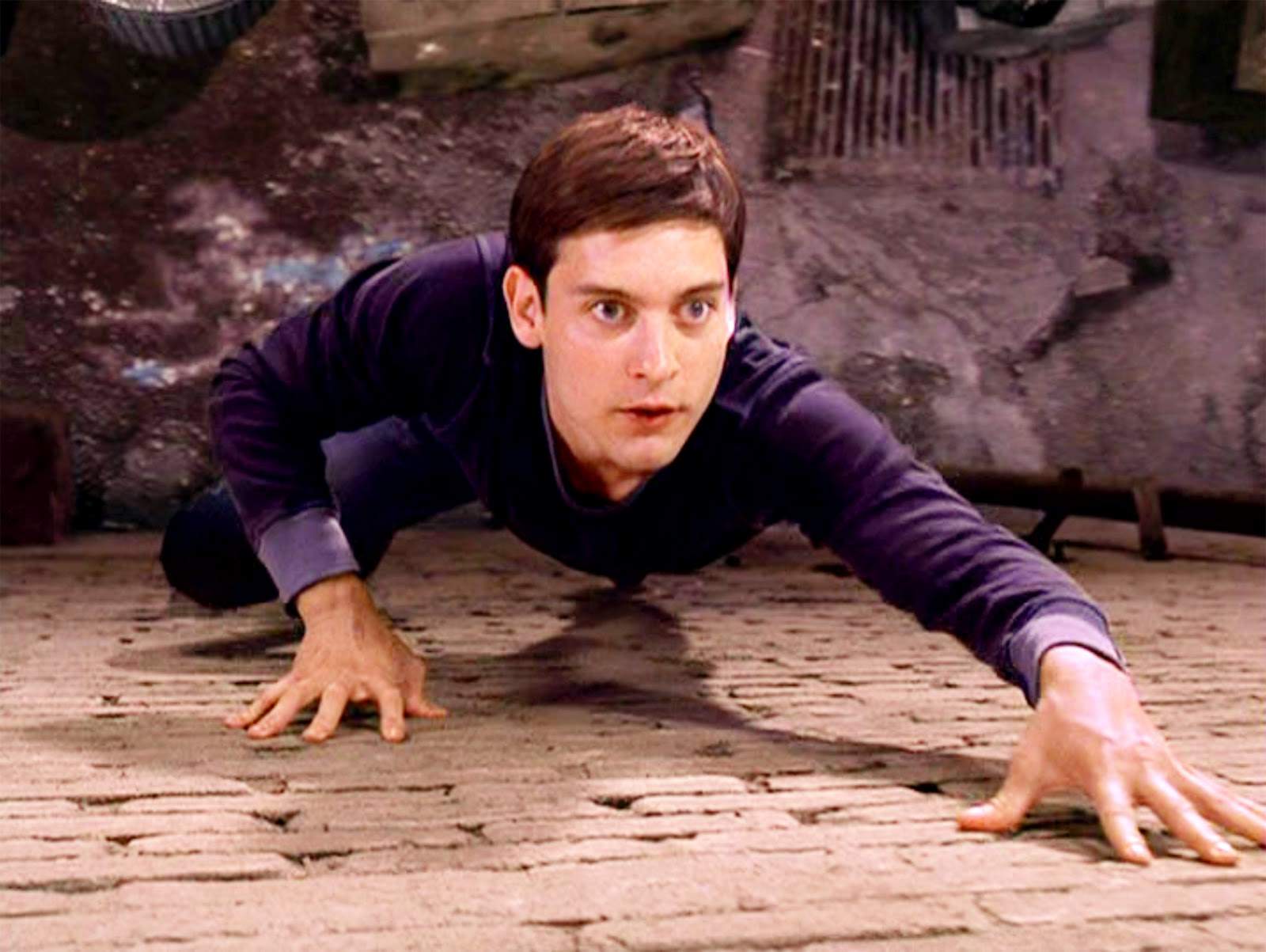
And it all seems to have hinged on the character of Peter Parker (Tobey Maguire). I had no problems with him, but Ebert apparently did.

"The great failing of 'Spider–Man 3' is that it failed to distract me from what a sap Peter Parker is," Ebert wrote. "It lingers so long over the dopey romance between Peter and the long–suffering Mary Jane [Kirsten Dunst] that I found myself asking the question: Could a whole movie about the relationship between these two twentysomethings be made? And my answer was: No, because today's audiences would never accept a hero so clueless and a heroine so docile."

I thought that was a bit harsh, considering that the movie's sole purpose was to entertain — not to make some profound statement.

Well, perhaps that wasn't its sole purpose. I wouldn't rule out the money motive. The original "Spider–Man" became the first movie to exceed $100 million at the box office in its first weekend on American movie screens. Its sequel, which was released in 2004, beat the original's opening–day record by $1 million.

It was logical to expect a similar response to the third movie, and it didn't disappoint — well, not entirely. It was the highest–grossing film of the three movies in the trilogy — but, although the DVD sales grossed more than $120 million, they still came up short of expectations.

Anyway, Ebert and I were never on the same page on the "Spider–Man" movies. He didn't like the first and third movies; I did.

On the other hand, he did like the second movie. "Now this is what a superhero movie should be," he wrote of that first sequel. I thought the only purpose for the second movie (other than to make a lot of money) was to be a bridge between the first and second movies. I still think that, for that matter.

Go figure.

Anyway, I can kind of understand where some folks were coming from in their criticism — the ones who complained that there were too many stories going on at once.

Yes. There were quite a few stories being told.

There were the continuing stories dating back to the original movie — of Peter Parker and M.J., of Parker's newspaper career and his editor (J.K. Simmons) and of the son of the Green Goblin (Willem Dafoe), whose spirit urged his son to seek vengeance (and tried to do so through M.J.).

And there was some new stuff. There was Bryce Dallas Howard (Ron Howard's talented and beautiful daughter) who played Parker's lab partner and temporary love interest.

There was also the introduction of a new villain, played by Thomas Haden Church, who, as it turned out, had been responsible for the death of Parker's uncle (Cliff Robertson). His aunt (Rosemary Harris) was back.

Yep, there was a lot going on. Nothing neat and orderly about it. But isn't that the burden of a superhero?

Wednesday, May 03, 2017

Spinning Spider-Man's Web on the Big Screen


I was never a devotee of comic books.

Oh, sure, there were some I would read when I was a kid — but not regularly. I could take 'em or leave 'em.

I always preferred the comic books that made me laugh as opposed to the ones that I judged to be dramatic, more serious in nature.

It was in that category that I would put characters like Superman, Spider–Man, etc. It seems to me that superheroes are, almost by definition, about serious stuff, and their fans are deadly serious about them. I've known people who were really into the superhero thing. I even worked with a guy once who was petrified of spiders but loved the character Spider–Man. Go figure.

That might explain why I liked the "Super–Man" movie that made its debut on this date in 2002 — even though many people seem to prefer the version from 2012. I've never seen that one, though, so I can't be making any kind of comparison except based on what I've heard from others.

That wouldn't be a satisfactory answer, either, though, because the general consensus seems to be that the 2012 version was better. And it may well have been.

I just felt thoroughly entertained by the version that premiered 15 years ago today. It may not have had the special effects that were available a decade later, but movies have always been that way. They've always had to compensate for the things they didn't have or couldn't do.

"Spider–Man" told a good story. That always makes up for a lot with me. It was like watching a comic book, frame by frame, on the movie screen. I could almost see the balloon dialogue between the characters.

Except there was a difference.

Comic books have always seemed scripted to me. In real life, people aren't usually as quick on their feet as they appear to be in a book, comic or otherwise. In real life, humans sometimes (often, in fact) need at least a little time to absorb what they have heard or seen before making a response — which is rarely as impressive as what appears in print. Books, comic or otherwise, may be intended to appear spontaneous, and many may succeed even though they almost certainly went through several lengthy revisions.

But the acting in "Spider–Man" always had just enough of those human pauses for entirely plausible intervals to make things seem spontaneous — even though the movie was just as scripted as the book(s), comic and otherwise.

Although it might have lacked as much action as Millennials prefer, I thought it was a good call to spend the first half of the movie essentially exploring the character of Peter Parker (Tobey Maguire) rather than assuming that everyone who saw the movie already was familiar with his story. It helped to establish that he had been a neighbor of Mary Jane (Kirsten Dunst) since he was 6 and, by his own admission, had been in love with her all that time.

It was certainly a good call as far as Maguire was concerned. It was the movie that made him a star.

Film critic Roger Ebert and I frequently agreed in our assessments of movies, but we never saw eye to eye on the "Spider–Man" franchise.

Ebert, for example, thought Maguire was miscast. I did not.

"Imagine 'Superman' with a Clark Kent more charismatic than the Man of Steel," Ebert wrote, "and you'll understand how 'Spider–Man' goes wrong. Tobey Maguire is pitch–perfect as the socially retarded Peter Parker, but when he becomes Spider–Man, the film turns to action sequences that zip along like perfunctory cartoons."

I suppose that was the quality I liked best. I always see comic books when I see suuperheroperhero movies, anyway. For me, that made Maguire ideal for the role.

And, although their roles were supporting, Cliff Robertson and Rosemary Harris were well cast as Maguire's aunt and uncle.

Willem Dafoe was perfect as Norman Osborn, the father of Maguire's best friend and a bit of a mad scientist who became Spider–Man's nemesis, the Green Goblin.

I guess the thing about the movie to which I objected was the portrayal of the newspaper editor. Now, I like J.K. Simmons, who played the part. I especially like him in his television role in the Farmers Insurance commercials.

It is likely that he had little input into the character, but I thought it was an unrealistic portrayal. I have worked for several newspapers — and, as a result, several editors. They all had their shortcomings, but they had their redeeming qualities, too. Simmons' character did not.

Sunday, December 18, 2016

Going Home


Billy (Gordon Pinsent): It's finding the center of your story, the beating heart of it, that's what makes a reporter. You have to start by making up some headlines. You know: short, punchy, dramatic headlines. Now, have a look, what do you see? [Points at dark clouds on the horizon] Tell me the headline.

Quoyle (Kevin Spacey): Horizon Fills With Dark Clouds?

Billy: Imminent Storm Threatens Village.

Quoyle: But what if no storm comes?

Billy: Village Spared From Deadly Storm.

Some actors and actresses become typecast because they play a certain kind of role so well.

When I saw Kevin Spacey in "The Shipping News," which made its big–screen debut on this day in 2001, I kind of had that sensation about him. He is always playing dysfunctional characters, I thought to myself.

That wasn't really fair. His characters aren't always dysfunctional — but his character in "The Shipping News" sure was.

In my experience dysfunctional people generally don't owe that condition to any one person or one event. Oh, sure, there are some who do, but for most it seems to have been an ongoing process to which many people and many events contributed. So it was with Spacey's character in "The Shipping News."

Some of it was beyond his control — his emotionally abusive father, for example — but some of it was simply the outcome of the kind of bad choice that most of us make at some point in our lives — like marrying the wrong person. In Spacey's case, that was Cate Blanchett, who played the town tramp (and was virtually unrecognizable); she gave Spacey a daughter and took off.

He got an answering machine message from his father, who hinted that he and his wife would be gone soon, presumably in a murder–suicide, and, it turned out, they were. Spacey barely had time to mourn that loss when he got news about his wife. She and her, uh, friend took a plunge off a bridge and died when the car hit the water.

His aunt (Judi Dench) stopped to see him as she was en route to the family's ancestral home in Newfoundland; Spacey and his daughter wound up accompanying her. He'd been an ink setter for a newspaper in Poughkeepsie, N.Y., and naturally gravitated to the local newspaper, The Gammy Bird — but was hired as a reporter, not an ink setter. His standing assignment was to cover the shipping news — a pretty important beat in a seaside community.

He wasn't a trained journalist, but he took the initiative to write an article he hadn't been assigned to write. When it was published, to his surprise (and to the surprise of his co–workers), his publisher (Scott Glenn) liked it well enough to make him a columnist.

He also became friendly with a young widow named Wavey (Julianne Moore).

Wavey lost her husband when his ship went down during a storm. I thought one of her most powerful lines must surely resonate with people who have lost someone to whom they were close — in other words, everyone.

"It was four years ago," she said of the loss, "and it was yesterday."

That was a realistic observation, I thought then (and still think today; my hat is off to whoever wrote that line). When you lose someone close to you, the moment you experienced the loss is always lurking just beneath the surface. No matter how much times passes, it doesn't take much to bring back the sharpness of the pain as if it were happening for the first time.

I was impressed with that — but mostly, I think, I was impressed with the portrayal of a small–town newspaper office and staff. I have worked for newspapers large and small, and the atmosphere in a small newspaper office is special. You know you aren't likely to be or work with a Pulitzer Prize winner at a small–town newspaper — after all, William Allen Whites are few and far between — but the work that is done at a small–town newspaper every day truly is the embodiment of what community journalism is all about. It may not be exciting or particularly interesting to anyone outside what may be a rather narrow circulation area, but to those readers in your newspaper's readership, local news is important to them — and there is nowhere else they can get it.

Not even in the digital age.

But there is a dark side to small–town newspapers, and Spacey encountered it in the form of the editor, who apparently made it his mission to get Spacey's character fired. If you haven't seen the movie, you'll have to watch it to find out whether he succeeded.

Well, I guess there is probably at least one sociopathic personality in every newsroom, even the small ones. I'm sure it isn't limited to newsrooms, though. Perhaps there is one in every workplace.

But it didn't stop Spacey's character.

Monday, November 21, 2016

'Rocky' Did It Right


Mickey (Burgess Meredith): Your nose is broken.

Rocky (Sylvester Stallone): How does it look?

Mickey: Ah, it's an improvement.

If there is anything that is almost guaranteed to engage a movie audience, it is a story about an underdog overcoming the odds — and when director John G. Avildsen's "Rocky" made its debut on this day in 1976 movie audiences got enough of that to keep them satisfied until "Hoosiers" hit the big screen 10 years later — although they had plenty of those underdog movies, some good and some not so good, in the interim.

They always do. Movie makers know underdog stories make money. Well, that ones that do it right make money — and "Rocky" did it right.

I well remember the first time I saw "Rocky." It was in a theater in my hometown. Now my hometown theater — well, the one of my early childhood — was one of those spacious theaters with a lobby and a balcony and one truly big screen, but it had been out of business for awhile by the time "Rocky" made its premiere. So I never got to see it in that setting (although I have often wished that I had). I saw it in the more compact theaters in which one sees movies today — more like screening rooms than theaters, if you ask me, but that's a topic for another time. By modern standards, it was rather tiny. It only contained two screens — but that allowed twice as many movies to be shown and, therefore, provided twice as many options for consumers in my hometown.

The arrival of that two–screen theater produced as much buzz in my hometown as the arrival of the first McDonald's.

Anyway, in that more modern moviegoers' milieu, I saw something from the old days of which I have heard but I have seldom actually seen. I saw an audience stand and applaud when the movie was over.

A sport of some kind is always good for that kind of reaction (for a real–life example, one need look no further than this year's World Series, won by the Chicago Cubs for the first time in more than a century) — even though other pursuits can be used. "Rocky," of course, was about an individual sport — boxing. Team sports are good, too, but they teach a different kind of lesson that extols different values. Those movies are tributes to the virtues of teamwork and unselfishness. Movies about individual sports are more about determination, self–sufficiency and resourcefulness.

You couldn't really say Rocky (Sylvester Stallone) was down on his luck. He had never had much in the way of luck. He wasn't a bum, as Marlon "I coulda been a contendah" Brando memorably said of himself in "On the Waterfront." Rocky really could have been a contender. He was a Philly brawler who had squandered his prime and figured he would never get to fight for a title, not even once. (In the words of a Beatles' song, "Isn't he a bit like you and me?")

That was a source of frustration for Mickey (Burgess Meredith), the operator of a gym and trainer of would–be contenders, which, in turn, was a source of friction between Rocky and Mickey.

But then Rocky was offered an opportunity to fight the champ, a fellow named Apollo Creed (Carl Weathers), to mark the occasion of America's bicentennial. The champ didn't take the fight seriously, but Rocky did. He got up in the predawn hours to drink a glass of raw eggs and run in the dark, cold streets of Philadelphia, and he used sides of beef as punching bags in a meat freezer under the management of his friend Paulie (Burt Young).

Mickey swallowed his pride and approached Rocky about helping him prepare for the fight, but Rocky, briefly succumbing to that all–too–human tendency to engage in a little "how do you like me now?" banter, refused. When Mickey walked away, humbled and hurt, Rocky followed and reconciled with him.

Now, in case you have never seen this movie — and, frankly, it is hard for me to imagine anyone who hasn't seen "Rocky" by now — it is important to realize that Apollo wasn't looking for a legitimate fight. He was looking for more of an exhibition, a fight against an unknown on New Year's Eve. Rocky didn't get his shot at the title because he had been an up–and–coming contender. He was chosen purely at random. The champ saw Rocky's nickname — "The Italian Stallion" — and liked its possibilities as a marketing angle for the fight.

The champ never thought the Italian Stallion would be a serious threat, and he didn't go through serious preparations for the fight, which kind of foreshadowed, in a life–imitates–art kind of way, Buster Douglas' stunning upset of seemingly invincible heavyweight champion Mike Tyson in 1990. In one of my enduring memories from the movie, Apollo's trainer (Tony Burton) watched with alarm a TV report on Rocky's training regimen in the meat locker and kept telling Apollo to come watch the segment. But Apollo was too busy going over marketing plans for the fight.

Many things were finally coming to Rocky after a lifetime of waiting. Here he was getting a chance, at long last, to fight for the title, and he had also found love. Adrian (Talia Shire) was Paulie's sister, kind of plain and quiet. She worked at a pet store and lived with Paulie. She cooked his meals, cleaned his house, did his laundry. Apparently as a younger man he had promised to look after her because the family had concluded she couldn't look after herself. "I don't get married because of you," he yelled at her in frustration the night she moved out of his house — and into Rocky's tiny apartment. Maybe her family thought she was retarded or autistic. Fact was she was just introverted.

It was probably the love story — more than anything else — that made "Rocky" and its many sequels work. Most people probably fantasize about doing whatever they do professionally so well that they receive standing ovations and live handsomely for the rest of their lives.

Most people never achieve that, of course, so they can't relate to "Rocky" on that level (except in their dreams), but most people probably do find love — some don't but most do — and sometimes it is against the odds, in their own minds if no one else's.

On that level, most people probably could relate to "Rocky" in their real experiences — even if they had never participated in a sport, whether team or individual.

Rocky's love for Adrian was at the heart of everything he did. The movie was as much about his commitment to her as it was his commitment to giving his very best shot in the fight of his life. Maybe — no, make that probably — more.

So much of that is due to Shire's performance. Audiences already knew her as the Corleones' sister from the "Godfather" movies, and she had been nominated for Best Supporting Actress for her performance in "Godfather Part II."

She received a Best Actress nomination for her work in "Rocky" as the shy, sensitive Adrian. It was a powerful performance, all right, and perhaps she should have won — but she won neither Oscar.

"When she hesitates before kissing Rocky for the first time," wrote film critic Roger Ebert, "it's a moment so poignant it's like no other."

In a way, I guess, the audience already knew how the fight between Rocky and Apollo Creed would turn out before it even happened.

It didn't really matter, I guess, if Rocky wasn't a winner in the ring (except it always bothered me that, in the fight scenes in the first and subsequent Rocky movies, when punches landed, they always sounded like car doors being slammed in echo chambers).

He won the love of his life against all odds.

And so, too, did the movie. It won Best Picture (as well as Best Director and Best Film Editing) at the Academy Awards — in spite of heavyweights like "All the President's Men" and "Network" on the Academy's ballots.

Talk about your underdog–makes–good finish.

And Bill Conti was nominated for — and probably should have won — the Oscar for Best Original Song. "Gonna Fly Now" is such an iconic movie tune now. Forty years later it lives on in more memories than the winner of that Oscar, Barbra Streisand and Paul Williams' "Evergreen."

Take my advice. If you have a daunting task facing you and you need to get pumped up, listen to "Gonna Fly Now." Works every time.

Actually, Conti probably should have been nominated for Best Original Score. But there is a limit for even an underdog's triumphs.