Showing posts with label 1947. Show all posts

Sunday, December 17, 2017

Scaling a 'High Wall'


Robert Taylor often turned in vapid performances, but that was not the case in "High Wall," a rarely remembered film noir that premiered on this day in 1947.

Taylor's character, a decorated war veteran, found himself in a situation like The Fugitive of the classic 1960s TV series. His wife was dead, and he stood accused of her murder, but he insisted he was innocent and tried to find the real murderer.

Initially, Taylor caught his wife being unfaithful to him with her boss (Herbert Marshall), and she ended up being strangled. All evidence indicated Taylor was responsible. He tried to kill himself by driving his car into the river, but he survived and was sent to a psychiatric hospital. He had no memory of what had happened to his wife, possibly due to an injury he suffered during the war.

It was strongly suggested that Taylor could be cured by surgery, but he refused, preferring to remain in the hospital rather than facing conviction of his wife's murder. It was only after he learned that his young son would be sent to an orphanage that he changed his mind.

In an attempt to cure his amnesia, Taylor tried to re–create the scene of the crime with the help of a doctor (Audrey Totter), who doubted his guilt and became his staunchest ally.

It is probably appropriate at this point to say a word or two about Totter. I have watched a fair number of film noir movies in my life, and Totter was frequently cast in them. She usually played a bad girl, but this time she played against type.

I have always found Totter to be an underappreciated talent. She appeared on the silver screen with many of the top stars of her day, but her kind of character fell from favor in the 1950s, and she gravitated to television, where she found steady work.

She was always good, but she may have delivered her best film noir performance in "High Wall."

The whole cast was at the top of its game, but particular mention should be made of Marshall, who was suitably creepy in his role.

But I have learned that you will never find unanimity in anything, and so it is with this movie — or at least the individual performances. I know one person, for example, who thought Taylor's performance was the redeeming feature of a movie in which Totter was a cold fish and Marshall was miscast. That was precisely the opposite of my reaction — and the reactions of most of the people with whom I have discussed "High Wall."

"High Wall" also introduced audiences to a term with which many were still not familiar in 1947 — sodium pentathol or "truth serum."


Saturday, November 25, 2017

One of the Best Film Noirs of All Time


"I sell gasoline. I make a small profit. With that I buy groceries. The grocer makes a profit. We call it earning a living. You may have heard of it somewhere."

Jeff (Robert Mitchum)

One of my favorite Paul Simon songs never made much of a ripple on the radio but rode "50 Ways to Leave Your Lover" to the top of the charts as its B side — "Some Folks' Lives Roll Easy."

"Out of the Past," which debuted on this day in 1947, always makes me think of that song.

Because, as the song says, some folks' lives do roll easy, and "some folks' lives never roll at all." Some people follow straight trajectories onward and upward to the top (or, at least, in that general direction); most of us, I guess, have something in our pasts from which we're trying to escape.

In director Jacques Tourneur's "Out of the Past," Robert Mitchum was trying to break free from his past as a private investigator. But, like Al Pacino in "The Godfather Part III," he kept being pulled back in.

The story line doesn't exactly roll easy, either, but that is what might just make "Out of the Past" one of the best film noirs of all time — maybe even the best. Don't sit back to watch this with a beer in your hand, though. You'll need all your wits about you to keep up with the twists and turns in this one.

You'll find it is worth it.

There is an intriguing dynamic between Mitchum and Kirk Douglas, who were distinctly different in their styles. In a typical film noir way, the movie reeks with symbolism from the (literally) dark scenes to the clear cinematic triangle of good–guy Mitchum, bad–guy Douglas and femme fatale Jane Greer.

Douglas was a gangster, and Greer was his mistress. Douglas alleged Greer had shot him and stolen money from him; Mitchum, as a private investigator, had been hired to track her down.

After he found Greer, Mitchum became infatuated with her and ultimately confessed that he had been hired to find her. This did not come as a surprise to Greer; in fact, she had suspected as much and had been preparing her story all along.

And what a story it was. She denied stealing Douglas' money and urged Mitchum to run away with her. But Mitchum discovered that she was a liar and a killer.

Then the story got complicated ...

It is probably important to note that much of the story was told through flashbacks. After Mitchum and Greer eventually split up and Mitchum tried to start over again as a gas station operator, part of his new life involved a new girlfriend. This one, played by Virginia Huston, was much nicer, a real girl next door, and it was to her that Mitchum told the story as they were driving to meet with Douglas.

"She can't be all bad," Huston said at one point. "No one is."

"She comes closest," Mitchum replied.

His character was right about that. Greer had the qualities of a great femme fatale — on the screen as in life, a true femme fatale has no remorse for anything she does. She is completely self–centered, and she is beautiful and seductive enough that any man, even ones as smart and as tough as the ones with whom she was involved in "Out of the Past," could fall for her.

Although uncredited in many of his early films, Mitchum was known largely as a film noir actor at first. In hindsight, he seems like a natural choice for the role in "Out of the Past," but he was the fourth choice to play the part. Humphrey Bogart was the first choice, and by all accounts I have read he wanted to play it, but Bogart was under contract to Warner Brothers and RKO Pictures owned the rights to "Out of the Past."

John Garfield and Dick Powell turned down the role, and it went to Mitchum.

Sunday, November 19, 2017

Bringing a Stage Play to the Screen


For a long time, "Mourning Becomes Electra," which premiered on this day in 1947, was treated like a cinematic afterthought.

It was seldom seen on TV and unavailable in video tape or any comparable format (such as laserdisc) until it was finally released on DVD about a dozen years ago.

Why was that?

Well, it could have been the movie's performance at the box office. It lost more than $2.3 million.

I've read some reviews in which critics dismissed it as "stagey" and "wordy." I could understand that being a problem today. If it seemed that way to critics 70 years ago, I can only imagine what today's critics would say.

But it was adapted from a play written by Eugene O'Neill so it was to be expected that it would seem stagey. After all most of the action took place on a single set. And it would also be expected that it would be wordy. Plays tend to be driven by dialogue, not flashy explosions or car chases.

And, for its time, the movie was rather long — nearly three hours. But when it performed poorly at the box office and failed to win an Oscar, RKO Pictures made a decision that made matters worse — to slice about an hour from the film and re–release it. The original version, while long, made sense; the chopped–up version did not.

Fortunately, the movie has been restored to its original length — and, while it is not ordinarily my policy to promote a particular TV network, I must say that you can count on seeing that original version on Turner Classic Movies, which airs it fairly frequently. That is where I saw it, and I was impressed.

As a matter of fact, TCM will be showing the restored version on Tuesday, Nov. 28 at 3 p.m. (Central). Do not — I repeat, do not — watch the pared–down version. You have been warned.

In case you aren't familiar with the background of the movie, it was an adaptation of O'Neill's 1931 play that was, in turn, a re–telling of Aeschylus' Greek play "Oresteia" set in post–Civil War America.

Rosalind Russell's performance as Lavinia was so good it was a foregone conclusion she would win an Oscar; according to Oscar lore, when the Best Actress nominees were recited but before the winner was named, Russell rose from her seat, only to sink back down in it when it was announced that Loretta Young had won for "The Farmer's Daughter."

The comedic actress was nominated for Best Actress four times but never won.

Michael Redgrave was nominated for Best Actor that year but lost to Ronald Colman in "A Double Life." That was a pity, too, because it was his only Oscar nomination in a long and distinguished career on the stage and screen.

Redgrave, incidentally, is the only Best Actor nominee to have two daughters who were both nominated for Best Actress as well.

For some Russell's performance may seem overblown, and maybe it was, but I thought the character called for some of that, and Russell was good at it — better than Katharine Hepburn or Bette Davis, both of whom reportedly were considered for the role.

Kirk Douglas and Raymond Massey were great, as always. In fact, the acting on the whole was superb.

O'Neill's play has long been regarded a jewel of the modern American stage so it was no surprise to me that the actors turned in top–notch performances, and that can be enthralling on the stage, where the play can easily run twice as long as the movie.

Producer/director Dudley Nichols adapted the play for the screen, and as a writer I can appreciate his fealty to the original work. If you have ever seen the play and the movie, you know he tried to resist the temptation to stray from O'Neill's work.

But that may have worked against him. As New York Times film critic Bosley Crowther observed in his review, "It is one thing to watch a group of actors hiss and scream their deep emotions on a stage; it is quite something else to see the same thing done at great length by a group of photographs."

Motion pictures were still evolving in 1947, and filming adaptations of plays was still something of a mystery for many. That is why so many such movies appear now to be little more than films of stage productions — because that is essentially what they were. Shakespeare's plays have always been great on the stage, but it took considerable adaptation and experimentation to successfully bring them to the silver screen.

That was still a problem for O'Neill's plays 15 years later. By all accounts, director Sidney Lumet did a great job with "Long Day's Journey Into Night" — it even brought Katharine Hepburn an Oscar nomination — but, because that play, too, was largely confined to one set, even Lumet could not break past the impression that he had filmed a stage production.

Saturday, November 11, 2017

Walking the Walk


Kathy (Dorothy McGuire): You think I'm an anti–Semite.

Phil (Gregory Peck): No, I don't. But I've come to see lots of nice people who hate it and deplore it and protest their own innocence, then help it along and wonder why it grows. People who would never beat up a Jew. People who think anti–Semitism is far away in some dark place with low–class morons. That's the biggest discovery I've made. The good people. The nice people.

There have always been personal comfort zones, I suppose, and people become more inclined to guard them and hold on to them tightly as time passes.

That which is different and unfamiliar can be very frightening, very threatening. I suppose that is some sort of primitive self–defense mechanism buried deep in our DNA. It's there to protect us.

And that was probably a good thing up until a certain point in human development. It was prudent to be wary of people and things that were unfamiliar. Changes came slowly and gradually gained acceptance once people discovered they could trust those changes — like giving up a horse and buggy for one of them newfangled automobiles.

It is probably a byproduct of technological development, but changes happen at a more rapid pace now than they did for previous generations. Those generations could continue to live in their comfort zones for most, if not all, of their lives, but that really isn't possible today.

I often find myself lamenting changes — and I know that some are just minor annoyances, really. No big deal. For example, I used to enjoy watching the marching bands at halftime of football games on TV. Some were really good. I'm sure some are really good today, too, but you never know unless you attend the game in person and remain in your seat at halftime — or unless whoever is televising the game shows a five–second snippet of the band (most likely on the sideline waiting for the half to begin).

Otherwise they are treated as afterthoughts.

But as I say, that's a minor thing. There are bigger things, like human relations. People are more sensitive to how they treat others and the language that they use than I can remember at any other time in my lifetime — and that's a good thing, even though there are times when I think things get taken too far.

There is much progress still to be made, but I am a student of history, and I believe it is always important to remember how far we have come. Without that memory, no matter how painful it might be, permanent progress isn't possible.

And "Gentleman's Agreement," which premiered 70 years ago today, is a reminder of how far we have come — and perhaps how far we have yet to go.

Granted, the story is a bit dated now, but the message is still good.

Gregory Peck played a writer for a progressive magazine who had agreed to write about anti–Semitism, but he struggled to think of a good angle — until he came up with the idea of posing as Jewish to see what kind of reactions he received. He was new to the magazine so most of the people who worked there knew little about him, and he felt he could use that in his article.

He didn't intend to confine himself to the magazine staff, though. He planned to explore New York City and see how a Jewish man was received.

He encountered anti–Semitic behavior from predictable and not–so–predictable sources. One of the unpredictable ones was his new girlfriend (Dorothy McGuire). Her character, like so many others in the movie — including the magazine's publisher, a crusading liberal who was eager to expose anti–Semitism but wasn't prepared for the revelation that things weren't so squeaky clean in his own domain — talked the talk but didn't exactly walk the walk.

As Peck's character discovered, there are always people who give lip service to racial and religious tolerance but don't apply it to their actions.

Oh, he encountered the usual suspects, the ones you always expect to find — but he almost preferred them. They were honest if misguided. But Peck's character found "[t]he good people, [t]he nice people" to be disappointments.

At one point, for example, one of the minor characters asserted that "some of my best friends are Jewish," which drew a telling response from Celeste Holm, who won Best Supporting Actress: "I know, dear, and some of your other best friends are Methodist, but you never bother to say it."

Holm, by the way, wasn't the only Oscar nominee from "Gentleman's Agreement." Ann Revere, who played Peck's mother, also received a nomination for Best Supporting Actress. Peck was nominated for Best Actor, and McGuire was nominated for Best Actress.

The movie received Best Picture and Elia Kazan won Best Director.

Jewish actor John Garfield, who played a Jewish friend of Peck's, wasn't nominated — but he, along with other members of the cast and crew (including Revere and Kazan), was brought before the House Un–American Activities Committee. Because his wife was found to be a member of the Communist Party, Garfield, in fact, was brought before the committee twice, was blacklisted, then removed from the blacklist, then put back on it.

There were many who believed at the time that the stress of this experience led to Garfield's death of a heart attack at the age of 39.

Tuesday, September 05, 2017

About Faces


"You know, it's wonderful when guys like you lose out. Makes guys like me think maybe we got a chance in this world."

Vincent Parry (Humphrey Bogart)

I like all four of the movies that Humphrey Bogart and Lauren Bacall made together — each for a different reason.

And the reason I like "Dark Passage," which premiered on this day in 1947, is simple. It was the most creative of the four.

For about the first half of the movie, the audience never saw Bogart's face. A few times the viewers saw the figure of a man, but they could not see his face. They saw a photograph of a man in the newspaper who was supposed to be Bogart — but definitely was not Bogart. In fact it was a picture of character actor Frank Wilcox, who made a name for himself on TV.

Bogart played a man who had been convicted of killing his wife and escaped from prison. He got some assistance from Lauren Bacall, who, as it turned out, had been interested in his case and had attended his trial — although Bogart's character hadn't known that at the time.

AS I say, for the first hour of the movie, Bogart's face was not visible, which was a source of considerable anxiety for studio head Jack Warner. Bogart was Warner's most bankable star, but no one saw his face for more than an hour. Either things were seen from his perspective or his face was hidden by bandages after he got plastic surgery, which radically altered his appearance — as long as you believed that picture really was a pre–surgery photo of that character.

Once she helped Bogart remove the bandages, Bacall essentially disappeared from the story. She returned at the very end.

Bogart, meanwhile, had to fend off a blackmail attempt — in so doing, he learned the truth about who had killed his wife and his closest friend. It was Agnes Moorehead, Bogart's spurned lover who had testified against him in court.

Bogart's character wanted to record Madge confessing, and he had an advantage in that she didn't know who he was with his new face. He went to her home, posing as someone with a romantic interest in her acting on a recommendation from a mutual friend.

After he had gained her confidence and been allowed into Madge's home, he revealed his true identity to her. He told her that he had evidence proving her guilt, hoping to coerce her into making a confession, but she ended up falling from a window to her death, never having confessed.

"Dark Passage" was truly an exception to the theatrical rule. I'm not talking about how most of the first half of the movie was seen from Bogart's point of view. I'm talking about how that part was supported by first–person narration, not in the flashback kind of way that was used in movies like "Sunset Boulevard" but as a real–time kind of thing. Few pictures, then or now, could do something like that from start to finish — and, to be fair, "Dark Passage" stopped doing it after the viewers were allowed to see Bogart's face.

But it was effective when it was being used.

Friday, September 01, 2017

'Bobby-Soxer' Was Entertaining


"The Bachelor and the Bobby–Soxer," which made its debut 70 years ago today, was a silly story, but it had a strong cast that made it worth watching.

And, while it was silly, the story was interesting enough to keep audiences engaged — and the cast didn't hurt.

Cary Grant was one of the hottest stars in America (ranked #2 all time by the American Film Institute). The bobby–soxer was played by Shirley Temple, once the hottest star in the country (when she was a child) and ranked #18 among actresses by AFI. Myrna Loy didn't make AFI's list, but she found fame in the "Thin Man" movies in the years preceding "The Bachelor and the Bobby–Soxer."

All in all, a top–notch cast, and they produced an entertaining movie.

The first character the audience met was Loy, who played a judge at a time when female jurists must not have been too common. They can't be a lot more common today; the American Bar Association reported in 2014 that women made up slightly more than one–third of the American legal profession.

Loy may or may not have been seen as a trailblazer for women who aspired to careers in the law, but her portrayal may have been groundbreaking. I'm not aware of actresses who played judges in the movies before she did — although there may well have been some.

Anyway ...

Loy was presiding over a case in which Grant played a wrongfully accused defendant.

Grant's character was a bachelor artist who was charged with starting a brawl at a nightclub. When it became clear that the fight started between two women, both of whom wanted to be with Grant, Loy released Grant with a warning.

And Grant went on his merry way to deliver a lecture at a high school attended by Temple, who happened to be Loy's younger sister. As I observed earlier, Temple was the bobby–soxer of the story.

Now without going into too much detail — but for the benefit of any folks under 75 who are reading this — a bobby–soxer was a teenage girl — specifically one easily influenced by social trends or fads. Each generation has its own names for specific types of people, and bobby–soxer was the term used for impressionable teenage girls in the '40s.

Temple's character was susceptible to the messages — both real and imagined — from guest lecturers, and she fell in love with Grant, whom she (literally) saw as a knight in shining armor as he delivered his lecture on art.

Now that kind of puppy love has been around for a long time, and teenage girls, whatever your generation called them, always seem to be especially vulnerable to it.

Temple's character was a rather extreme case — even for a bobby–soxer. She manufactured a reason to be with Grant — as a model for one of his paintings. In a complex screwball comedy kind of way, Temple was discovered at Grant's apartment by Loy; Grant was arrested — and offered a deal. If he would pretend to date Temple and let the infatuation burn itself out, the charges would be dropped.

So he agreed.

But as the scenario played out, Grant and Loy began to fall for each other, much to the dismay of the assistant district attorney, who wanted Loy for himself. To get Grant out of the way, he agreed to drop all charges against Grant, thus freeing him of any further obligation to see Temple.

In the end, all the right people ended up with each other — as inevitably they must in a screwball comedy. Temple went back to her long–suffering high school boyfriend, and Grant and Loy were together as well.

Comedies, especially screwball comedies, are seldom rewarded with Oscar nominations, but "The Bachelor and the Bobby–Soxer" didn't just receive a nomination. It had an even rarer achievement when it won the Oscar for Best Original Screenplay.

Friday, June 30, 2017

The Irresistible Force vs. the Immovable Object


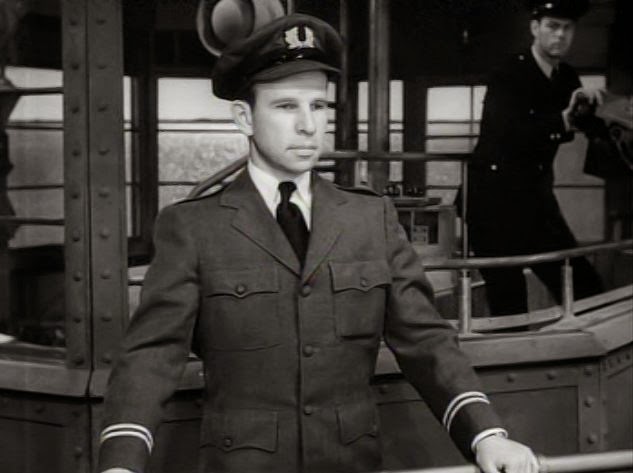
Upon first glance, Hume Cronyn seemed miscast as the ruthless prison guard in "Brute Force," which premiered on this day in 1947.

Physically unimposing as he was, though, Cronyn was the perfect choice. His performance effectively demonstrated how an apparently meek — but nevertheless narcissistic — individual can abuse even a dollop of power — and Cronyn's character had considerably more than a dollop of power. He was not above using anyone and anything to achieve his objectives, either.

I honestly felt that the character, with his sadistic personality, should have made the American Film Institute's list of the Top 50 movie villains. But it didn't.

Now, let me be clear. I don't have any issues with AFI's actual choices for its lists of villains and heroes. But the role was so unusual for Cronyn and he played it so well that I thought the performance at least deserved an honorable mention (although I don't think such a designation was available).

Anyway.

The story was essentially a retelling of the fabled irresistible force colliding with the immovable object. Burt Lancaster played an inmate who hated Cronyn and came up with an escape plan after having served a stretch in solitary confinement. It built up to a bloody finish, a riot when the escape plan didn't go very well.

It was good, but I'll be the first to say the movie had its weaknesses.

There were times when the story seemed a bit forced — like when the movie told the stories of the other inmates through flashbacks. To me, it seemed like a rather obvious tactic to introduce women into what was otherwise an all–male cast. And not just any women, either. These women were femme fatales, the ones who (directly or indirectly) were responsible for those men being on the inside while the women remained on the outside.

Clearly there were times when the movie was awash in stereotypes — at least those that existed in the '40s — and the references to World War II do make the story seem dated.

But for a movie that is 70 years old today, I think it has held up rather well.

"Brute Force" provides an unflinching, albeit melodramatic, glimpse into prison conditions for viewers today, but as I say, it is not without its shortcomings.

It really didn't have much to say that was new, even when it was in theaters. Prison movies weren't new when "Brute Force" was made, nor was the idea that conditions behind bars weren't good.

But it may have made that point better than any movie that preceded it.

Saturday, April 08, 2017

A Sentimental Journey


People watch movies at different times and for different reasons.

And when I was a boy, it seemed that there was always something to be seen at the movies that would fit whatever mood you were in — whether you wanted to learn something or feel inspired or hear some catchy tunes ... or be amorous.

It seems less that way now to me. People don't seem to care as much about those things today as they do about splashy special effects, but human nature always seems to crave the same things — moreso for some at certain stages of life, I suppose — and the progression of the generations does not change that.

(As a writer, I like a good story, regardless of the setting.)

Sometimes you want to see a movie that will make you feel good, and in the months and years following World War II, America seems to have wanted to feel good again when it went to the movie theaters.

If that is what people were looking for when "It Happened in Brooklyn" premiered 70 years ago yesterday, they weren't disappointed.

Frank Sinatra played a returning veteran who had built up Brooklyn in his mind to heights it could never possibly reach. No place could, and Brooklyn failed to live up to the buildup. It was a disappointment for him.

Well, everyone has problems.

Sinatra's buddy, played by Peter Lawford, followed him to the States from England in hopes of overcoming an extreme case of shyness. Lawford, as it turned out, was heir to a dukedom back in merry old England, but the journey to America seemed to be just the thing to bring him out of his shell.

If not, then love interest Kathryn Grayson could be.

That might be enough to make the plot thicken since Grayson was originally Sinatra's love interest — but, you see, the movie was really about how all these characters tried to launch careers in something other than the humdrum routine work they were doing.

Sinatra moved in with an old friend, played by Jimmy Durante (for whom the movie production was halted for a week and a half so he could finish work on another movie), and went to work as a shipping clerk, but he wanted to be — guess what? — a singer, and that dream was shown to come true. There's a surprise, huh?

In fact, nearly every dream in the movie did come true. Grayson, who was a schoolteacher, dreamed of being an opera star. That was a dream that was not shown coming true — but, with her relationship with a duke–to–be, the audience could presume that her dream came true as well.

It wasn't exactly a classic, and you can probably guess everything that is going to happen before it happens, but "It Happened in Brooklyn" is still fun to watch.

Oscar–winning pianist and composer André Previn played the piano solos in the movie.

Wednesday, February 01, 2017

Bela Lugosi in Living Color


When I was a child, my mental image of Bela Lugosi was in black and white.

He was Dracula even though others had portrayed Dracula on the big screen. Lugosi was the embodiment of Dracula with his thick Hungarian accent. The others who played Dracula all imitated Lugosi to one extent or another, and few could come close to his natural style.

When I got older, my image of Lugosi became more defined, thanks to the biopic "Ed Wood" about the filmmaker whose mediocre efforts gave Lugosi's career a final chance. That, too, was in black and white — but that was by choice.

Most of Lugosi's movies were in black and white, but that was a choice that was driven by economics. Color was simply too expensive for many filmmakers in the '30s, '40s and '50s when Lugosi was in demand.

That was about the only thing that made "Scared to Death," which premiered on this day in 1947, noteworthy. It is the only feature–length movie on Lugosi's resume that was filmed in color. The credits proudly proclaimed that the movie had been filmed in "natural color," but it didn't look terribly natural to me. It was a cheap process called Cinecolor.

The premise, such as it was, was that a young woman had been literally frightened to death, and the movie (which ran slightly more than an hour) was devoted to the investigation into how this could have happened.

Aside from the fact that it was in color, "Scared to Death" could have been an Ed Wood movie. It had the same wooden acting and the same bad dialogue, presented as if it were a bad junior high film production of an already bad play. The only thing it lacked was one of Wood's cheesy titles — although the title that was used came pretty close.

Even the color was suitable for an Ed Wood movie. It was cheap and unnatural.

"Scared to Death" further resembled an Ed Wood movie in the sense that it used every outlandish plot device imaginable — including having Lugosi's colleague played by Angelo Rossitto, a three–foot actor whose character had other challenges besides his stature.

"My little friend Indigo is deaf and dumb; he cannot hear and he cannot speak but reads the lips," Lugosi's character explained. "And I will advise you to say nothing to annoy him for his temper is as short as he is."

Most of the plot developments were contrived and only loosely served their purposes — such as they were.

My advice? Do yourself a favor and watch one of Lugosi's black–and–white movies. Just about any of them would be better than "Scared to Death."

Even one of Ed Wood's movies.

Well, that's a tough call ...