Showing posts with label Hays Code. Show all posts

Thursday, December 28, 2017

Survival in the Wild


"Behold, the bridegroom cometh. And no oil for my lamp as usual. A foolish virgin me. Oh, foolish anyway."

Daisy (Ann Harding)

On the rare occasions when I have seen "The Animal Kingdom," I have found it hard to believe it wasn't made in the 1960s. While it looks every bit the 1930s flick that it is, it was the classic tug–of–war between safe, conservative lifestyles/generations and rebellious ones.

In "The Animal Kingdom," which premiered on this day in 1932, Leslie Howard played a well–off book publisher who lived with his lover (Ann Harding), a Bohemian artist. (Remember, this was in the days before the implementation of the Hays Code.)

They also happened to be pretty close friends. Sex and friendship, as you may have noticed, do not always go hand in hand. In this case, though, they did.

His father wanted him to have a more conventional life, and when he acquiesced, his bride was Myrna Loy, who was socially prominent but did not have that same spark with Howard that he had with Harding.

It showed.

At Loy's insistence, Howard's character sold books he knew would sell — whereas, when he had been with Harding, he published the books he wanted to publish. Their sales potential had far less influence on his decisions.

Loy was also steering Howard away from his old friends; in fact, she just wanted him to sell the business and live with his father in New York where they could assume their rightful places as respectable members of society.

In the meantime, although she tried to stay away from Howard, Harding and the couple's circle of friends found it impossible to believe Howard truly was happy. That was a tough one for viewers to accept, too, given the fact that Howard kept seeking out Harding to use as a sounding board on, well, everything.

I know that Howard was a matinee idol in the '30s, and I know he was a civilian hero during World War II — but I also know that the characters he played (well, the ones I have seen) were weak–kneed schlemiels. Maybe that was just the kind of character he played — or perhaps that was how he chose to play all his characters, whether they were intended that way or not. Nevertheless his character in "The Animal Kingdom" fit that description.

Tom, his character in "The Animal Kingdom," was every bit as malleable as Ashley Wilkes in "Gone With the Wind."

I doubt that anyone ever mistook Leslie Howard for John Wayne.

I only recently became aware of this movie; while I liked it, the title baffled me and still does. At first I concluded that it was an allusion to the fact that humans, as advanced as we are, are still animals, and we act on our animal instincts, primitive though they may be.

But the second time I watched it I picked up on one of Harding's lines — "For all our big talk, we both still belong to the animal kingdom."

And I began to think that maybe it means more than animal instincts. Maybe it is a reference to the different ways humans find to survive trials and tribulations.

And isn't the instinct to survive the most powerful instinct of all?

Wednesday, December 06, 2017

When Less Was More


"I like the dark. It's friendly."

Irena (Simone Simon)

The Christmas season hardly seems like the time for a horror movie to be showing on America's silver screens, but that was the case 75 years ago.

I suppose for most people living today, when someone mentions the movie "Cat People," thoughts immediately turn to the 1982 movie starring Nastassja Kinski.

But that was actually a remake of a movie of the same name that premiered on this day in 1942. There were some differences between the two, especially in their directors' and producers' visions of what a horror movie should be — and what it could be, given the times when they were made.

Producer Val Lewton was hired by RKO Pictures to make horror films on less than $150,000 — and they were to be adapted to titles Lewton was given by the studio. Even though things cost less in 1942, $150,000 was still a pretty modest outlay to make a movie, and being given a title with no story was a challenge, to say the least, but Lewton did his job well. He recycled RKO's leftover sets, and director Jacques Tourneur completed filming in less than four weeks, coming in about seven grand under budget.

The movie made $4 million in its first two years, rejuvenating RKO financially.

When the movie began, a Serbian woman (Simone Simon) made sketches of a panther at New York's Central Park Zoo. She caught the eye of a young man who approached her and struck up a conversation.

The two ended up marrying, but Irena believed that she carried a Serbian curse and would become one of the fabled cat people of her homeland if they were intimate.

Thus followed an at times over–the–top story, although there was no denying that animals did react oddly to Irena. She couldn't walk into a pet store without frightening the birds there and provoking the dogs into barking fits.

Her fear of releasing the beast she believed to be within her kept her at arm's length from her boyfriend/husband and drove him into the arms of a co–worker. Audiences in 1942 had to imagine what went on with those two since the Hays Code was still in effect.

But viewers could assume what had happened between the two — as Irena surely did, and it provoked a powerful response from her. Suffice to say the beast had been released.

Frankly, the 1982 version was inferior to the original and pretty heavy on special effects and nudity, not so much graphic violence although there was some of that. It wasn't as heavy on dialogue as the '42 version, either.

By modern standards, I suppose the '42 version would be considered more suspense than horror. That was something Alfred Hitchcock knew well and employed in his movies. Hitchcock knew that sometimes it is better to show nothing than something. If he had shown more of the details of Norman Bates' mother during the infamous shower scene in "Psycho," it wouldn't have had the lasting impact it had.

You will still encounter people who believe Hitchcock directed horror movies, but his style was suspense, as I have mentioned here before. So, too, it would appear was it the style of Tourneur and Lewton.

At least in this movie.

In fact, it is clear to anyone who has watched Hitchcock's movies and the movies of Val Lewton that Hitchcock borrowed at least two scenes from Lewton productions. One was the pet shop scene in "Cat People," which was lifted almost shot for shot in "The Birds" two decades later. And the shower scene in "Psycho" bore a striking resemblance to a scene in "The Seventh Victim," which premiered in 1943.

For that matter Stephen King's books tend to be more suspense than horror, but he made his concessions to modern audiences in some of his books — and, consequently, in the movies that were based on them.

As I said sometimes it's better to show nothing than something. Viewers never saw the cat and never saw Irena's transformation into a cat. But, like the shark in "Jaws," the audience was always aware of the threat nearby.

"Cat People" of 1942 blended classic horror with pure suspense. Sadly, it is underrated and mostly forgotten today, but it is a reminder of Hollywood at its best — when it didn't hesitate to let the viewers be afraid of what lurked in their own minds.

Sunday, December 18, 2016

A Tale of Lust


Baby Doll (Carroll Baker): I don't want to be in the same room with a man that would make me live in a house with no furniture! My daddy would turn over in his grave if he knew, he would just turn over in his grave.

Archie Lee (Karl Malden): If your daddy turned in his grave as often as you say he'd turn in his grave, that old man would plow up the graveyard.

Tennessee Williams really knew how to get to the heart of things, and there may have been no better example of that than "Baby Doll," which premiered on this day in 1956.

It was a steamy story, all right — and the fact that it was almost totally implausible seems to have had no influence on moviegoers of the day. It was erotic and titillating and all that good stuff — and there wasn't a second of nudity to be seen! That may be the most implausible part of the whole thing for modern audiences — but you have to remember that this movie was in theaters at a time when the Hays Code was still in charge of things.

Consequently, anything of that nature took place in the viewers' minds. (This is purely speculation, of course, but it seems all but certain that "Baby Doll" be a much different movie if a remake was attempted today.)

That seems to have been the state of things when the movie began, too. Too much was happening in the mind — and not elsewhere.

Archie Lee (Karl Malden) was a middle–aged bigot, alcoholic and failing cotton gin owner in Mississippi. Carroll Baker, in an Oscar–nominated performance, was Baby Doll, his 19–year–old wife. They had been married for two years, but they had never been intimate because of a promise Archie Lee had made to Baby Doll's dying father.

He had promised they would not be intimate until her 20th birthday, and he had been faithful to his promise, but now Baby Doll's 20th birthday was drawing nigh, and she was dreading it. Archie Lee, meanwhile, had been impatiently waiting for it like a child waiting for Christmas morning. Baby Doll slept in a crib and sucked her thumb, and Archie Lee watched her through a hole in the wall, lusting for her.

"Baby Doll" was about lust of all kinds.

Eli Wallach, in his big–screen debut, was Archie Lee's competitor. He ran a newer and better cotton gin that had been taking away Archie Lee's business — and Silvy wanted Archie Lee's business and his wife.

Archie Lee torched the competitor's business. Wallach's character suspected Archie Lee was behind it, and he came up with a plan to get even. He took truck loads of cotton to Archie Lee and asked him to process the cotton for him. While Archie Lee was busy with that, the competitor put the moves on Baby Doll.

It may well have been the dialogues between Baby Doll and Silva that best demonstrated Williams' flair.

"I wouldn't dream of eatin' a nut that a man had cracked in his mouth," Baby Doll said at one point.

"You've got many refinements," Silva replied.

But it wouldn't be a Williams script without one of the characters enduring great emotional pain because of the actions of another character, and Malden's character was tortured by his tantalizing tease of a wife. She and Silva flaunted their flirtations in front of him, and Archie Lee got angrier and angrier.

Then Silva confronted Archie Lee with an affidavit he had forced Baby Doll to sign that incriminated Archie Lee in the burning of Silva's cotton gin. The police were summoned, presented with the affidavit, arrested Archie Lee and took him away.

The adaptation of Williams' earlier work, a one–act play called "27 Wagons Full of Cotton," was nominated for an Oscar but lost — as did Mildred Dunnock, nominated for Best Supporting Actress for her performance as Baby Doll's senile aunt who lived with the couple.

"Baby Doll" was condemned at the time of its release as amoral. Ironically, by modern standards, it is so tame it is shown frequently on cable movie channels like AMC and TCM.

Thursday, July 09, 2015

Let a Smile Be Your Umbrella


"Isn't she lovely? Aren't they all lovely? Isn't everyone lovely?"

Ted (Dick McGarvin)

When I first saw "Smile," which premiered on this day 40 years ago, I was a hot–blooded teenage boy. If I had been asked before going into the theater what the movie was about, I wouldn't have been able to say much. I knew it was about a beauty pageant, and I recognized the names of a couple of the young female stars — but, frankly, I was just hoping to see them in bikinis.

After all, pageant contestants wear swimsuits during part of the competition. "Smile" was a satire about a fictional beauty pageant, and I figured that the contestants wouldn't necessarily be wearing the one–piece bathing suits that beauty pageant contestants traditionally wear. Bikinis might be part of the satire.

Anyway, that was my logic on the Saturday afternoon that I saw it.

It was 1975, and I guess the Hays Code that had dictated how movies were made for 40 years was still in charge — but its grip was slipping. In the movies I had seen previously, nudity was never shown, merely suggested.

"Smile" was rated PG, and nudity was still mostly implied in R–rated movies, let alone PG–rated ones, in 1975. It's fair to say I wasn't expecting to see any skin that afternoon that you couldn't normally see on any sidewalk or beach in the summer.

It's also fair to say that has changed considerably in the last 40 years. It is no big deal now if there are scenes of partial nudity in PG movies and full frontal nudity in R movies; in fact, it is almost routine. It was very different in 1975.

Anyway, I was watching the movie, still hoping to see some bikini shots, when there was a brief — ever so brief — scene in which a couple of the girls could be seen changing their clothes and for a second or two, parts of the female anatomy that were usually covered in the movies — and in public — were not.

To put it in the context of the story, the son of one of the pageant organizers (Bruce Dern) was going to use his Polaroid camera to take candid pictures of the girls in the dressing room, then he would sell the pictures. But his plans went awry when he was caught after snapping only a few pictures of Annette O'Toole and Melanie Griffith, who played two of the contestants.

Much of the movie, you see, was centered around the week of preparations for the pageant. In addition to their individual work, the girls all had to participate in a range of musical productions. The actual competition part took very little screen time.

One of the girls (I think it was O'Toole) wore panties with the day of the week embroidered on them. They punctuated the film, informing viewers which day of the pageant week they were about to see unfold, but only the words were visible on screen. The viewers never really knew — until the very end — that they had been looking at embroidered panties.

In his review, film critic Roger Ebert recalled the county fairs of his youth, which featured livestock judging and a beauty pageant (on different nights). "[E]ven in those days before women's liberation," he wrote, "it struck me that the two competitions had points in common. Even some of the judges were the same."

Ebert acknowledged that the cows "weren't expected to sing, dance or play musical instruments, nor did they change costumes. But both they and the girls in the beauty contest were essentially being sized up as meat on the hoof, and that depressed me. Here were girls I'd grown up with, and this dreary and demeaning ritual was forcing them to walk around in bathing suits on a stock–car track."

I gathered from the start of Ebert's review that he didn't go into the movie in the same frame of mind that I did. And I'm quite sure he did not. My state of mind reflected the sexist attitudes that dominated many areas of life when I was growing up. It is probably too easy, too simple to say I was the product of the times in which I was raised, and perhaps I am passing the buck when I say that. But it is true to a great extent.

Ebert's assessment was that the movie was "a sometimes funny, more often harrowing look at a teen–age beauty competition."

In many respects, I suppose, "Smile" must be viewed in an unflattering light.

The girls in the movie, Ebert observed, were "judged in all the categories such events pretend are important — talent, grades, personality, 'pep' — but everyone seem[ed] in tacit agreement that physical appearance is the crucial criterion."

In other words, it's what's on the outside that really matters.

And that really shouldn't come as a surprise, should it? I mean, after all, that is what those pageants really are all about, isn't it? Some of the girls were oblivious to it, but some were hip to what was going on, sharing their beauty secrets with their assigned roommates. In hindsight, cynical is probably the best word to describe the story.

Still, it is worth remembering something that Dern's character says when asked if anything ever gets him down.

"I get my apple cart upset sometimes," he says. "I just learned a long time ago to accept a little less from life, that's all."

Monday, June 01, 2015

The Truly Divine Miss M


"Hi. It's me, don't you remember? The tomato from upstairs."

The Girl (Marilyn Monroe)

I'm a fan of Marilyn Monroe — even though she was way before my time — and I have always believed she was more talented than she got credit for. You probably couldn't tell that, though, from her movie that premiered on this day in 1955 — Billy Wilder's "The Seven–Year Itch."

(It also happened to be Marilyn's 29th birthday.)

She was such a dumb blonde in that one that her character didn't even have a name. She was simply called "The Girl." Oh, there was a time or two when the male lead, Tom Ewell, tried to convince his wife (in imaginary conversations — he was in New York and she was spending the summer in Maine) that he wasn't as predictably faithful as he imagined that she thought. At one point, it was suggested that he had a blonde in his kitchen and was asked who she was. He responded by saying, "Wouldn't you like to know? Maybe it's Marilyn Monroe!" — which, of course, it was.

A nice little inside joke, eh? Just between Tom Ewell and the audience.

But her character was never addressed by any kind of name, not even as The Girl, by anyone in the movie — which suggests two possibilities to me that may have been at work (and both could be happening at the same time). First, it is an indication of how socially insignificant women were in the 1950s. By implication, that seven–year itch was afflicting the man. The Girl just happened to be there. It could have been any female. The man in the scenario had an itch to scratch. With whom he scratched it did not matter.

Second, because she was deemed to be of so little consequence, she wasn't worthy of a name. Even a dog has a name and is addressed by that name, but "The Girl" was not. For all intents and purposes, I suppose, her character was less than a dog. She was a prop, eye candy.

(It's ironic, really, that the girl was regarded as replaceable. I have heard that Wilder wanted to cast Walter Matthau as the male lead, but 20th Century Fox preferred to have Ewell reprise his Broadway role.)

Of course, it didn't help Marilyn's case that her character provided perhaps the most iconic image ever in the movies in the course of making it. It was a very suggestive image, which shouldn't be a surprise really. In spite of the Hays Code, Hollywood has always been about sex appeal. Rather than banning certain thoughts, words or images from the big screen, the Hays Code merely made some things even more tempting because they were forbidden and encouraged some movie makers to skirt around the edges of what was acceptable and what was not.

(And sometimes the movie makers played with fire. I've heard that it was the spectacle of the repeated takes of that scene, before a leering audience from across the street, that was the straw that broke the back of Marilyn's marriage to baseball icon Joe DiMaggio.)

Marilyn certainly did her part to bring about the eventual demise of the Hays Code — in no small part because of the role she played in "The Seven–Year Itch." It was never explicit, mind you, but it was suggestive.

All of that contributed to her sex kitten image. Frankly, I think Marilyn shrewdly used that image whenever and however she pleased.

I've never really understood why Marilyn got such a bad reputation, especially since her character was often capable of some really insightful comments, the kind of thing you didn't hear women saying — openly, anyway — for a few decades, things like this ...

"You think every girl's a dope. You think a girl goes to a party, and there's some guy in a fancy striped vest strutting around giving you that I'm–so–handsome–you–can't–resist–me look. From this she's supposed to fall flat on her face. Well, she doesn't fall on her face. But there's another guy in the room, over in the corner. Maybe he's nervous and shy and perspiring a little. First, you look past him. But then you sense that he's gentle and kind and worried. That he'll be tender with you, nice and sweet. That's what's really exciting."

(Now, personally, I don't really buy that, but perhaps I have become jaded by the times in which I live. In the mid–'50s, though, it must have raised some eyebrows.)

But there was the flip side to that — and it was the side that fueled her dumb blonde image.

The Girl had some unusual tastes ...
"Hey, did you ever try dunking a potato chip in champagne? It's real crazy!"

The Girl thought things were elegant — it seemed to be her favorite word. She thought it was elegant that Ewell was married. Cool air on a hot summer evening was elegant, too — actually, she might have been on to something there.

And she thought it was elegant to have an imagination.

"I just have no imagination at all," she said. "I have lots of other things, but I have no imagination."

I'm not so sure that is true. Now, there was no doubt that Ewell's character had a vivid imagination — and, perhaps, when compared to his imagination, anyone's imagination would pale. He was a kind of dweebish publishing executive whose imagination was straining at its leash — the residue, I'm sure, of all his repressive years of proofreading manuscripts.

And there was no doubt that Marilyn's character did, indeed, have "lots of other things." (I suppose you can define that as you wish ...)

But I think she did have an imagination. It just couldn't compete with Ewell's. His only equal, I'm inclined to think, was Walter Mitty.

Even Walter Mitty couldn't conceive of the kind of scenarios Ewell's character could — for example, his fantasy about him and Dolores Rosedale (whose character did have a name — Elaine) in a spoof of the beach scene in "From Here to Eternity."

I guess it wasn't necessary for Ewell to fantasize about Marilyn; her character, after all, was living in the apartment above his. He was alone for the summer. He still fantasized about her, though.

No fantasy could compete with the real thing. And the real thing was right there, up close and personal all the time; Ewell's fantasies took off.

Like, for example, when he fantasized about seducing her by simply playing Rachmaninoff.

"It isn't fair," he imagined her saying. "Every time I hear it, I go to pieces. It shakes me, it quakes me. It makes me feel goose–pimply all over. I don't know where I am or who I am or what I'm doing. Don't stop. Don't stop. Don't ever stop!"

In reality, though, they had conversations and looked at books about photography and such.

I guess it was a concession that the movie made. In the play on which the movie was based, the two had sex. They couldn't do that in the movie. That made certain other changes to the story necessary as well.

In fact, Wilder called it a "nothing movie." It should be remade without censorship, he said. "Unless the husband, left alone in New York while the wife and kid are away for the summer, has an affair with that girl, there's nothing. But you couldn't do that in those days, so I was just straitjacketed."

Wilder and Monroe worked together again — in the biggest hit of Monroe's career, "Some Like It Hot."

Sunday, October 05, 2014

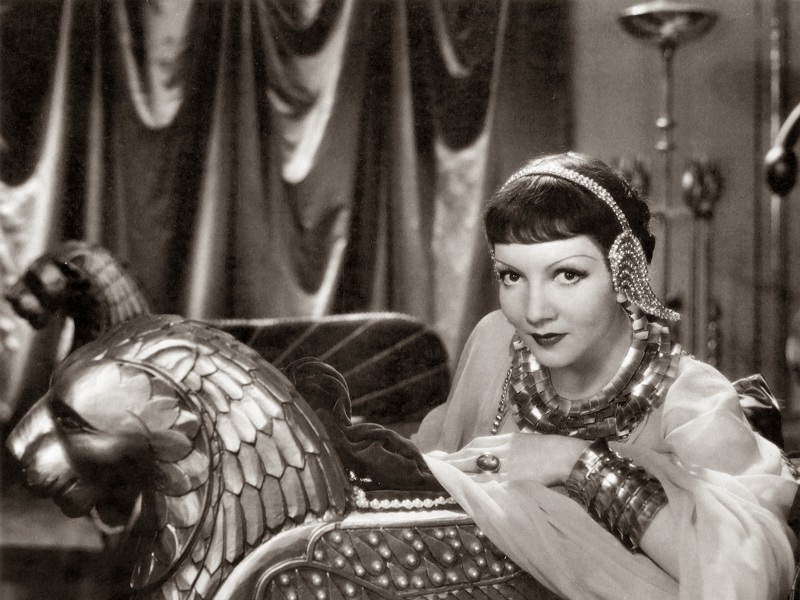
'Cleopatra' Was a Defining Role for Colbert


"Women should be but toys for the great. It becomes them both."

Cleopatra (Claudette Colbert)

For all intents and purposes, Cleopatra was the last pharaoh of ancient Egypt. She was survived by her teenage son for about a week and a half. That made him the last pharaoh — technically — but his rule was spent in captivity and ended with his apparent execution.

More than 2,000 years after her death, Cleopatra is still a fascinating figure in the West. She has been portrayed countless times on the stage in Shakespeare's play "Antony and Cleopatra" and Jules Massenet's opera "Cléopâtre," and she has been portrayed in numerous films, TV productions and video games. She is regarded as one of history's great beauties; she was seen that way by her contemporaries, too.

Thus, it wasn't surprising when one of the big screen's great beauties, Elizabeth Taylor, was cast as Cleopatra in 20th Century Fox's lavish 1963 production.

But I felt that Claudette Colbert's version of "Cleopatra," which was released 80 years ago today, was as good as — if not better than — Taylor's. Just, well, different.

I know I will get arguments about that, but hear me out. As nearly as I could tell, both movies told the same story and emphasized mostly the same events; the '63 version took a lot longer to do it and, when adjusted for current dollars, may have been the most expensive movie ever made.

The role of Cleopatra may well have defined Colbert more than her role in any other movie.

The '34 version may have been guilty of focusing strictly on Cleopatra and not paying as much attention to the men around her — or some of the facts — as the '63 version did. It was Colbert's movie — whereas Taylor, who had already won an Oscar, shared the screen and the credits with two other well–known actors, Richard Burton and Rex Harrison.

I don't know if Colbert is considered one of the screen's great beauties (or even if she was seen as such in her own time), but I do know some of her roles made her something of an early sex symbol.

(That includes her performance in "Cleopatra," although, personally, I have always thought she resembled Lilith Sternin from Cheers! and Frasier in that one.)

Although I have never seen it, I have heard that Colbert's bare breasts could be seen briefly in 1932's "The Sign of the Cross" in a scene that I have heard was a primary catalyst for the strict enforcement of the Hays Code.

When it asserted itself as the authority over movies in the United States, the Motion Pictures Producers and Distributors of America (MPPDA) prohibited, among several other things, "licentious or suggestive nudity — in fact or in silhouette; and any lecherous or licentious notice thereof by other characters."

Colbert's "Cleopatra" was made when the Hays Code was just beginning to flex its muscles — and producer/director Cecil B. DeMille pushed some boundaries.

Colbert was dressed in skimpy costumes that might not have been permitted if the movie had been made only a few months later.

Was that historically accurate? I don't know. I doubt it, just as I doubt that the decor of ancient Rome was as art deco as it was in DeMille's "Cleopatra."

Certain concessions do seem to have been made to the moviegoers of 1934.

In another instance of pushing the envelope, a seemingly naked slave girl holding two incense burners could be seen in the opening credits. The indistinct lighting left much to the imagination.

Nudity was not the focus of "Cleopatra." Sex, however, was.

The emphasis really was on Colbert. The men were mostly props; none would be recognizable to modern movie watchers. Some were regarded as being among the best actors of their time, but they were really only there because Cleopatra needed a Marc Antony and a Julius Caesar — and she couldn't play all the roles.

As I say, I don't know if Colbert had a reputation as a sex symbol in 1934, but she was quite popular. She won an Oscar for her performance in "It Happened One Night," and that movie certainly featured the kinds of things that would seldom, if ever, be permitted on the big screen for another 35 years.

Colbert had quite a range as an actress, and playing Cleopatra was only one style of which she was capable — if the role can be confined to a single style. In one scene, Colbert's Cleopatra could be playful and flirtatious; in the next, she might well be cold and calculating.

If Colbert is remembered for anything, I suppose it is her flair for screwball comedy, and there were elements of that to be seen in her portrayal of Cleopatra.

If nothing else, I thought Colbert was having a lot of fun. Perhaps I was mistaken.

"Cleopatra" definitely was not a screwball comedy. But, when it was done, Colbert resolved never to be typecast in overtly sexual roles again.

That might have been the wisest career move for her. Colbert was nominated for two other Oscars but lost both (the first time to Bette Davis, the second time to Ingrid Bergman). She might not have been nominated at all if she had felt demeaned by her roles.

Did her role in "Cleopatra" demean her? Judge for yourself.

Wednesday, July 02, 2014

When the Hays Code Started Enforcing Movie Censorship


If "It Happened One Night" had been made a few months later, Claudette Colbert
might not have been able to get away with making this iconic scene.


Eighty years ago, the motion picture industry began enforcing the Hays Code, a production code informally named after Hollywood's chief censor, Will Hays.

The Motion Pictures Producers and Distributors of America (MPPDA), later the Motion Picture Association of America (MPAA), adopted the code in 1930, began enforcing it in 1934 and dropped it entirely in 1968 in favor of a ratings system, but, for nearly 35 years, the Hays Code acted as censor for motion pictures. What was acceptable (by implication) and what was not acceptable was spelled out in two lists — the "Don'ts" and the "Be Carefuls."

The Production Code was written by a Catholic layman and a Jesuit priest. As a result, it had decidedly Catholic undertones.

The "Don'ts" were 11 things that "shall not appear in pictures ... irrespective of the manner in which they are treated:"
Pointed profanity — by either title or lip — this includes the words 'God,' 'Lord,' 'Jesus,' 'Christ' (unless they be used reverently in connection with proper religious ceremonies), 'hell,' 'damn,' 'Gawd,' and every other profane and vulgar expression however it may be spelled;
Any licentious or suggestive nudity — in fact or in silhouette; and any lecherous or licentious notice thereof by other characters in the picture;
The illegal traffic in drugs;
Any inference of sex perversion;
White slavery;
Miscegenation (sex relationships between the white and black races);
Sex hygiene and venereal diseases;
Scenes of actual childbirth — in fact or in silhouette;
Children's sex organs;
Ridicule of the clergy;
Willful offense to any nation, race or creed.

Those were the things that were not allowed under any circumstances. Some probably were rarely, if ever, included in pre–1934 movies, but the Hayes Code went ahead and spelled it out, anyway.

The items on the "Be Careful" list could be permitted, but movie producers had to be very careful. Hence, the title. There were more than twice as many of those:
The use of the flag;
International relations (avoiding picturizing [sic] in an unfavorable light another country's religion, history, institutions, prominent people, and citizenry);
Arson;
The use of firearms;
Theft, robbery, safe–cracking, and dynamiting of trains, mines, buildings, etc. (having in mind the effect which a too–detailed description of these may have upon the moron);
Brutality and possible gruesomeness;
Technique of committing murder by whatever method;
Methods of smuggling;
Third–degree methods;
Actual hangings or electrocutions as legal punishment for crime;
Sympathy for criminals;
Attitude toward public characters and institutions;
Sedition;
Apparent cruelty to children and animals;
Branding of people or animals;
The sale of women, or of a woman selling her virtue;
Rape or attempted rape;
First–night scenes;
Man and woman in bed together;
Deliberate seduction of girls;
The institution of marriage;
Surgical operations;
The use of drugs;
Titles or scenes having to do with law enforcement or law–enforcing officers;
Excessive or lustful kissing.

By the late 1960s, the Hays Code had simply become unenforceable.

I majored in journalism. I worked for newspapers and a trade magazine. I have taught and am teaching journalism students.

And I have very strong opinions about censorship.

I understand that there are times when it is a necessary evil, but it should be severely restricted. If an exception to a general censorship policy is to be made, it should favor the one being censored, not the one doing the censoring.

Freedom of speech and freedom of the press were mentioned in the First Amendment to the Constitution for a pretty good reason. The Founding Fathers knew that those freedoms were — and are — essential.

Saturday, February 22, 2014

The First Movie to Sweep the Major Oscars


"I want to see what love looks like when it's triumphant. I haven't had a good laugh in a week."

Peter (Clark Gable)

There may have been movies that premiered before this date in 1934 that could be classified as screwball comedies.

But the genre really began to gain popularity when "It Happened One Night" premiered on this date in 1934. For all intents and purposes, I suppose, the screwball comedy was born 80 years ago today. (As a comedy, the American Film Institute ranks it eighth all time.)

And its influence can be seen in numerous movies in the decades that followed, even though the screwball comedy's heyday was in the 1930s. The blueprint for the genre — a headstrong, runaway heiress gets hooked up with someone, frequently a reporter, who can gain something from the relationship — has shown up in various forms over the years.

"Roman Holiday," for instance, had a runaway princess (Audrey Hepburn) in the company of a reporter (Gregory Peck) who needed a scoop to revive his career.

That, in a nutshell, was the plot of "It Happened One Night." (There were a few differences, but not many.)

But, because it was so different from other movies in the still–emerging motion picture art form, it didn't enjoy the enthusiastic support of some of its principal participants. Claudette Colbert, for example, had worked with director Frank Capra before, and the experience had not been pleasant. She wasn't going to work with him again, but she relented on the conditions that her pay be doubled and that her work on the project be done in time for her to take a planned vacation.

Capra claimed that Clark Gable was hesitant to participate in the project as well.

And Capra himself reportedly said it was "the worst picture in the world."

Ellie (Claudette Colbert): I'll stop a car, and I won't use my thumb!

Peter (Clark Gable): What're you gonna do?

Ellie: It's a system all my own.

Thus, it caught just about everyone by surprise when "It Happened One Night" became the first movie to sweep Best Picture, Best Actor (Gable), Best Actress (Colbert), Best Director (Capra) and Best Adapted Screenplay (Robert Riskin) at the Academy Awards. It was a feat that would not be duplicated for more than 40 years — until 1975, when "One Flew Over the Cuckoo's Nest" won all five Oscars.

Modern movie viewers who have watched other movies from the 1930s undoubtedly will notice that "It Happened One Night" was more daring than its contemporaries, and there is a good reason for that. "It Happened One Night" was made just before enforcement of the Motion Picture Production Code (also known as the Hays Code for Will Hays, Hollywood's censor–in–chief of the day) began.

Consequently, there was more of a sense of freedom in "It Happened One Night" than there was in most of the screwball comedies of the 1930s. Certainly, there was more bare skin than one sees in most movies from that decade. No nudity, but scenes in which skin — like Gable's bare chest and Colbert's bare leg — was shown.

In other movies of the '30s (and for decades after), you rarely, if ever, saw an unmarried couple sleeping in the same room, much less the same bed (even married movie couples didn't do that).

Gable and Colbert didn't sleep in the same bed, but they did sleep in the same room.

And they used a clever strategy for maintaining their individual privacy — they hung a blanket between the beds.

Peter (Clark Gable): Remember me? I'm the fellow you slept on last night.

Ellie (Claudette Colbert): You needn't concern yourself about me. I can take care of myself.

Peter: You'll never get away with it, Miss Andrews.

I never understood the objections that some actors had to the quality of the script. I thought it was smart, clever.

To be fair, some movie stars who turned down the roles that ultimately went to Gable and Colbert claimed that the actual script in the movie was not the same script they had been shown.

Be that as it may, there was an undeniable chemistry between Gable and Colbert in "It Happened One Night," and that more than anything else made it such an appealing movie.

The story transcended global politics — both Josef Stalin and Adolf Hitler were said to be fans of "It Happened One Night."

They weren't the only ones. Before "It Happened One Night" swept the Oscars, it swept the country. It was a smash hit for Columbia Pictures. Made for an investment of $325,000, it earned $2.5 million at the box office.

It's hard to imagine a better return on your investment in 1934.

Wednesday, October 09, 2013

A Remake By Another Name


Most movie remakes are, to borrow from Yogi Berra, like deja vu all over again.

And "Mogambo," which was released 60 years ago today, was no exception.

Many years ago, I was watching a movie from the early 1930s on the late, late show called "Red Dust." I had never heard of it before, but I saw it in the listings, noticed that Clark Gable was in it, and decided to watch it.

When I did, I had the feeling that I had seen and heard the story before — and I had. It was, essentially, the same story with only a few deviations. The first movie was set in Indochina, the second was set in Africa, but darn near everything else was the same.

Well, except for one big thing. "Red Dust" had more energy, more sizzle. In spite of the improvements in filmmaking that had occurred in a couple of decades, "Mogambo" lacked something. "Red Dust" made "Mogambo" seem tame.

In "Red Dust," Gable was the overseer of a rubber plantation. In "Mogambo," he was a safari leader.

In both, he was the center of attention from two women, a primary love interest (Jean Harlow in the first, Ava Gardner in the second) and a married woman as a secondary love interest (Mary Astor in the first, Grace Kelly in the second).

Frankly, it was kind of disappointing. I mean, I would have expected this kind of setting with Gable, Gardner and Kelly — and director John Ford behind the camera — to be a cinematic slam dunk, but it really wasn't. Not compared to what it could have been.

Everything turned out the way viewers probably secretly hoped they would — Gable wound up with Gardner, and Kelly remained with her husband. The movie might have been made in Africa, but it was a Hollywood production.

In real life, I've been told, Gable and Kelly had an off–screen relationship that fizzled when their age difference (Gable was more than 28 years older) became too great to ignore.

On screen, though, the sparks — such as they were — were between Gable and Gardner, not Kelly.

I've often wondered if the so–called Hays Code was the reason "Mogambo" was so uninspiring, at least when compared to "Red Dust." The Hays Code imposed restrictions that would seem prudish compared to modern movie standards. "Red Dust" was made in the early days of the Hays Code, when movies could still get away with things they wouldn't be able to get away with for decades.

Perhaps that isn't fair. "Mogambo" did have some things going for it — it was shot on location, for one thing. "Red Dust" wasn't filmed in Indochina — it was filmed on a studio backlot in Hollywood, as I understand it — but Americans wouldn't be familiar with Indochina for another 35 years so it really didn't matter. I'm sure the studio heads figured no one would know the difference, and they were probably right.

Most Americans probably weren't too familiar with Africa, either, in 1953, but they likely had more of an idea of what Africa should look like than they did of Indochina.

Whether they did or not, what they got in "Mogambo" was the real thing, and the cinematography really was remarkable for its time. At the Academy Awards, though, Gardner and Kelly were rewarded with nominations, but the technical aspects were entirely overlooked.

And that, I think, is a shame. Gardner (nominated for Best Actress) and Kelly (nominated for Best Supporting Actress) were good, but I've seen both perform better. Gable wasn't nominated at all, and I have no problem with that. His role in "Mogambo" wasn't one of his best performances.

The material in "Mogambo" wasn't terrible — but neither was it great, and, while I have heard some people describe Gardner's performance as the best of her career, I'm inclined to think that several other performances were better.

I've always felt that Kelly was a rare mix of beauty and talent. There was a vulnerability to her performances that was very appealing, and I thought that vulnerability may never have been so striking as it was when Kelly played the young and lusty Linda of "Mogambo." Her character projected a cool reserve, but there was a smoldering sensuality beneath it.

I guess you could say that about all the roles she played — especially her roles in Hitchcock movies, which always seemed to bring out that quality in her performances.

It was still early in her career, though, and Kelly played a character that was a lot like the one she played a year earlier in "High Noon." She didn't begin to show her range as an actress until a year later, when she made "The Country Girl," for which she received her only Oscar.

I guess the biggest problem I had with "Mogambo" was that it never really made up its mind whether it was going to be a love story or an adventure movie. Ford seemed to want to make "Mogambo" a story worthy of Hemingway — and there were plenty of jungle scenes — but the star power of the cast seemed to pull him back to the love triangle.

In the end, I guess you could say the love triangle won. Again, this is a Hollywood production we're talking about.

But sometimes I think it was more of an adventure story. That's the real problem with remakes.

Tuesday, August 23, 2011

Finding the Right Track


Nearly 15 years ago, Roger Ebert observed that "The Big Sleep," which premiered on this date in 1946, was "about the process of a criminal investigation, not its results."

Considering the movie's rather tortuous tale, that is an important distinction to keep in mind.

In the interest of entertainment, movies and TV shows usually spare audiences the more mundane details of a criminal investigation — and ordinary viewers probably would be amazed at just how many insignificant details there can be.

I never participated directly in such an investigation, but, when I was a newspaper reporter covering the police beat, I knew several of the city and county investigators and I know how many undramatic dead ends and red herrings they often had to pursue before they finally found themselves on the right track — if they ever did.

Investigators, after all, are human. They make mistakes, and they can find themselves on the wrong track very easily, especially when there is pressure on them to solve a high–profile case quickly.

I guess the process for investigating criminal activity — like the processes for making laws and sausages — isn't very glamorous. It is messy. It can get pretty ugly at times.

Anyway, I suppose the gauzy, almost dreamlike opening of "The Big Sleep," with the shadowy figures of Humphrey Bogart and Lauren Bacall and the blurry–then focused–then blurry again title and names of the cast members, should have been an early indication of what audiences could expect.

Well, perhaps not. Little was clear in "The Big Sleep" even after one watched it all the way through. Besides, the same technique was used in "The Maltese Falcon" just five years earlier — and it was a hit. (Bogart himself said "The Maltese Falcon" was a masterpiece.)

"The Big Sleep" and "The Maltese Falcon" had a lot in common. They were both film noirs, and both were adaptations of novels by noted writers. A significant difference between the two, however, was that "The Maltese Falcon" was pretty straight forward in its resolution, and "The Big Sleep" was not.

I guess a certain amount of ambiguity was unavoidable. When the movie's screenwriters were making their adaptation for the screen, they ran into a number of problems — not the least of which was the fact that the writers could not tell if a character had been killed by someone else — or himself.

All that was really clear was that he was dead.

In an attempt to resolve the issue, the writers wired the author, Raymond Chandler, with their question, but he couldn't shed any light on it.

The screenwriters encountered other problems adapting the book in a way that would conform to the requirements of the Motion Picture Production Code — also known as the Hays Code — which was the set of guidelines that determined whether a film was acceptable.

Movie studios and all the people who worked for them were, understandably, eager to remain in the Hays Office's good graces — but sometimes that was easier said than done.

And there definitely were elements of Chandler's story that were problems for screenwriters.

Originally, the character of Carmen (played by Martha Vickers in the movie) was the killer, but then the character of her sister Vivian (Bacall) would have been an accessory to murder, which would have been contrary to the Code. Consequently, the story was rewritten for the screen to cast suspicion on another character, a small–time criminal played by John Ridgely.

In the process, the writers created considerable uncertainty about who the killer really was — uncertainty that persists to this day.

The book also presented some sexual issues with which the writers had to deal.
  • One character in the book sold pornography (which was affiliated in those days with organized crime) and was homosexual to boot.

    For the screen, the pornography part could only be mentioned indirectly. Sexual orientation wasn't mentioned at all.
  • In the original book, Carmen was nude in one character's home and in another character's bed. That wouldn't do, either. She had to remain completely clothed, and her promiscuity could only be mentioned indirectly as well.

    (A memorable line from early in the movie had Bogart telling Carmen's father that she "tried to sit in my lap while I was standing up.")
The timing of the movie's release posed other problems. Filming was completed around the end of World War II, but the studios of the day, fearing that interest in war movies would start to wane, decided to strike while the iron was hot and dumped their films with war themes into the marketplace all at once, delaying the release of less time–sensitive movies like "The Big Sleep." Thus, "The Big Sleep" was not released until this day in 1946 — even though it was ready in 1945. Well, "ready" really isn't the right word, is it? I mean, with the additional time, the screenwriters might have thought of more plausible rewrites and scenes could have been re–shot, perhaps ridding the movie of much of its ambiguity. At the very least, there were issues of timeliness that made the movie seem dated even in 1946 — some of the wartime dialogue could have been changed (i.e., references to rationing), and some scenes could have been re–shot so the sets could be more contemporary (with photos of Harry Truman, who had been president for more than a year, instead of FDR on office desks and walls). But the extra time was not used that way, and the movie that was released in 1946 was the same one that was completed in 1945. Timeliness was not the priority for "The Big Sleep" in 1946 that it had been for all the war pictures that were in the theaters in 1945. The Bogart–Bacall relationship was promoted rather heavily after being more or less introduced to the public two years earlier in "To Have and Have Not." The two were married by the time "The Big Sleep" was released, and the studio eagerly embraced the public's apparent acceptance of the union. As you can see in the poster at the left, the Bogie–Bacall angle was emphasized in the movie's promotion 65 years ago. Little was said about the author of the original story. It was Chandler's first novel — and a pretty good one at that (in 2005, TIME named it one of the 100 best novels of all time). Bogart was a quarter–century older than Bacall (who is still alive), and, in some circles, Bogart was seen as more of a mentor and Bacall was seen as an eager young student than as traditional spouses. I don't know what the truth was about their relationship, but it lasted until Bogart's death in 1957, and they made two more movies together, "Dark Passage" and "Key Largo."
Clearly, it was a partnership that worked.