Showing posts with label Geraldine Fitzgerald. Show all posts

Tuesday, April 22, 2014

Bette Davis' Victory Over the Dark


"Nothing can hurt us now. What we have can't be destroyed. That's our victory — our victory over the dark. It is a victory because we're not afraid."

Judith (Bette Davis)

(1939 is widely regarded as the greatest year ever for the motion picture. Ten movies were nominated for Best Picture that year, and today I take a look at the fourth of those 10 movies to hit the theaters.)
"Dark Victory," the Hal Wallis–directed movie that premiered 75 years ago today, had a star–studded cast — but anyone who comes across it while channel surfing and hopes to see a lot of Humphrey Bogart or Ronald Reagan or George Brent or Geraldine Fitzgerald will be disappointed.

Well, I suppose Brent had more screen time than the others. Not only was he Davis' doctor, but they got married as well. Still, this was purely a Bette Davis vehicle. The others were there, I suppose, because it couldn't be a one–woman show. They had their parts to play, and they played them well.

But make no mistake about it: "Dark Victory" was Davis' movie.

It was a bit melodramatic for my taste. Davis played a young heiress who likes horses, fast cars and partying. She's been ignoring headaches and dizzy spells, but when her vision is affected, she goes to see a doctor (Brent).

It is determined that Davis' character has an inoperable brain tumor. The diagnosis is confirmed by experts.

It is at this point that one sees a big difference between the way patients were handled in the 1930s and the way they are treated today.

In "Dark Victory," the option of deliberately concealing Davis' terminal condition from her is openly discussed by her doctor and best friend (Fitzgerald). It is even the strategy that is used for a time — until Davis' character learns the truth on her own.

I have to think that, in the 21st century, doctors would advocate being honest with their patients, even when the truth is unpleasant, and most patients probably want to play active roles in their treatment, to make choices as long as possible.

Still, it was consistent with a general theme of denial. Early in the movie, Davis' character ignores warning signs; it is never mentioned whether she might have been saved if a doctor had been aware of those symptoms earlier. Perhaps medical science had not found a preventive measure for that condition — perhaps it still hasn't — and medical personnel of that time believed it was kinder to ignore a terminal condition than confront it with the patient.

In the end, Davis' character clung to her denial strategy, sending her husband off knowing that she would soon be dead but never acknowledging the gravity of her condition. (You'd think that, being a physician, especially the one who made the original diagnosis, her husband would be aware of her declining condition. But he never showed any sign of that in the movie.)

I suppose that is in keeping with a long–standing American tradition of suffering in silence.
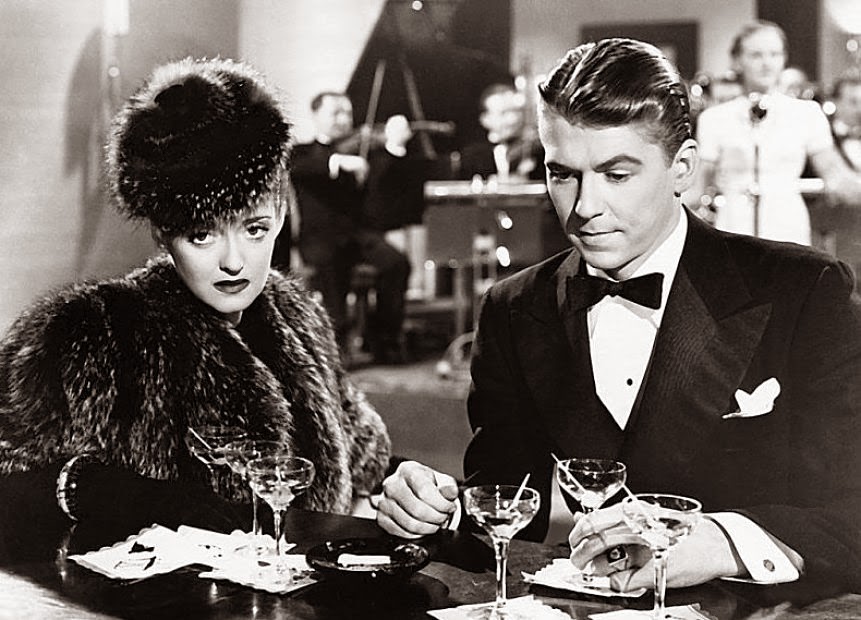
Frank Nugent wrote in the New York Times that "[a] completely cynical appraisal would dismiss it all as emotional flim–flam ... But it is impossible to be that cynical about it."

Perhaps that makes me cynical then. I found the story to be, as I have said, melodramatic. Davis was nominated for Best Actress, but when I first watched "Dark Victory," I felt she was guilty of overacting — and, in hindsight, I am glad Vivien Leigh won for "Gone With the Wind."

Leigh's was a better performance, anyway.

Sunday, April 13, 2014

What If ...?


"If he loved you with all the power of his soul for a whole lifetime, he couldn't love you as much as I do in a single day."

Heathcliff (Laurence Olivier)

(1939 is widely regarded as the greatest year ever for the motion picture. Ten movies were nominated for Best Picture that year, and today I take a look at the third of those 10 movies to hit the theaters.)
Emily Brontë would have been a terrific writer for Twilight Zone if such a thing had existed in the 19th century. Her book "Wuthering Heights" and the first of four movie adaptations based on it are perfect examples.

Of course, the William Wyler–directed movie, which premiered 75 years ago today, differs from the book. It told the story of the romance of Heathcliff and Cathy, to be sure, but it said nothing about their children, who play significant roles in the end of the book. In fact, in the movie, Heathcliff and Cathy have no children.

Having read the novel many years ago, I am inclined to think the book really was the Gothic romance it is said to be, but the movie was something different, largely because it left out that second generation stuff.

It was useful as a cautionary tale, I suppose, about jealousy and hostility.

There was also a certainly element of dishonesty — I suppose filmmakers would call it creative license. Although the story was set in the Yorkshire moors of northern England, the filming was done in California. That is the sort of thing that is done all the time, I guess, and is easily excusable, but, given the location of Yorkshire, I would have expected to hear more of a Scottish accent than I heard from the cast. All British accents are not the same.

Another thing: When I saw "Wuthering Heights" for the first time on some movie channel, I felt that there wasn't the kind of chemistry — perhaps passion is a better word for it — between Heathcliff (Laurence Olivier) and Cathy (Merle Oberon) that would be expected.

If I didn't simply imagine that, perhaps it was because Olivier had wanted Vivien Leigh, his lover and future wife, to be his co–star. But Leigh was not yet a major star — she became one when "Gone With the Wind" came out later that year — and producer Samuel Goldwyn opted for Oberon.

Or was that the reason?

If legend is to be believed, Olivier and Oberon did not like each other, to put it mildly, and I'm kind of inclined to wonder whether Oberon was more of a star than Leigh at that point, but I'm also inclined to think that star power wasn't the driving force. Hungarian producer Alexander Korda had sold half of Oberon's contract to Goldwyn so casting her in the role of Cathy may have been purely a financial decision.

Frankly, Oberon never matched the mental image I had of Cathy when I read the book. If I could have chosen, I probably would have chosen Leigh to play the role. She came much closer to being the Cathy I imagined.

It's intriguing, isn't it, to think of how different movie history might have been.

If Oberon had not been cast in the role of Cathy, if the part had gone instead to Leigh, who would have played Scarlett in "Gone With the Wind?"

"Wuthering Heights" almost certainly would have had more passion — and might well have won Best Picture and/or other Oscars it lost, too. It was nominated for eight Oscars as it was — and actually won one, for black–and–white cinematography.

But it lost Best Picture, Best Director, Best Actor and Best Supporting Actress (Geraldine Fitzgerald) as well as nominations for screenplay, score and art direction. Five of those awards went to "Gone With the Wind."

Some still recognize "Wuthering Heights" as one of the great movies of its type. The American Film Institute ranked it 15th on its all–time list of romance movies.

1939 was a banner year for movies, half a dozen of which made AFI's Top 100 romance list, but only one — "Gone With the Wind" — rated higher than "Wuthering Heights."

If Leigh, not Oberon, had co–starred with Olivier, would their screen passion have changed movie history? Or, at least, the order of some of AFI's lists?