Showing posts with label Rosemary Harris. Show all posts

Thursday, May 04, 2017

The End of the Spider-Man Trilogy


Sequels are seldom worthy successors to the originals.

Sometimes a second chapter is necessary only so it is possible to move on to a third. I have always thought that was the case with the "Back to the Future" movies, and I definitely feel that way about the "Spider–Man" movies, the third installment of which made its debut on this day in 2007.

As I observed yesterday, I liked the "Spider–Man" movie from 2002 — and I liked its second sequel, the one that premiered 10 years ago today. The second movie, which premiered in 2004, didn't have much going for it, as far as I was concerned.

(The third part of a trilogy isn't always so great. The third chapters of "The Godfather" and original "Star Wars" trilogies easily make that case.)

Not everyone felt that way. Film critic Roger Ebert and I frequently had similar reactions to movies — but not the "Spider–Man" trilogy.

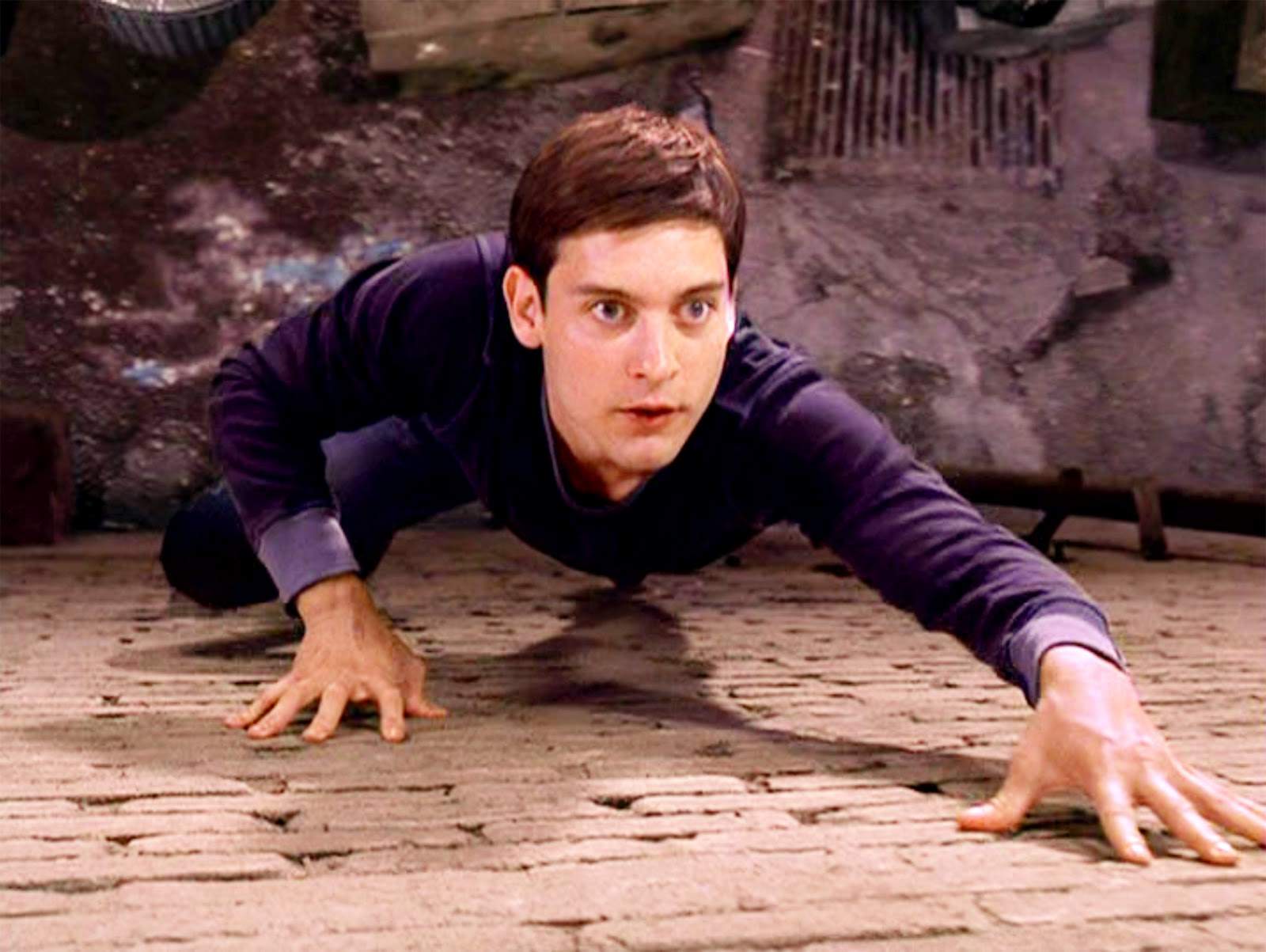
And it all seems to have hinged on the character of Peter Parker (Tobey Maguire). I had no problems with him, but Ebert apparently did.

"The great failing of 'Spider–Man 3' is that it failed to distract me from what a sap Peter Parker is," Ebert wrote. "It lingers so long over the dopey romance between Peter and the long–suffering Mary Jane [Kirsten Dunst] that I found myself asking the question: Could a whole movie about the relationship between these two twentysomethings be made? And my answer was: No, because today's audiences would never accept a hero so clueless and a heroine so docile."

I thought that was a bit harsh, considering that the movie's sole purpose was to entertain — not to make some profound statement.

Well, perhaps that wasn't its sole purpose. I wouldn't rule out the money motive. The original "Spider–Man" became the first movie to exceed $100 million at the box office in its first weekend on American movie screens. Its sequel, which was released in 2004, beat the original's opening–day record by $1 million.

It was logical to expect a similar response to the third movie, and it didn't disappoint — well, not entirely. It was the highest–grossing film of the three movies in the trilogy — but, although the DVD sales grossed more than $120 million, they still came up short of expectations.

Anyway, Ebert and I were never on the same page on the "Spider–Man" movies. He didn't like the first and third movies; I did.

On the other hand, he did like the second movie. "Now this is what a superhero movie should be," he wrote of that first sequel. I thought the only purpose for the second movie (other than to make a lot of money) was to be a bridge between the first and second movies. I still think that, for that matter.

Go figure.

Anyway, I can kind of understand where some folks were coming from in their criticism — the ones who complained that there were too many stories going on at once.

Yes. There were quite a few stories being told.

There were the continuing stories dating back to the original movie — of Peter Parker and M.J., of Parker's newspaper career and his editor (J.K. Simmons) and of the son of the Green Goblin (Willem Dafoe), whose spirit urged his son to seek vengeance (and tried to do so through M.J.).

And there was some new stuff. There was Bryce Dallas Howard (Ron Howard's talented and beautiful daughter) who played Parker's lab partner and temporary love interest.

There was also the introduction of a new villain, played by Thomas Haden Church, who, as it turned out, had been responsible for the death of Parker's uncle (Cliff Robertson). His aunt (Rosemary Harris) was back.

Yep, there was a lot going on. Nothing neat and orderly about it. But isn't that the burden of a superhero?

Wednesday, May 03, 2017

Spinning Spider-Man's Web on the Big Screen


I was never a devotee of comic books.

Oh, sure, there were some I would read when I was a kid — but not regularly. I could take 'em or leave 'em.

I always preferred the comic books that made me laugh as opposed to the ones that I judged to be dramatic, more serious in nature.

It was in that category that I would put characters like Superman, Spider–Man, etc. It seems to me that superheroes are, almost by definition, about serious stuff, and their fans are deadly serious about them. I've known people who were really into the superhero thing. I even worked with a guy once who was petrified of spiders but loved the character Spider–Man. Go figure.

That might explain why I liked the "Super–Man" movie that made its debut on this date in 2002 — even though many people seem to prefer the version from 2012. I've never seen that one, though, so I can't be making any kind of comparison except based on what I've heard from others.

That wouldn't be a satisfactory answer, either, though, because the general consensus seems to be that the 2012 version was better. And it may well have been.

I just felt thoroughly entertained by the version that premiered 15 years ago today. It may not have had the special effects that were available a decade later, but movies have always been that way. They've always had to compensate for the things they didn't have or couldn't do.

"Spider–Man" told a good story. That always makes up for a lot with me. It was like watching a comic book, frame by frame, on the movie screen. I could almost see the balloon dialogue between the characters.

Except there was a difference.

Comic books have always seemed scripted to me. In real life, people aren't usually as quick on their feet as they appear to be in a book, comic or otherwise. In real life, humans sometimes (often, in fact) need at least a little time to absorb what they have heard or seen before making a response — which is rarely as impressive as what appears in print. Books, comic or otherwise, may be intended to appear spontaneous, and many may succeed even though they almost certainly went through several lengthy revisions.

But the acting in "Spider–Man" always had just enough of those human pauses for entirely plausible intervals to make things seem spontaneous — even though the movie was just as scripted as the book(s), comic and otherwise.

Although it might have lacked as much action as Millennials prefer, I thought it was a good call to spend the first half of the movie essentially exploring the character of Peter Parker (Tobey Maguire) rather than assuming that everyone who saw the movie already was familiar with his story. It helped to establish that he had been a neighbor of Mary Jane (Kirsten Dunst) since he was 6 and, by his own admission, had been in love with her all that time.

It was certainly a good call as far as Maguire was concerned. It was the movie that made him a star.

Film critic Roger Ebert and I frequently agreed in our assessments of movies, but we never saw eye to eye on the "Spider–Man" franchise.

Ebert, for example, thought Maguire was miscast. I did not.

"Imagine 'Superman' with a Clark Kent more charismatic than the Man of Steel," Ebert wrote, "and you'll understand how 'Spider–Man' goes wrong. Tobey Maguire is pitch–perfect as the socially retarded Peter Parker, but when he becomes Spider–Man, the film turns to action sequences that zip along like perfunctory cartoons."

I suppose that was the quality I liked best. I always see comic books when I see suuperheroperhero movies, anyway. For me, that made Maguire ideal for the role.

And, although their roles were supporting, Cliff Robertson and Rosemary Harris were well cast as Maguire's aunt and uncle.

Willem Dafoe was perfect as Norman Osborn, the father of Maguire's best friend and a bit of a mad scientist who became Spider–Man's nemesis, the Green Goblin.

I guess the thing about the movie to which I objected was the portrayal of the newspaper editor. Now, I like J.K. Simmons, who played the part. I especially like him in his television role in the Farmers Insurance commercials.

It is likely that he had little input into the character, but I thought it was an unrealistic portrayal. I have worked for several newspapers — and, as a result, several editors. They all had their shortcomings, but they had their redeeming qualities, too. Simmons' character did not.

Tuesday, December 22, 2015

Not Exactly a Christmas 'Gift'


"Miss Wilson, I don't believe in what you do. I'll just be straight with you. Not only that, I don't like it. But, we've got to the end of the road of our investigation ... and looked under every rock there is to look under ... and we'd like you to tell us what you can to help us."

Sheriff (J.K. Simmons)

"The Gift," which premiered 15 years ago today, seemed to slip in beneath most people's radars. That is a shame because it really was a suspenseful tale.

Many of those who went to see it during the Christmas season in 2000 may well have expected to see a holiday–oriented tale if all they knew of it was its title. Boy, were they in for a surprise.

Cate Blanchett played a young widow, a psychic who did card readings for people in a small town in Georgia. In the early minutes of the movie, audiences must have been certain that Hilary Swank, who played a victim of spousal abuse, would be likely to turn up dead. Instead it was Katie Holmes, the fiancee of Greg Kinnear who was having torrid affairs with apparently everyone, who turned up missing.

It was enough to give anyone a headache — and then there was Blanchett's long–dead grandmother (Rosemary Harris) who popped up to remind her to trust her instincts.

There were enough creepy things going on to make sure everyone knew this wasn't a Christmas movie.

Now before I proceed, I should try to address what I see as a conflict in terminology. I said that Blanchett played a psychic although I suppose when I was a child I would have called her a fortune teller because questions about the future are what card readings always seemed to me to be about when I was growing up. You know, questions like will I fall in love and get married? or will I be successful? Magic 8–Ball stuff.

And I gather that Blanchett's character did her share of that with many of her clients, but the clients the audience saw were always having their pasts revealed — Swank's abuse as well as the abuse of another character, Buddy (Giovanni Ribisi), who had been abused as a child by his father.

My point is that I'm not sure if psychic and fortune teller mean the same thing or different things.

It is in the area of revelation of the past that I associate the term psychic — if only because I hear from time to time of psychics being brought on to help criminal investigators who have run into a wall in their probes into disappearances.

That is what happened in "The Gift."

Holmes' disappearance brought Blanchett into the apparently stalled investigation. She had a vision of Holmes being attacked and killed and then thrown into a pond on property belonging to Swank's husband (Keanu Reeves), and that led to Reeves' arrest and eventual conviction after Holmes' body was retrieved from his pond.

This brings me to one of my quibbles with the movie. It appeared that Reeves was arrested, then almost immediately put on trial. I know the Constitution guarantees every defendant the right to a speedy trial, but that is much faster than the legal process usually works.

(Speaking as someone who, like many novice reporters, covered police and fire beats, things don't happen as quickly as they seem to happen in the movies.)

But Reeves' character wasn't guilty, as Blanchett learned in another vision, and she went to the prosecutor (Gary Cole) to ask him to reopen the case. She couldn't see who the killer was, she said, but there seemed to be no shortage of prospects, including Swank, who knew that Holmes had been sleeping with her husband and, consequently, "she deserved what she got."

Such can be the moralizing posture of a small Southern town.

When I saw "The Gift," I was inclined — and I still am — to think of it as being successful in its bid to be suspenseful, in no small part because of the cast that was assembled. Otherwise, though, I kind of felt it became a rather predictable whodunnit in the second half of the movie.

Film critic Roger Ebert was more glowing in his praise. "The movie is ingenious in its plotting, colorful in its characters, taut in its direction and fortunate in possessing Cate Blanchett," Ebert wrote. "If this were not a crime picture (if it were sopped in social uplift instead of thrills), it would be easier to see the quality of her work. By the end, as all hell is breaking loose, it's easy to forget how much everything depended on the sympathy and gravity she provided in the first two acts."

There is truth in that.

Blanchett's character provided a balance in the telling of the story — at one point Buddy told her she was the "soul" of the town, and I think the same could be said of her influence on the movie.

But what many people — mostly, I suppose, adolescent males — found and still find memorable about "The Gift" was it contained Holmes' first nude scene.

Ebert's opinion notwithstanding, the movie received no recognition from the Oscars — doesn't seem to be too surprising. The Oscars seldom give nominations to comedies or supernatural thrillers.

That doesn't mean, of course, that they aren't worthy of recognition. It's merely a long–standing Academy bias.