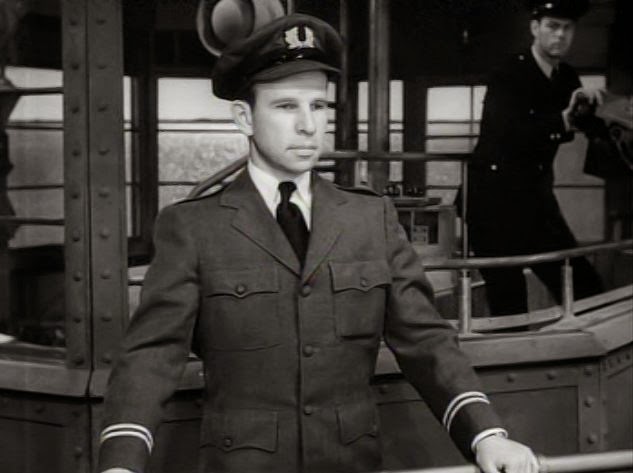
Robert Taylor often turned in vapid performances, but that was not the case in "High Wall," a rarely remembered film noir that premiered on this day in 1947.
Taylor's character, a decorated war veteran, found himself in a situation like The Fugitive of the classic 1960s TV series. His wife was dead, and he stood accused of her murder, but he insisted he was innocent and tried to find the real murderer.
Initially, Taylor caught his wife being unfaithful to him with her boss (Herbert Marshall), and she ended up being strangled. All evidence indicated Taylor was responsible. He tried to kill himself by driving his car into the river, but he survived and was sent to a psychiatric hospital. He had no memory of what had happened to his wife, possibly due to an injury he suffered during the war.
It was strongly suggested that Taylor could be cured by surgery, but he refused, preferring to remain in the hospital rather than facing conviction of his wife's murder. It was only after he learned that his young son would be sent to an orphanage that he changed his mind.
In an attempt to cure his amnesia, Taylor tried to re–create the scene of the crime with the help of a doctor (Audrey Totter), who doubted his guilt and became his staunchest ally.
It is probably appropriate at this point to say a word or two about Totter. I have watched a fair number of film noir movies in my life, and Totter was frequently cast in them. She usually played a bad girl, but this time she played against type.
I have always found Totter to be an underappreciated talent. She appeared on the silver screen with many of the top stars of her day, but her kind of character fell from favor in the 1950s, and she gravitated to television, where she found steady work.
She was always good, but she may have delivered her best film noir performance in "High Wall."
The whole cast was at the top of its game, but particular mention should be made of Marshall, who was suitably creepy in his role.
But I have learned that you will never find unanimity in anything, and so it is with this movie — or at least the individual performances. I know one person, for example, who thought Taylor's performance was the redeeming feature of a movie in which Totter was a cold fish and Marshall was miscast. That was precisely the opposite of my reaction — and the reactions of most of the people with whom I have discussed "High Wall."
"High Wall" also introduced audiences to a term with which many were still not familiar in 1947 — sodium pentathol or "truth serum."
"I sell gasoline. I make a small profit. With that I buy groceries. The grocer makes a profit. We call it earning a living. You may have heard of it somewhere."
Jeff (Robert Mitchum)
One of my favorite Paul Simon songs never made much of a ripple on the radio but rode "50 Ways to Leave Your Lover" to the top of the charts as its B side — "Some Folks' Lives Roll Easy."
"Out of the Past," which debuted on this day in 1947, always makes me think of that song.
Because, as the song says, some folks' lives do roll easy, and "some folks' lives never roll at all." Some people follow straight trajectories onward and upward to the top (or, at least, in that general direction); most of us, I guess, have something in our pasts from which we're trying to escape.
In director Jacques Tourneur's "Out of the Past," Robert Mitchum was trying to break free from his past as a private investigator. But, like Al Pacino in "The Godfather Part III," he kept being pulled back in.
The story line doesn't exactly roll easy, either, but that is what might just make "Out of the Past" one of the best film noirs of all time — maybe even the best. Don't sit back to watch this with a beer in your hand, though. You'll need all your wits about you to keep up with the twists and turns in this one.
You'll find it is worth it.
There is an intriguing dynamic between Mitchum and Kirk Douglas, who were distinctly different in their styles. In a typical film noir way, the movie reeks with symbolism from the (literally) dark scenes to the clear cinematic triangle of good–guy Mitchum, bad–guy Douglas and femme fatale Jane Greer.
Douglas was a gangster, and Greer was his mistress. Douglas alleged Greer had shot him and stolen money from him; Mitchum, as a private investigator, had been hired to track her down.
After he found Greer, Mitchum became infatuated with her and ultimately confessed that he had been hired to find her. This did not come as a surprise to Greer; in fact, she had suspected as much and had been preparing her story all along.
And what a story it was. She denied stealing Douglas' money and urged Mitchum to run away with her. But Mitchum discovered that she was a liar and a killer.
Then the story got complicated ...
It is probably important to note that much of the story was told through flashbacks. After Mitchum and Greer eventually split up and Mitchum tried to start over again as a gas station operator, part of his new life involved a new girlfriend. This one, played by Virginia Huston, was much nicer, a real girl next door, and it was to her that Mitchum told the story as they were driving to meet with Douglas.
"She can't be all bad," Huston said at one point. "No one is."
"She comes closest," Mitchum replied.
His character was right about that. Greer had the qualities of a great femme fatale — on the screen as in life, a true femme fatale has no remorse for anything she does. She is completely self–centered, and she is beautiful and seductive enough that any man, even ones as smart and as tough as the ones with whom she was involved in "Out of the Past," could fall for her.
Although uncredited in many of his early films, Mitchum was known largely as a film noir actor at first. In hindsight, he seems like a natural choice for the role in "Out of the Past," but he was the fourth choice to play the part. Humphrey Bogart was the first choice, and by all accounts I have read he wanted to play it, but Bogart was under contract to Warner Brothers and RKO Pictures owned the rights to "Out of the Past."
John Garfield and Dick Powell turned down the role, and it went to Mitchum.
"You know, it's wonderful when guys like you lose out. Makes guys like me think maybe we got a chance in this world."
Vincent Parry (Humphrey Bogart)
I like all four of the movies that Humphrey Bogart and Lauren Bacall made together — each for a different reason.
And the reason I like "Dark Passage," which premiered on this day in 1947, is simple. It was the most creative of the four.
For about the first half of the movie, the audience never saw Bogart's face. A few times the viewers saw the figure of a man, but they could not see his face. They saw a photograph of a man in the newspaper who was supposed to be Bogart — but definitely was not Bogart. In fact it was a picture of character actor Frank Wilcox, who made a name for himself on TV.
Bogart played a man who had been convicted of killing his wife and escaped from prison. He got some assistance from Lauren Bacall, who, as it turned out, had been interested in his case and had attended his trial — although Bogart's character hadn't known that at the time.
AS I say, for the first hour of the movie, Bogart's face was not visible, which was a source of considerable anxiety for studio head Jack Warner. Bogart was Warner's most bankable star, but no one saw his face for more than an hour. Either things were seen from his perspective or his face was hidden by bandages after he got plastic surgery, which radically altered his appearance — as long as you believed that picture really was a pre–surgery photo of that character.
Once she helped Bogart remove the bandages, Bacall essentially disappeared from the story. She returned at the very end.
Bogart, meanwhile, had to fend off a blackmail attempt — in so doing, he learned the truth about who had killed his wife and his closest friend. It was Agnes Moorehead, Bogart's spurned lover who had testified against him in court.
Bogart's character wanted to record Madge confessing, and he had an advantage in that she didn't know who he was with his new face. He went to her home, posing as someone with a romantic interest in her acting on a recommendation from a mutual friend.
After he had gained her confidence and been allowed into Madge's home, he revealed his true identity to her. He told her that he had evidence proving her guilt, hoping to coerce her into making a confession, but she ended up falling from a window to her death, never having confessed.
"Dark Passage" was truly an exception to the theatrical rule. I'm not talking about how most of the first half of the movie was seen from Bogart's point of view. I'm talking about how that part was supported by first–person narration, not in the flashback kind of way that was used in movies like "Sunset Boulevard" but as a real–time kind of thing. Few pictures, then or now, could do something like that from start to finish — and, to be fair, "Dark Passage" stopped doing it after the viewers were allowed to see Bogart's face.
Even though she was before my time, I am a fan of Marilyn Monroe.
My admiration goes beyond her obvious physical appeal. I think she was a talented actress, too, unappreciated during her life and still so decades after her death.
And I thought I had seen all of her movies — until one day a few years ago when I happened to see "Don't Bother to Knock" being televised. I realized I had never seen it before so I watched it. That movie, which premiered 65 years ago today, was definitive proof of talent that did not depend on good looks.
In that sense, I was reminded of Grace Kelly in "The Country Girl."
Like Kelly, Monroe was always beautiful, but there were variations to her beauty. Sometimes she was glamorous; in "Don't Bother to Knock," I guess her beauty was more understated. It would take concentrated effort to mar her beauty, but you could drape her in clothes that were rather plain and that would bring her beauty down a notch or two.
That, I would say, is what they did in "Don't Bother to Knock."
And Monroe reciprocated with a riveting performance.
It was part of her character. At first she came across as shy and demure. Her clothes were plain. Her demeanor was almost unassuming. But that was all deceptive.
Her character wanted to wear nice clothes and expensive jewelry. But she, like so many others then and now, did not feel she could ever have the finer things she desired. Some people turn to lives of crime to gain the things they want in life. When the audience first saw her in "Don't Bother to Knock," Monroe's character was content to take risks but not necessarily to commit crimes. Well, not exactly, but we'll come back to that.
She was Richard Widmark's love interest. He was on the rebound after being jilted by Anne Bancroft, who was the real glamour girl, a sultry lounge singer. Bancroft had had a fling with Widmark, decided it was one of those things and wrote him a Dear John letter. In this case, I guess you'd call it a Dear Jed letter.
Jed came to New York to try to talk Bancroft out of it, but she didn't budge. Back in his hotel room, Jed looked out his window and saw Monroe across the courtyard, wearing clothes and jewelry that belonged to her employers for the evening, an out–of–town couple (Jim Backus and Lurene Tuttle) who hired her to babysit their daughter (Donna Corcoran) while they were attending a banquet downstairs.
Widmark and Monroe agreed to have a liaison in Monroe's room. Widmark was unaware that the young girl was sleeping in the adjacent room until the girl walked in on them.
As the evening progressed, Widmark became more and more aware that Monroe's character was mentally unstable. At one point, he thought Monroe would push the child out an open window — modern audiences would probably be shocked to see no barriers of any kind on upstairs windows — no rails or bars or anything at a time when air conditioning was still a rare luxury and the only relief to be found on a hot night came from open windows.
I'll leave some of the intricacies of the plot for you to discover for yourself, but Monroe's character continued to descend into a mental state in which she was convinced that Widmark was actually her deceased fiance.
She also bound and gagged the child with whom she had been sitting that evening. Turned out she had a history of mental issues. She had been institutionalized after her fiance's death. She had tried to kill herself, too, by slashing her wrists.
"Don't Bother to Knock" was a mostly forgettable movie, I suppose. The characters lacked emotional depth, and there wasn't a lot of context given until near the end (which, I suppose, was typical of film noir).
But Monroe's performance as the psychologically fragile Nell undoubtedly was influenced by Monroe's own experiences with her mother. That alone would make "Don't Bother to Knock" worth watching.
It was Monroe's first truly dramatic effort after appearing in 17 other films, mostly comedies, and it was a few years before the comedies for which Monroe is best remembered — "The Seven–Year Itch" and "Some Like It Hot."
It was Bancroft's debut.
Monroe's wasn't the first film portrayal of a mentally disturbed individual — but seldom has it been as honest.
Upon first glance, Hume Cronyn seemed miscast as the ruthless prison guard in "Brute Force," which premiered on this day in 1947.
Physically unimposing as he was, though, Cronyn was the perfect choice. His performance effectively demonstrated how an apparently meek — but nevertheless narcissistic — individual can abuse even a dollop of power — and Cronyn's character had considerably more than a dollop of power. He was not above using anyone and anything to achieve his objectives, either.
I honestly felt that the character, with his sadistic personality, should have made the American Film Institute's list of the Top 50 movie villains. But it didn't.
Now, let me be clear. I don't have any issues with AFI's actual choices for its lists of villains and heroes. But the role was so unusual for Cronyn and he played it so well that I thought the performance at least deserved an honorable mention (although I don't think such a designation was available).
Anyway.
The story was essentially a retelling of the fabled irresistible force colliding with the immovable object. Burt Lancaster played an inmate who hated Cronyn and came up with an escape plan after having served a stretch in solitary confinement. It built up to a bloody finish, a riot when the escape plan didn't go very well.
It was good, but I'll be the first to say the movie had its weaknesses.
There were times when the story seemed a bit forced — like when the movie told the stories of the other inmates through flashbacks. To me, it seemed like a rather obvious tactic to introduce women into what was otherwise an all–male cast. And not just any women, either. These women were femme fatales, the ones who (directly or indirectly) were responsible for those men being on the inside while the women remained on the outside.
Clearly there were times when the movie was awash in stereotypes — at least those that existed in the '40s — and the references to World War II do make the story seem dated.
But for a movie that is 70 years old today, I think it has held up rather well.
"Brute Force" provides an unflinching, albeit melodramatic, glimpse into prison conditions for viewers today, but as I say, it is not without its shortcomings.
It really didn't have much to say that was new, even when it was in theaters. Prison movies weren't new when "Brute Force" was made, nor was the idea that conditions behind bars weren't good.
But it may have made that point better than any movie that preceded it.
"I'd hate to take a bite outta you. You're a cookie full of arsenic."
J.J. (Burt Lancaster)
I am a fan of black–and–white movies for many reasons, but one of the things I really like about them is they remove the distraction of color.
Don't get me wrong. Color movies have their place, and some stories simply could not be told without color. But the absence of color somehow allows more emphasis to be placed on the characters and their dialogue — and that is where I think "Sweet Smell of Success," which was first shown on this day in 1957, really came through for the audience.
It came through on several levels.
Frankly, I don't care how long you have been watching film noir movies or how many you have seen. You've never seen one with dialogue that crackled like this one did — and it seemed that everyone in the movie, from the stars to the bit players, got to deliver at least one snappy line. Clifford Odets and Ernest Lehman should have received an Oscar nomination for their writing. It's some of the best you'll ever experience (this is a lifetime of writing talking here).
They weren't the only ones who contributed to "Sweet Smell of Success," but no one received an Oscar nomination for work on that movie.
And that was a big mistake. Tony Curtis gave what many people regard as his greatest performance as Sidney the smarmy press agent. If he was outdone by anyone, it was Burt Lancaster who played J.J. the callous newspaper columnist who wanted to prevent his sister from marrying perhaps the only good guy in the movie. His lines in the movie were the most savage.
But Curtis had some pretty good — and pretty insightful — lines, too. At one point, he advised, "Don't do anything I wouldn't do!" then observed, "That gives you a lot of leeway."
I can understand why "Sweet Smell of Success" got no Oscar nominations. As I have mentioned on this blog before, the folks who vote on the Oscars seem to like to reward movies that promote the positive side of human nature — love, loyalty, honesty, integrity, that sort of thing. The Oscars rarely recognize movies that focus on the gritty reality of life with so much as a nomination. It is as if the voters don't even want to have the option of voting for such a movie, let alone rewarding it with a statuette.
Of course, there are exceptions to that, but it does seem to be an unwritten rule.
To maintain a sort of balance, the Oscars tend to avoid nominating comedies, which is why some of the greatest entertainers in movie history were never nominated for Academy Awards.
"Sweet Smell of Success" was hardly a comedy, but you really had to look hard to find a good guy in the story.
More often than not, it seems to me, the Oscars voters like to reward feel–good movies. I suppose, after spending most of the year profiting from violence and exploitation, Hollywood likes to shine the spotlight on its more uplifting — and decidedly more infrequent — positive efforts.
I don't mean that the Best Picture always goes to a Disney movie or anything like that. The characters in the Oscar winners do have their flaws, but there is usually something ennobling about at least one of them, too, something that tells the audience that no one is irredeemable. (Look, this guy is X, Y or Z, and yet he still managed to be A, B or C.)
There's nothing wrong with that. It's good to draw attention to movies that praise those qualities to which we should all aspire — even if the movies aren't box–office successes and the qualities they embrace aren't especially prevalent.
The box–office successes typically focus on the things that we all find unpleasant, but many people choose to spend their entertainment dollars watching those movies, anyway — perhaps in part due to an understanding that there are far more sinners than saints in this world.
Sometimes, though, Hollywood rewards movies in which none of the characters seems to have any good qualities. Such was the case when the Coen brothers' "No Country for Old Men," which premiered at the Cannes Film Festival 10 years ago today, won the Oscar for Best Picture.
And since its commercial release, the movie has become the Coens' biggest moneymaker — ever. Winning Best Picture didn't hurt at the box office, of course.
Neither did the facts that the Coens shared the Oscar for Best Director, and Javier Bardem won the Best Supporting Actor Oscar for his portrayal of the thoroughly evil hit man Anton Chigurh.
If there were any redeemable characters in "No Country for Old Men," they must have been the random minor characters who had the misfortune of crossing paths with Chigurh — and the audience never knew enough about them to conclude whether they really were redeemable.
Chigurh, though, was a mystery, a real enigma, although not entirely to at least one person — the arrogant bounty hunter (Woody Harrelson) who was put on his trail. Harrelson's character observed that Chigurh was a psychopathic killer, but "You could even say that he has principles. Principles that transcend money or drugs or anything like that. He's not like you. He's not even like me."
For that matter, no one knew how to pronounce Chigurh's name. One character pronounced it sugar, but there was nothing sweet about him. I suppose that was intended to be a paradox. The Coens like to work those in when they can.
Anyway, Chigurh was hired to recover the money from a drug deal that went bad in the west Texas desert. Josh Brolin, playing a struggling welder out hunting antelope, stumbled onto the scene and found the loot — more than $2 million — sparking a cat–and–mouse chase that is the heart of the story.
Brolin's circumstances may have aroused the audience's sympathy as he tried to get away with the money and, at the same time, protect his wife Carla Jean (Kelly Macdonald), but he really had no redeeming quality. He was every bit as ruthless, if not as violent, as Chigurh, the man who pursued and, ultimately, killed him.
Chigurh also killed the bounty hunter who was hired to bring him down.
Harrelson's performance was adequate but never really rose above my rather modest expectations. I enjoyed watching him on Cheers!, but I have hardly been blown away by his theatrical work, probably stemming from his post–Cheers! work in "Indecent Proposal," although that was far from his first movie. Unfortunately, it was not far from his best.
Most of the time Harrelson has been a supporting character — as he was in "No Country for Old Men."
And to be honest, that is what nearly all of the characters in the movie were. I suppose that is what nearly all the characters in every movie are, even the movies with "all–star" casts. Some of those stars, regardless of their statures in Hollywood, will be in supporting roles. How well they succeed depends upon how well they are able to keep their often considerable egos in check when only two of them are truly the stars of the show.
Even though he shared top billing with his lesser–known co–stars, Tommy Lee Jones was a supporting character as the rural West Texas sheriff hot on the trail of Brolin and Chigurh. He must have known that all along.
His character was about to retire, and his greatest contribution to the movie was serving as the inspiration for its title. Well, the actual wording comes from a poem from Yeats, but in the context of the story, Jones' character began the movie with his general lament that the area was so violent — and, at the end, he spoke of his dreams of his father, who had also been a sheriff, and how in one of the dreams his father, who was on horseback, told him he was going on ahead in a snowy mountain pass to make a fire and wait.
There was no place for him in West Texas. It was no country for old men.
In his way, I guess, Jones' character was seeking redemption — perhaps a way to win his father's approval — but he was really just looking for a way out of the place that was not meant for old men. I guess we all want that, to escape. That doesn't make us any nobler or any more worthy of admiration than anyone else.
"I always figured when I got older, God would sorta come into my life somehow," Jones' character remarked near the end of the movie. "And he didn't. I don't blame him. If I was him I would have the same opinion of me that he does."
His remarks were pithy, short and sweet as so many Texans are inclined to be — and that comes from a lifetime of observing Texans, including my own grandparents, who lived there most of their lives, and my parents, who did not.
As I say, the characters who may have had more cause for redemption were the minor ones who came in contact with Chigurh purely at random.
Carla Jean was such a character. She wasn't with Brolin when he stumbled onto the scene of the drug deal. She didn't play the cat–and–mouse game Brolin played with Chigurh. The only time she ever saw or spoke to him was near the end of the movie, when he came presumably to kill her.
I say presumably because the audience never saw him take her life — only his departure from the house where she had been staying and his casual glance at the soles of his boots. Knowing the character as the audience did, that strongly suggested that he might have been concerned that he had stepped in something — like fresh blood.
But the viewers never knew that for certain.
The genre of "No Country for Old Men" has always been a bit ambiguous.
I've heard some people call it film noir, even though that evokes thoughts of a private investigator — and, while it does deal with a crime — several crimes, in fact — film noir really isn't sufficient to describe it.
Of course, a serious problem with film noir is that it is something of a moving target when it comes to its definition. I would say that it can be whatever you want it to be. (And with the Coens there is no telling what that might be.)
Neither is it entirely accurate to call "No Country for Old Men" a western. That makes people think of cowboys and Indians, horses and stagecoaches, cattle drives and roundups.
And yet it is both at the same time — modern–day film noir and modern–day western. Not stereotypical of either. It defies easy and conventional description.
"Bad news sells best 'cause good news is no news."
Charles (Kirk Douglas)
"If you build it, they will come."
That line belonged to another movie, not the one that premiered on this day in 1951 — Billy Wilder's "Ace in the Hole." But it could have.
Kirk Douglas played one of those old–fashioned reporters — the kind who learned the trade in the field instead of the classroom. Don't get me wrong. That can be a good thing if the right lessons are learned, but Douglas' character didn't learn the right lessons.
Early in the movie he practically boasted about losing nearly a dozen big–city newspaper jobs for one infraction or another (i.e., libel, adultery, drinking) as he worked his way west, and he hoped to get a big–city newspaper job again. For that, he needed a big story, a human interest story that would capture the public's imagination — and would be a valuable scoop for whoever hired him.
In the meantime, he needed to put food on the table — and get some repair work done on his broken–down car.
So Douglas walked into the newsroom of the newspaper in the city where his car had given out on him — Albuquerque, New Mexico — and sweet–talked his way into a job. But after a year on the job, he still wasn't sitting on a blockbuster human interest story. In fact, he was being sent out to rural New Mexico to cover a rattlesnake hunt.
But a funny thing happened along the way. Douglas and the newspaper's young and idealistic photographer stopped off in a bump in the road sort of town — where, they learned, a local man had just become trapped inside a cave where he had been searching for Indian artifacts. Douglas figured this could be his ticket to that big–city newspaper job and did the very thing that my journalism instructors told us not to do — don't become a part of your story in any way, they admonished us, and they were right.
No instructor ever told Douglas that, of course, because he never attended journalism school, and he began to manipulate the rescue effort behind the scenes, making the trapped man and his family believe he was their friend when really he was using them and persuading an ethically challenged sheriff to lean on the contractor who was trying to drill his way to the trapped man and get him to follow a strategy that would delay the rescue and keep the story on the front pages longer.
Douglas' character was really more of a showman than a journalist, and he knew that the best possible outcome would be a happy ending in which the trapped man was saved, and the people who had been following the story were left with that warm, fuzzy feeling. The more time that the outcome was in doubt, the higher the anxiety — and the greater the payoff when that warm, fuzzy feeling happened.
Douglas' character knew that people who follow dramatic stories make emotional investments in them — and they expect an emotional payoff at the end. Call it the feel–good factor.
That is what he was aiming for, but there were complications, you see ...
As the days dragged on, the man who was trapped became more despondent. And then, there was his wife, played by Jan Sterling, who was remembered for her performance as the "sluttish, opportunistic wife" in "Ace in the Hole" after she died in 2004 (Ronald Bergan of The Guardian wrote at the time that it was "[b]y far her best role"). When her husband was trapped in the cave, she had been planning to leave him — but she was persuaded to stay when Douglas told her the big story would bring crowds of people to the area, and the little diner/curio shop run by the victim's family would make more money than ever.
He turned out to be right about that. In almost no time, the area became a circus. Well, actually, it was a carnival, with rides and food vendors and all of that; it sprang up after its operators paid handsomely for the privilege. There was even a song that was sung about the victim by a traveling troubadour.
As I said, Douglas' character was, at heart, a showman, and in this case the show followed the showman. It was really drawn more by the fact that so many people had already arrived on the scene, hoping to witness a dramatic rescue.
And the victim's wife had dollar signs in her eyes as she watched a line of traffic coming through that quiet New Mexico valley that put the line of traffic at the end of "Field of Dreams" to shame.
After all she knew that people needed to eat.
But the good times came to an end when the victim died before the drill could reach him. No happy ending. Actually, there wasn't a happy ending in the real–life inspiration for the movie — a case in which a man named Floyd Collins was trapped in a cave in Kentucky in 1925. A reporter from Louisville won a Pulitzer Prize for his coverage of the event — even though that victim died before his would–be rescuers could reach him.
Douglas' character mentioned that event — by then more than a quarter of a century removed from the fictionalized account that played on America's movie screens in the summer of 1951. Just in case you were inclined to think that media obsession over a single story is a new phenomenon. My guess is it's been going on at least since Johannes Gutenberg invented the movable–type printing press in the 15th century.
"Ace in the Hole"was a first in several ways, though, virtually all involving Billy Wilder.
It was the first time Wilder was writer, producer and director of a movie. That was a combination that worked really well in Wilder's later films, like "Some Like It Hot,""The Apartment" and "The Fortune Cookie."
It was also his first project without Charles Brackett, his collaborator on "The Lost Weekend" and "Sunset Boulevard."
Last but far from least, it was the first of Wilder's projects to be both a critical and a commercial failure. Given his record of award–winning successes, the fact that Wilder ever had misfires is shocking to me — even though he had his share, like everyone else.
But if you understand something about the times, it isn't so shocking.
Wilder had been critical of the media of his day for its bias. Consequently, "Ace in the Hole" got bad reviews in American newspapers, and that kept attendance down.
Nevertheless, I have heard it said that "Ace in the Hole" was one of Wilder's favorites — high praise indeed when you consider the other movies Wilder made in his career.
At some point 65 years ago this month, the movie "M" made its debut.
It was a remake of a German movie that was made two decades earlier, and it had roughly the same plot — the search for a serial killer — but the setting shifted from Germany to Los Angeles, presumably to take advantage of the locations in the Los Angeles area that had been frequently used to tell stories on the big screen — and continued to be until the Victorian neighborhood underwent extensive renovation starting a few years later. Several locations in the movie do still exist, however, and are sometimes used in movies today.
I have never seen the 1931 movie, and I only saw the 1951 version recently. It is not the greatest movie ever made. At times, the editing seemed choppy to me, and the story isn't told as smoothly as movie stories tend to be told today.
But I found myself thinking of several things as the movie revealed the various themes that were happening at once. And it had an unexpected ending for a movie made early in the 1950s, a decade that is routinely savaged as the "Leave It To Beaver" decade.
I thought, for example, of the notorious child murders in Atlanta in 1980. That is probably the only case of child serial murders to receive national attention in my lifetime. Maybe there are other, equally obvious examples that I am simply forgetting, but that really is the only one that comes to mind.
It isn't, unfortunately, the only case of an individual child murder that comes to mind. I've known of many of those in my life. Too many.
"M" was an interesting movie for several reasons.
While it was kind of raw in its presentation, the nature of the story was raw — and, I am sure, shocking for movie audiences of that time. I have long thought that many of the things that we find repugnant, like child murder and sexual assault, do not happen with any greater frequency today than they did many years ago. They are just spoken of more frequently.
That, it seems to me, was what people really found shocking about such stories in 1951 and even when I was growing up long after "M" was in the theaters. It was the kind of thing that nice people simply didn't talk about.
But ignorance is not bliss, and that was one of the unspoken lessons of "M." If a serial killer is on the loose, knowledge really is power.
The people in "M" knew there was a serial killer on the loose, and the chief of police even made an appearance on TV to warn citizens of the danger. But things were different 65 years ago. TV was not in every home, and many people had to see TV from the display window at the appliance store. That was what was shown in "M," and it must have looked perfectly normal to audiences in 1951, but it looks odd to audiences who can carry TV with them in a phone/computer/camera/TV gadget that is small enough to fit in one's breast pocket. Such audiences can't comprehend a time when everything wasn't available on demand.
(If the movie is ever remade again, that is something that will have to be rewritten. It wouldn't be hard to do, but it would have to mention all the ways that the police could get the word out and solicit the public's assistance. You know. Along with TV, radio and newspapers, the police could be shown preparing messages for Facebook, Twitter and all the other social medial outlets.)
If you think about it in the context of 1951 vs. 2016, you are left with the truly inescapable conclusion that the story's writer was positively prescient. The words that came from the police chief's mouth in his address on TV could be the same speech, virtually word for word, that was given by Atlanta's mayor to his terror–stricken city three decades later.
David Wayne played the child killer, driven by a compulsion that was the result of ideas that had been planted in his brain by his mother when he was very young.
The police were getting desperate. There had been too many deaths and too few plausible leads, and they began to harass mobsters, who did not appreciate the increased police attention. It kept them from doing business so they decided to find the killer themselves. And they did.
He was taken to a parking garage for a mock trial and was convicted by a jury of mobsters.
As I say, it wasn't an artfully done movie.
But there was a remarkable moment at the end when the murderer spoke for himself and explained how all these blood sacrifices had been his way of seeking salvation.
The movie featured several familiar faces — or, at least, they would become familiar to audiences in the years ahead and mostly on television after it became more of a fixture in people's homes.
David Wayne tended to play supporting roles in movies. His performance as the child killer in "M" was a rare opportunity to see him in a leading role. His TV credits were extensive, mostly in guest roles but occasionally in recurring ones.
Jim Backus played the mayor but was better known later in his career as Mr. Howell on Gilligan's Island and the voice behind Mr. Magoo.
Raymond Burr was many things in his career. He played Perry Mason and Ironside, but in "M" he played a gangster named Pottsy.
Oh, and one more thing. Do you know what the M in the title stood for?
It was the code name for the operation that was intended to apprehend the killer. The name was Operation: Murder. That implies that murder was such a rare occurrence in 1951, even in a big city, that the effort to capture a serial killer could be code–named "Murder" — when, in fact, murder was not necessarily a rare occurrence. As I wrote earlier, I think things like that probably just weren't spoken of as much 65 years ago.
If a new version of the movie is ever made, the title will need to be changed — perhaps to a C for children or K for kids.
Inspector (Robert Keith):Don't you eat anything but dog food?
Eleanor (Ann Sheridan):He's not particular, and I'm lazy, so we eat out.
With its snappy dialogue, I'm kind of surprised that "Woman on the Run," which debuted on this date in 1950, didn't receive an Oscar nomination for its writing.
But not really. A film noir seldom seems to have been recognized by Oscar in those days — unless a big name was involved.
It was still a good story. When the movie began, a fellow was out at night walking his dog, and he saw someone in a car talking about a crime. That person was shot at point–blank range by the driver of the car, who then saw the shadow of the fellow and fired at it twice, thinking it was a person and, consequently, missing both times. Unseen by the audience, the killer then drove off in a hurry.
Turned out that the person who was shot had been planning to testify in court against a gangster. He wisely went into hiding.
The police then tried to get information from his barely wife (Ann Sheridan), who didn't seem to have much love left for her husband but did appear to be loyal to him. When he called her and the police tried to trace the call, the wife warned him and he promptly hung up.
Dennis O'Keefe played a newspaperman who was after an exclusive story, and he managed to enlist the wife in helping him search for her husband.
And thus was launched a kind of competition between the wife (with the newspaperman) and the police.
As the story went on, Sheridan's character learned that her husband was still in love with her — and the audience learned that O'Keefe's character was really the killer, trying to find — and silence — Sheridan's husband with her help.
At one point, the police thought they had found Sheridan's husband — or what was left of him. The body had been badly beaten, and the police had to ask Sheridan to come in to make an identification. When she saw the body, she got weak at the knees and had to be helped from the room. But she later confided to O'Keefe that the corpse had not been her husband.
And, in a scene that foretold an event early in Alfred Hitchcock's "Strangers on a Train," which made its debut the following year, Sheridan and O'Keefe found themselves in a seaside amusement park at night — and Sheridan took a harrowing roller coaster ride.
Before Sheridan rode that roller coaster, the movie had one of my favorite dialogue exchanges. It's the kind of snappy dialogue that was sprinkled throughout "Woman on the Run," so much so that it may well have been overlooked by audiences then — and now — simply because it came late in a movie in which that kind of dialogue was commonplace.
Eleanor:I don't like this place.
Danny (Dennis O'Keefe):It's a good spot. I used to come here with my girl when I was a kid.
Eleanor:It's more frightening than romantic.
Danny:It's the way love is when you're young ... life is when you're older.
Sheridan's character was a hardened woman of her times who probably would be uncomfortable in the modern world. In a conversation with the police early in the movie, she spoke of how her husband was a drifter who drifted from job to job and city to city. When she was asked if she had ever gotten a job to help the couple through the rough patches, she observed that supporting the family was his responsibility, not hers.
Saying that her role in "Woman on the Run" may have been the best of Sheridan's career probably doesn't mean much to modern viewers. Few have ever heard of her. If they have seen any of her movies, it was purely by accident, and they may not even remember seeing her.
But if "Woman on the Run" had been recognized at the time, Sheridan might be better known today.
As I say, a film noir typically does not receive that kind of recognition. But "Woman on the Run" wasn't a typical film noir.
I'm not an authority on Bill Holden's body of work. I've seen many of his movies, and I know he was one of the best actors of his generation, but I certainly haven't seen all of his movies. And, while I am hesitant to proclaim anything the best that someone ever did unless I have seen or heard or read all the entries for myself, I would probably have no problem declaring his performance in Billy Wilder's "Sunset Boulevard," which premiered on this day in 1950, his best. It's hard for me to see how he could have topped it.
In a story that began at the end, with Holden's lifeless body floating in a swimming pool, and was told in flashback, Holden played a down–on–his–luck screenwriter, trying to scrape together enough cash to square things with his aggressive auto finance company. I'm sure there were equally pressing issues in his life, but that was the one on which he was fixated when the movie began — and it dictated his every move.
It was while trying to evade the guys from the finance company who wanted to collect past–due payments or repossess the vehicle that Holden's character found himself on the estate of Norma Desmond (Gloria Swanson), a great star from the silent movie era but a has–been since the advent of talkies. He first thought the mansion was deserted, but it wasn't. Swanson's character lived virtually alone in a cavernous mansion, accompanied only by her dedicated — and fiercely protective — servant (Erich von Stroheim).
When I say "cavernous," I mean it. Really. In the viewer's first real glimpse of it, that huge mansion — with its overgrown tennis court and empty swimming pool — always reminds me of Xanadu in "Citizen Kane." A big, mostly empty (of people, that is, not things) coliseum. About the only things missing were the animals Charles Foster Kane had gathered from around the world.
But Norma Desmond matched Citizen Kane when it came to manipulating people. She always got her way — or she got her revenge.
Holden became something of a kept man. Swanson's character had been working on a script to be used as her comeback vehicle, and she needed a writer to polish it. He accepted the job, not realizing that she intended for him to move in to the mansion. He discovered that the next day, when he woke up in the room she had provided — supposedly for one night — to find his belongings all around him. Max (von Stroheim) had moved them himself, and Norma had settled things with his landlord. Holden resented his sudden dependent status, but he accepted it as the price of doing business.
It was at a New Year's party that he realized that Norma was in love with him, and he bailed. He felt liberated, but later, when he called to ask that his things be forwarded to a new address, Max informed him that Norma had attempted suicide, and he was back in her web.
It seems to me that Swanson was so good in that role not because she was the best actress but because she had lived much of the character's life. The character had been a huge silent film star, and so had Swanson, but a key difference (well, sorta) is that Swanson was quick to embrace talkies, appearing in her first talkie in 1929. But she never really made it in talkies. Swanson made her attempts to fit in to the world of the talkies, but she never really caught on and had made only half a dozen movies in the two decades before she starred in "Sunset Boulevard."
In "Sunset Boulevard," Norma Desmond appeared to have resisted the changing technology — I don't think it was established whether she had ever tried to make a talkie — but she also seemed to have reached the conclusion that she would have to adapt if she wanted her career to have a new life — and she clearly did. It was, after all, her motivation for the script.
But, whether it was stated or not, it was clear to me that Norma hadn't been around the movie culture much after talkies came along. Why was that? I don't know. Maybe her character was one of those people who don't like the sounds of their own voices. Maybe she believed her skill as an actress was only suited for a silent environment. We can only guess.
In Swanson's visit to the studio to meet with her former director, Cecil B. DeMille, the legendary filmmaker offered to show her around because so much had changed since the last time she had been there. He artfully avoided any discussion of Norma's script — which he really didn't want, anyway — and then escorted her to her car. She seemed none the wiser.
In fact, she embarked on a beauty regimen in anticipation of her big comeback, and Holden began working nights with a pretty script reader on an idea she thought showed promise. In the course of their work together, the two fell in love. Swanson found out about it and, in a series of events that are better seen than explained, wound up shooting Holden three times.
And, as the movie came to its conclusion, the viewers were returned to the present day, with Holden's body floating in the pool and the police filling both the poolside and the house. Norma descended her staircase, believing that the cameras were there to film her comeback. Max — who, the audience learned earlier, was once a film director who discovered the teenage Norma, made her a star, married and then divorced her and became her servant rather than live apart from her — played along with her, giving her directions while she spoke of being ready for her close–up.
The American Film Institute, by the way, chose that line about her close–up as the #7 movie line of all time.
Swanson was good enough to earn an Oscar nomination for Best Actress, but she lost to Judy Holliday.
"Sunset Boulevard" got 11 Oscar nominations in all — including Best Picture, Best Director, Best Actor, Best Supporting Actor and Best Supporting Actress — but won only three in more technical categories (Best Story and Screenplay, Best Dramatic or Comedy Score and Best Black and White Art Direction).
Franz Waxman won the Oscar for Best Dramatic or Comedy Score, and the American Film Institute ranked his work on "Sunset Boulevard" 16th among all film scores.
"She was a charming middle–aged lady with a face like a bucket of mud."
Philip Marlowe (Dick Powell)
I have no memory of Dick Powell before he first portrayed film noir detective Philip Marlowe on the big screen in "Murder, My Sweet," which premiered 70 years ago today.
That I have no memory of it should be no surprise, really. My parents were teenagers and wouldn't meet for several years yet when "Murder, My Sweet" hit the nation's movie screens.
But what I really mean to say is that I don't recall ever seeing Powell in any of his song–and–dance flicks. That, apparently, was what he did until making the movie that made its debut 70 years ago today.
That was a pretty big development. Before "Murder, My Sweet," as I say, Powell was known as a song–and–dance and romantic lead, but he didn't have to do anything that strenuous in "Murder, My Sweet"— just deliver ironic and, at times, sarcastic lines. Powell, who took the role in large part because he felt he was too old to play romantic leads, went on to play Philip Marlowe in additional movies and on the radio.
He successfully reinvented himself as a dramatic actor at the age of 40. That reinventing yourself stuff isn't easy to do. Well, I guess the reinventing yourself part isn't too difficult. It's the successfully part that seems to throw so many folks.
Of the story, there really isn't much to say. Powell was hired to find the former girlfriend of an ex–con who lost track of her while he was in prison for eight years. Other things happened, too, but I'll leave that for you to discover on your own. Just make sure you don't confuse the story lines.
If it seems familiar to more modern audiences, it is worth mentioning that it was remade in 1975 under the original title of author Raymond Chandler's novel upon which it was based — "Farewell, My Lovely," which was primarily noteworthy for being an early screen appearance of Sylvester Stallone.
But, for the most part, "Murder, My Sweet" endures as the origin of many of the film noir cliches with which you are familiar.
For many folks, it's the answer to a trivia question. You'll see what I mean when you watch this movie. I remember watching movies like that with some of my college buddies. We would laugh at certain points, suddenly realizing where something we had joked about all our lives actually originated.
For me, whenever I watch "Murder, My Sweet," I expect to see Steve Martin in a cameo from "Dead Men Don't Wear Plaid."
No kidding.
I was once watching this movie with some friends of mine (actually more like friends of the family, several years older). Suddenly, I was reminded of a scene from "Dead Men Don't Wear Plaid," and I burst out laughing. My friends stared at me as if I were crazy. I couldn't let them in on the joke.
Richard (Edward G. Robinson):The flesh is still strong, but the spirit grows weaker by the hour. You know, even if the spirit of adventure should rise up before me and beckon, even in the form of that alluring young woman in the window next door, I'm afraid that all I'll do is clutch my coat a little tighter, mutter something idiotic and run like the devil.
Dr. Barkstane (Edmund Breon):Not before you got her number, I hope?
Richard:Probably.
A lot of movies are labeled film noir, but "The Woman in the Window," which debuted 70 years ago today, is a classic of the genre — purely film noir.
And, when I say it is "purely film noir," I mean that is really all that it is — no distracting subplots.
Fittingly, then, "The Woman in the Window" is credited, at least in part, with the first use of film noir as a description of that particular genre. It is my understanding that film noir was first applied to American movies in 1946 when several of the movies that are now recognized as the early ground–breakers — among them "The Maltese Falcon,""Double Indemnity,""Laura" and "The Woman in the Window" — were first released in France.
In many ways, it reminded me of "Double Indemnity," another film noir that was in the theaters only a couple of months earlier and featured Edward G. Robinson — but in a different kind of role. In "The Woman in the Window," he played the same kind of part Fred MacMurray played in "Double Indemnity." He, too, was involved with a seductress; he, too, killed a man who was connected to the woman.
MacMurray's character killed as part of a plot, though, whereas Robinson's character killed in self–defense. Or did he? Was he an unsuspecting pawn manipulated by the woman in the window?
Robinson's femme fatale was played by Joan Bennett. Before I saw "The Woman in the Window," I knew her only as Elizabeth Taylor's warm–hearted mother in "Father of the Bride." But that was a later phase of her career. It really was like watching a completely different actress in "The Woman in the Window" and "Scarlet Street," both of which were directed by Fritz Lang and starred Bennett, Robinson and Dan Duryea.
As I say, Robinson's character shared some similarities to the one played by MacMurray in "Double Indemnity," but there were some differences as well. MacMurray was in insurance; Robinson was a psychology professor. Well, I suppose there were some similarities there as well. I mean, an insurance salesman has to comprehend a certain amount about human psychology, right? Actually, I guess that is true of a successful salesman of any kind.
They both tried to dispose of the bodies of their victims, and the women with whom they were involved tried to help. Afterward, they both tried to nonchalantly learn details of investigations into the disappearances of their victims — in "Double Indemnity," MacMurray, as an insurance salesman, tried to learn about the investigation from the claims adjuster, played by Robinson.
In "The Woman in the Window," Robinson tried to find out what the police knew by prying details from the district attorney, played by Raymond Massey. And Robinson took some good–natured teasing from Massey — not unlike the joshing Robinson threw MacMurray's way — about really being guilty of the crime (wink, wink, nudge, nudge) that was much more on the mark than any of the characters knew.
Of course, the audience knew — and, in "The Woman in the Window," Robinson actually managed to make viewers sympathize with him. He was, after all, a lonely professor whose wife and children were on a vacation; it was purely a random thing that he found himself in the wrong place with the wrong person. He and Bennett met when he noticed a painting of her in a display window, and it turned out she was there to observe people's reactions to the painting.
They struck up a friendship and went back to Bennett's home, where her wealthy lover showed up and got into a fight with Robinson. In self–defense, Robinson stabbed him with a pair of scissors.
The rest of the story was about how Robinson and Bennett (Robinson mostly) disposed of the body and tried to keep from being discovered.
That led to a surprise ending of which the filmmakers were quite proud.
By and large, film noir can be a bit heavy–handed for my taste. For example, the first time we saw Robinson in this movie, he was lecturing his students about the legal degrees of homicide.
"The various legal categories such as first– and second–degree murder, the various degrees of homicide, manslaughter, are civilized recognitions of impulses of various degrees of culpability," Robinson told his students, neatly foreshadowing what was to come. "The man who kills in self–defense, for instance, must not be judged by the same standards applied to the man who kills for gain."
Did I say "foreshadowing?" It wasn't as subtle as that. How about "telegraphing?"
If there was a theme to the story, I suppose it was that conditions often resolve moral dilemmas, one way or the other. That certainly was true of Robinson and Bennett. Everything they did was dictated by things that, for the most part, appeared out of their control.
And if I have a blanket criticism of film noir, it is the general absence of subtlety. Maybe it is because the facts of the case are assumed to be known — or at least strongly suspected — by the audience, whether that much information actually has been communicated to the audience or not.
I'm not saying that was the case with "The Woman in the Window," only that it has been a problem with many of the film noirs I have seen in my life.
"The Woman in the Window" was a pretty good movie. It's a shame that many of the entries in the film noir genre that followed didn't come close to its standards.
"I shall never forget the weekend Laura died. A silver sun burned through the sky like a huge magnifying glass. It was the hottest Sunday in my recollection. I felt as if I were the only human being left in New York. For Laura's horrible death, I was alone. I, Waldo Lydecker, was the only one who really knew her."
Waldo (Clifton Webb)
Opening line
"Film noir is known for its convoluted plots and arbitrary twists," wrote movie critic Roger Ebert more than 10 years ago, "but even in a genre that gave us The Maltese Falcon, this takes some kind of prize."
That's for sure. Not only is "Laura" a whodunnit, it's a whogotit as well. As in who got killed? For that matter, did anyone get killed?
From the beginning, viewers were told that Laura (Gene Tierney), a young advertising executive, had been murdered. A streetwise detective (Dana Andrews) investigated.
As the detective went deeper and deeper into the case, he began to fall in love with the beguiling Laura, a woman he had never met but had seen frequently in a portrait.
Then, just when Andrews (and the audience) thought the case was wrapped up, who should walk in but Laura herself, very much alive?
There were several interesting characters in the story — a rather prissy newspaper columnist (Clifton Webb), Laura's leech of a boyfriend (Vincent Price), her affluent aunt who was also interested in the boyfriend and her housekeeper.
When Laura was believed to be dead, any one of them would have been a worthy suspect.
But it turned out that she wasn't the victim after all, which changed the whole emphasis of the investigation.
I won't tell you how the investigation turned out — or who the victim turned out to be.
I will say that I thought it was an excellent film noir, the kind that would really keep you guessing — but I probably would have tried to find a different leading lady. Tierney was pretty, yes, but she came across as a bit young for the role of an advertising executive (she was not yet 24 when "Laura" premiered). She seemed better suited for the role of a schoolgirl.
Maybe the movie's producers tried to get someone else to play the part. Maybe Tierney wasn't their first choice. Not that she didn't give it her best shot. I just thought that someone else would have been more effective. She was a veteran of nearly a dozen movies by that time, but she just didn't have the look for it. She needed to look like someone who was old enough to be teaching a college class, not leading cheers on Saturday afternoons.
Anyway, that would have been my recommendation. Someone with a little more gravitas.
"Laura" was nominated for five Oscars and won one (Joseph LaShelle for Best Black and White Cinematography).
"It was a hot afternoon, and I can still remember the smell of honeysuckle all along that street. How could I have known that murder can sometimes smell like honeysuckle?"
Walter (Fred MacMurray)
Most people probably associate Billy Wilder with outrageous comedies like "Some Like It Hot," but he worked on some of the great dramas in film history as well — like film noir "Double Indemnity," which premiered on this day in 1944.
Film noir became something of a refuge for movie people who had been pigeonholed. Take Dick Powell, for example, who found a whole new career, thanks to "Murder, My Sweet," which premiered a few months after "Double Indemnity."
Rightly or wrongly, many film historians have said "Double Indemnity" was the first film noir. There were others that were made around the same time but, like "Murder, My Sweet," premiered later. It cannot be said that those films were influenced by "Double Indemnity," only that they came along later — by a few weeks or months.
But because of its chronological prominence, I suppose, "Double Indemnity" is perceived as the first and, therefore, the one that established the rules for film noir. That was true to an extent, I suppose. But film noir has always been reinventing itself, rewriting its rules.
On the surface, "Double Indemnity" was a story of two people who used each other to commit murder and collect the insurance money — all the while insisting they loved each other. But they didn't act the way I would expect two people in love to behave. They didn't have to be bumping into the furniture, but they could have been more convincing.
I thought I knew what motivated Barbara Stanwyck's character, Phyllis. The victim was her husband. Through Walter (MacMurray), she got a life insurance policy with a double indemnity clause if her husband died accidentally. The $50,000 payoff seems like chump change in the 21st century, but it was a small fortune in the '40s. Phyllis was clearly a phony, with her obvious wig, and she oozed sleaziness with that anklet she wore. Shouldn't an insurance salesman like Walter Neff, who dealt with all kinds of people every day, be able to see through her?
What was it that motivated Walter? Did he lust for Phyllis the way he said he did? Or did he want his share of the money? Or both? Maybe even he didn't know.
I guess most critics interpret Walter as being overcome with lust and greed. Walter was a weak man, and he was easily manipulated by Phyllis, who was much stronger psychologically. Perhaps Phyllis was driven entirely by profit — the audience knew her husband had been losing money so it was easy to accept that as both her motivation and the source of her sense of urgency — and she used Walter to accomplish her goal.
The first time I saw "Double Indemnity," I had no problem believing that Walter and Phyllis worked together to kill Phyllis' husband for the insurance money. I just never really felt they were as into each other as they claimed to be.
And the more I thought about it, the more I doubted that either one was in it for lust or greed. Money was the surface motivation; I think it was more primal than that. They were in it for the thrill of the kill — one of those cases you hear about from time to time, like the killers of that family in Kansas that Truman Capote immortalized in "In Cold Blood." Alone, they were capable of primarily petty crimes, might even hurt someone now and then but could never kill anyone. Paired with a complementary personality, they could.
They became like one.
If you watch the movie, pay particularly close attention to how Phyllis reacts to Walter's first visit to her home. It is as if a light bulb suddenly has come on in her head and a plan to kill her husband begins to take shape. Was Walter its inspiration? Did Phyllis really love him, or was he merely a convenient element of the plan?
By the time the movie was over, I just didn't think they were behaving like two people helplessly in love. I guess that goes without saying, though; I mean, they did shoot each other in the end.
I really liked Edward G. Robinson's character, the veteran claims adjuster. Even after repeated viewings, though, I still can't figure him out. Not entirely.
Was he wise to Walter all along? Or did he only learn the truth when he overheard Walter recording his confession?
The thing I can figure out is that his character was good at his work.
"This Dietrichson business," he said. "It's murder, and murders don't come any neater. As fancy a piece of homicide as anybody ever ran into. Smart, tricky, almost perfect — but I think Papa has it all figured out. It's beginning to come apart at the seams already. Murder is never perfect. It always comes apart sooner or later. When two people are involved, it's usually sooner."
I guess the folks who vote on the Oscars didn't really know what to make of "Double Indemnity," either. It got seven Oscar nominations — including Best Picture, Best Director, Best Actress and Best Writing — but didn't win any.
"In Italy for 30 years under the Borgias they had warfare, terror, murder and bloodshed, but they produced Michelangelo, Leonardo da Vinci and the Renaissance. In Switzerland they had brotherly love — they had 500 years of democracy and peace, and what did that produce? The cuckoo clock."
Harry Lime (Orson Welles) American Film Institute's #37 movie villain
All my life, I have heard that "Citizen Kane" is the greatest movie ever made.
But, apparently, some people think "The Third Man," which premiered on Sept. 2, 1949, is the greatest movie ever made. Well, one of them, anyway. And Orson Welles starred in both.
While there was no mistaking Welles' role in "Citizen Kane," it was kind of hard to figure out the part he played in "Third Man" until more than halfway through. See, up to that point in the movie, the assumption everyone made was that Welles' character, Harry Lime, had recently died. There had been a funeral and everything.
The guy with the most screen time was Welles' friend, a writer played by Joseph Cotten (who also appeared in "Citizen Kane"). He showed up in postwar Vienna planning to work for Welles — only to learn Welles' character recently died after being struck by a car while crossing the street.
But was that really what happened? That, as film critic Roger Ebert observed, is "the engine that drives the plot."
Cotten was told that a mysterious third man helped two other men (whose identities were known) carry Welles from the scene. He was also told by a British officer (Trevor Howard) that Welles had been a thief and a murderer, accusations Cotten refused to believe. But, as the movie progressed, he learned that what he had been told was true — and he found out that Welles was very much alive.
"By the time Lime finally appears," Ebert wrote, "we have almost forgotten Welles is even *in* the movie."
And, thus, the stage was set for the final scene — a chase through the sewers of Vienna.
It was in that final scene that the movie's distinctive cinematography was most in evidence, with its severe lighting and unusual camera angles.
"The chase sequence ... is another joining of the right action with the right location," Ebert wrote. "Harry escapes into the sewer system like a cornered rat, and [director Carol] Reed edits the pursuit into long, echoing, empty sewer vistas, and closeups of Lime's sweaty face, his eyes darting for a way out."
And the music. Its influence on the mood of the movie was unmistakable.
"Has there ever been a film where the music more perfectly suited the action?" Ebert wrote, referring to the nearly constant zither music. Reed came across the musician who performed it one night in a Viennese beer house where the musician was playing. The movie's theme was one of the biggest hits of 1950.
My answer to Ebert's question would be "Probably not."
I don't think "The Third Man" was the greatest movie ever made — I'm still inclined to give that designation to "Citizen Kane" — but I definitely think it was one of the great film noirs ever made.
I got my bachelor's degree in journalism from the University of Arkansas, and I got my master's degree in journalism from the University of North Texas. Most of my adult life has been dedicated to writing and editing in one form or another. Most recently I have taught writing (news and developmental) as an adjunct journalism professor at Richland College, where I advise the student newspaper staff. Go, Thunderducks!