Showing posts with label Bette Davis. Show all posts

Monday, December 11, 2017

To Catch a Falling Star


"If you're a star you don't stop being a star."

Margaret (Bette Davis)

It is human nature, I suppose, to be reluctant to give up anything that is comfortable and familiar — whatever it may be.

People who have been in the public spotlight — athletes, politicians, movie stars — seem particularly stubborn about acknowledging the ravages of time or the fickleness of followers. Their resistance is doomed to failure, of course, and most of them probably already know that the batting average for those who preceded them is roughly .000, but they always seem to think that they will be the exception.

Bette Davis played such a character in "The Star," which premiered on this day in 1952. There was an ironic twist to the casting — but I'll come back to that.

Davis' character had once been an in–demand Hollywood star whose latest movies always drew long lines at the box office, an Academy Award winner, but that was when she was young and beautiful. Davis still saw herself that way, but the moviegoing public did not. (Davis, by the way, was 44 when the movie premiered and more than 20 years removed from her own big–screen debut.)

Davis' character clearly was in the stages of grief later described by Elisabeth Kübler–Ross. Mostly in "The Star," she alternated between the anger and denial stages, but there was a generous helping of depression and even a bit of bargaining involved.

Ultimately all that was followed by the acceptance stage, but it came at the very end, and the audience had to go through that journey with Davis. It was the point of the movie.

Davis' character, who apparently hadn't been in a movie for quite awhile and was forced to sell many of her most valuable possessions to pay her debts, was offered a small role that was completely at odds with her self–image — the role of the older sister of a younger, sexier character (played by the latest Hollywood sex symbol).

In her screen test, Davis' character figured she could snag the starring role by putting a sexy spin on her performance. But that — predictably — was a dismal failure, and Davis realized what Sterling Hayden (a former actor Davis had helped once) and a young Natalie Wood (14 when "The Star" premiered and cast as Davis' daughter) had been trying to tell her.

Her career was over. It was time to decide what she was going to do with the rest of her life.

Wood's role was definitely a supporting one — and not really all that big, even for a supporting role — but symbolically she represented the future, Hollywood's real–life next generation — in many ways like Davis' younger rival in "The Star."

Davis did receive her ninth Best Actress nomination (she lost to Shirley Booth) but would be so honored only once more in her lifetime — for "What Ever Happened to Baby Jane?"

Wood, on the other hand, received only three Oscar nominations and rarely received praise for what she did, but she seldom lacked for work in her comparatively brief career.

Tuesday, October 31, 2017

Bette Davis Eyes


"I didn't bring your breakfast because you didn't eat your din–din!"

Baby Jane Hudson (Bette Davis)

If it is true what they say about the eyes being the windows of the soul, then Bette Davis' eyes spoke volumes in "What Ever Happened to Baby Jane?"

Davis' and Joan Crawford's hatred for each other was probably the worst–kept secret in Hollywood — ever — which made them the perfect choices to play sisters who hated each other in "What Ever Happened to Baby Jane?" which premiered on this day in 1962.

You may think that you know all about sibling rivalry. You may even think that you know all about it from personal experience. But trust me, you don't know sibling rivalry until you have seen "What Ever Happened to Baby Jane?"

Davis and Crawford weren't siblings, of course. They only played siblings in the movie. But their loathing for each other was at the heart of the movie's initial appeal.

When the movie began and the siblings were young girls, Baby Jane was the star of the family while her older sister Blanche toiled in her shadow. But as they got older, their roles reversed. Blanche (Crawford played the adult version) was the success while Jane (played by Davis) was a flop.

Blanche's career came to an abrupt end when she was paralyzed from the waist down in a car accident that was shrouded in mystery. Unofficially it was blamed on Jane — who became Blanche's caretaker and lived with her in a house that had been bought with Blanche's movie earnings.

But caretaker was far from the right word for Jane. She was a mentally ill alcoholic who believed she should have been a star but that Blanche had stolen it from her. Consequently she was abusive and cruel to her sister, who told her one day that she had decided to sell the house. Jane descended further into her mental abyss, removing the telephone from her sister's room and serving her a dead parakeet and a dead rat for her meals.

Jane also became obsessed with reviving her career and began looking for a pianist to accompany her on the songs she used to sing when, as Baby Jane, she had enchanted audiences everywhere. Victor Buono, as a down–on–his–luck pianist, responded to an ad she had placed in a local newspaper and encouraged her to seek the spotlight again.

He was unaware of some of the things Jane had already done to keep her dream alive — she had severely beaten her sister and she had killed the housekeeper when she became too inquisitive.

But when he discovered Blanche bound in her bed, he left to notify the authorities.

I always felt the Buono–Davis relationship was intriguing. When I was a young reporter at my first newspaper job, one of my standing assignments was to cover the police beat. In the process, I learned a lot more about the law and law enforcement than I ever did in my college courses.

One of the things I learned was how, sometimes, two people brought together become capable of things that neither would have done alone. It's like they create a third personality. I have always seen Buono and Davis as being that way — or, at least, they could have been.

There is no telling what would have happened if they had continued to work together, but when Buono bailed, Jane took her emaciated sister to the beach, which led to the climax of the story. I won't share that with you. Everyone should see it.

And today, being Halloween, would be a good time to see it.

It wouldn't be right to wrap this up without saying a little more about the Davis–Crawford feud.

"What Ever Happened to Baby Jane" was nominated for five Oscars. Davis was nominated for Best Actress, and Buono was nominated for Best Supporting Actor. Neither won.

Crawford contacted the other Best Actress nominees and offered to accept the award on their behalf if they won but could not attend. Anne Bancroft, the eventual winner, took Crawford up on the offer. She was performing in a play in New York the night of the Oscars ceremony.

Davis claimed that Crawford lobbied against her with Oscar voters — in spite of the fact that an Oscar for Davis would have meant considerably more money at the box office. Both actresses had agreed to lower salaries so they could share in the movie's profits.

Sunday, October 22, 2017

Bette Davis' Finest Performance?


"Oh, Jerry, don't let's ask for the moon. We have the stars."

Charlotte (Bette Davis)
Ranked #46 on the American Film Institute's list of the Top 100 movie quotes

Of all her film roles, Bette Davis' performance in a movie that premiered 75 years ago today, "Now, Voyager," has to rank among her best.

And even after 75 years, it is a story that surely resonates for some, perhaps many, living today. I think it will continue to be relevant after we're gone — and that will keep Davis' performance relevant as well.

Under the oppressive thumb of a domineering mother (Gladys Cooper), Davis played a frumpy spinster who suffered from neuroses; she was unattractive and overweight, but with the assistance of her doctor (played by Claude Rains), Davis' character really bloomed, becoming an independent and refined woman.

At her sister–in–law's urging, Davis went on a cruise before returning to her mother's home. While on this cruise she met a married man (Paul Henreid) who apparently would have divorced his manipulative wife if not for his devotion to his young daughter.

Fate intervened when the two found themselves stranded on a mountain together for five days following a car crash. They discovered that they were falling in love but decided it would be best if they didn't see each other again.

Davis returned to her home where her family was amazed at her transformation. Her mother was determined to get Davis back under her thumb and tried to resume her abusive treatment of her daugher; Davis was just as determined not to be subjugated again, and her experience with Henreid gave her the courage to pursue a life of independence. In fact she was just about to marry another man when a chance meeting with Henreid caused her to break it off.

Then meeting Henreid's daughter changed her plans. The young girl reminded Davis's character of herself. Neither had been wanted by their mothers, and neither enjoyed the love of their mothers.

That tends to be a toxic combination for most people in that position. To counter the effects Davis took the young girl under her wing.

Davis was permitted to remain in the young girl's life — with the understanding that her relationship with Henreid would remain platonic.

Then, at the end, came Davis' famous line that can be seen at the top of this post. It says that Davis' character had accepted the fact that she couldn't have everything she wanted — but she was grateful for what she had especially when you consider what she had to overcome to acquire it.

Davis was nominated for Best Actress but lost to Greer Garson in "Mrs. Miniver." Cooper was nominated for Best Supporting Actress (the first of her three nominations), but she lost to Teresa Wright, who also appeared in "Mrs. Miniver."

Max Steiner won an Oscar for his music score.

Sunday, January 01, 2017

Monty Woolley's Defining Role


"Is there a man in the world who suffers as I do from the gross inadequacies of the human race?"

Sheridan Whiteside (Monty Woolley)

There are some actors and actresses who become typecast for spot–on portrayals in large — and not–so–large — roles. Carroll O'Connor as Archie Bunker comes to mind. So does Max Baer Jr. as Jethro Bodine.

Monty Woolley almost surely fit that description for audiences of an earlier generation with his portrayal of Sheridan Whiteside in "The Man Who Came to Dinner," a movie that premiered 75 years ago today but was based on a play in which Whiteside starred on Broadway a few years earlier.

Sometimes people who become typecast in the public's imagination as certain characters embrace them, and Whiteside could be put in that category. After hundreds of stage appearances and a big–screen performance of the same role, he went on to be Sheridan Whiteside on TV, too. He didn't just embrace the role, he embraced the emerging technology of his day.

There probably was no one more qualified to play Whiteside on the big screen than Woolley, who gave nearly 800 stage performances as the sharp–tongued radio curmudgeon who slipped on some ice and injured his leg when visiting the home of a prominent Ohio family (the matriarch was Billie Burke, perhaps better known as Glinda the Good With of the North from "The Wizard of Oz") during the Christmas season.

Whiteside was told he had to stay where he was until he healed so the wheels were set in motion. Do you think millenials are self–centered? They are amateurs compared to Sheridan Whiteside. If you look up the word narcissist in the dictionary, you'll probably find a picture of Sheridan Whiteside next to the definition.

The conniving Whiteside soon came to dominate the household and all who came in contact with it.

As this guest who would not leave, he began to wreak all sorts of havoc — all under the guise of being seriously injured. You see, Whiteside — and the audience — learned fairly early on that he wasn't as seriously injured as previously thought. Still he faked his injury and sought to impose his will on everyone else.

He lavished insults on everyone, ran up huge phone bills, entertained a parade of unsavory visitors and monopolized the time and energy of the house staff. He told the patriarch's children to follow their dreams, which was very much against their father's wishes (not to mention the societal norms of the times). He tried to sabotage his assistant (Bette Davis) in her budding romance with a local newspaperman using Ann Sheridan. Then when his plan backfired he tried to get Ann Sheridan out of the way with the help of his buddy, played by Jimmy Durante.

Woolley wasn't the only original Broadway cast member to appear in the movie. Making her big–screen debut was Mary Wickes, who returned as Nurse Preen. She became a familiar face but was known more as a character type, not a specific character.

Woolley, with his trademark whiskers, was the embodiment of his character type, and that character type was synonymous with his elitist–sounding name — Sheridan Whiteside.

I guess Woolley had every right to be proud of his performance. Both Charles Laughton and Orson Welles were considered for the role even though Woolley had been in all those Broadway productions. Welles did eventually play Sheridan Whiteside — in a TV adaptation.

Tuesday, October 13, 2015

All About Catty Backstage Backstabbing


"Funny business, a woman's career — the things you drop on your way up the ladder so you can move faster. You forget you'll need them again when you get back to being a woman. That's one career all females have in common, whether we like it or not: being a woman. Sooner or later, we've got to work at it, no matter how many other careers we've had or wanted. And in the last analysis, nothing's any good unless you can look up just before dinner or turn around in bed, and there he is. Without that, you're not a woman. You're something with a French provincial office or a book full of clippings, but you're not a woman. Slow curtain, the end."

Margo Channing (Bette Davis)

As its title implied, "All About Eve" — which premiered on this day in 1950 — was, well, all about Eve (Anne Baxter), an ambitious ladder climber in the theatrical world. Fate threw her in with Bette Davis, who played an aging (and sensitive about it) actress.

I'll spare you most of the details — after all, you might want to see it if you haven't already, and I would encourage you to do so — but Eve maneuvered her way into more than Davis' home. She became Davis' understudy in the Broadway play in which she was appearing — then Celeste Holm manipulated events so Davis was unable to make it to the theater, and Eve had to fill in for her, as understudies are sometimes required to do.

And a star was born.

Her performance was so good it ultimately led to the awards ceremony that opened the movie, in which she was being honored for her work. The rest of the story was told in a kind of flashback mode.

In spite of the title, the movie was not all about Eve. At times, it seemed to be about everyone but Eve. You probably guessed that — even if you haven't seen the movie. Eve was like a pebble that is dropped in the middle of a pond, sending ripples in all directions. She was disarmingly modest — calculatedly so.

Much of the movie was about Davis, whose character's name was Margo, and Bill (Gary Merrill), a director who was in love with her. Their relationship was threatened at times by the young, vivacious (and manipulative) Eve.

Davis claimed that her inspiration for her portrayal of Margo was Tallulah Bankhead. Davis' line "Fasten your seatbelts. It's going to be a bumpy night" was #9 on the American Film Institute's list of the Top 100 movie quotes of all time. It certainly was a great line, but the truth is that just about all the lines in "All About Eve" were gems.

As always, Thelma Ritter played a blunt character — this time named Birdie — who didn't hesitate to voice her opinion of Eve.

"Birdie, you don't like Eve, do you?" Margo asked her at one point.

"You looking for an answer or an argument?" Birdie asked.

"An answer," Margo replied.

"No," Birdie said.

"Why not?" Margo wanted to know.

"Now you want an argument," Birdie replied.

With dialogue like that, it is no wonder that both Baxter and Davis were nominated for Best Actress — but both lost to Judy Holliday in "Born Yesterday" — and Holm and Ritter were nominated for Best Supporting Actress — both lost to Josephine Hull in "Harvey."

Those who are fans of movie trivia will note that "All About Eve" was one of Marilyn Monroe's early films. See her there at the bottom right?

George Sanders was nominated for Best Supporting Actor — in a movie that was primarily about women and their relationships with each other — and he won! Ironic, huh?

"All About Eve" also won Best Picture, Best Director (Joseph Mankiewicz), Best Screenplay (Mankiewicz), Best Sound Recording and Best Black–and–White Costume Design.

Saturday, June 28, 2014

The Ties That Bind


"You cad, you dirty swine! I never cared for you, not once! I was always makin' a fool of ya! Ya bored me stiff; I hated ya! It made me sick when I had to let ya kiss me. I only did it because ya begged me, ya hounded me and drove me crazy! And after ya kissed me, I always used to wipe my mouth! Wipe my mouth!"

Mildred (Bette Davis)

"Of Human Bondage," the movie based on the W. Somerset Maugham novel that premiered 80 years ago today, was the movie that really made Bette Davis a star.

Some people will point to her Oscar–winning turns in "Dangerous" or "Jezebel," and they did confirm her status as a star, but it was her performance as Mildred the waitress in "Of Human Bondage" that put her squarely in the public spotlight.

(She was well established by the time she said, "What a dump!" the line that was really made famous when it was quoted by Elizabeth Taylor in "Who's Afraid of Virginia Woolf?" Davis uttered that line in the '40s.)

The role Davis played was so challenging that some of the most noted actresses in Hollywood turned it down — and understandably so. It was a callous character.

But Davis saw it as a chance to showcase the range of her skills as an actress. She did such a good job of playing Mildred that, when Leslie Howard's character "finally expressed his contempt for Mildred's behavior, applause was heard from all sides [of the theater]," wrote Mordaunt Hall in the New York Times.

I gather, from what I heard from people who were there, that audiences applauded movies (even if only politely) much more routinely in the '30s and '40s — as if they were watching a play. That was long before my time. My experience has been that audiences seldom applaud movies unless they are truly moved to do so.

Nevertheless, Hall was impressed by the applause he heard in 1934. Based on that, I can only conclude that the applause he heard must have been quite enthusiastic for him to feel compelled to comment on it.

Maybe it was because Davis exceeded his expectations — and the audience's. Her co–star was certainly impressed.

Howard had been unimpressed with Davis prior to the filming of the movie, but he spoke highly of her after he had seen what she could do.

(Personally, I was unimpressed with Howard. Perhaps it wasn't his fault. His characters always seemed to wear their hearts on their sleeves, but almost never as much as he did in the role of Philip, the delicate, club–footed medical student — not even when he played Ashley Wilkes in "Gone With the Wind."

(On the other hand, maybe it was the way he played them. Philip struck me as being the same wuss that Alan was in "The Petrified Forest" and that Holger was in "Intermezzo.")

Director John Cromwell gave Davis considerable freedom in the role of the quarrelsome Mildred, and she really used it to her advantage.

If you're an early bird, you can see "Of Human Bondage" next Saturday at 5:30 a.m. (Central) on Turner Classic Movies.

Tuesday, April 22, 2014

Bette Davis' Victory Over the Dark


"Nothing can hurt us now. What we have can't be destroyed. That's our victory — our victory over the dark. It is a victory because we're not afraid."

Judith (Bette Davis)

(1939 is widely regarded as the greatest year ever for the motion picture. Ten movies were nominated for Best Picture that year, and today I take a look at the fourth of those 10 movies to hit the theaters.)
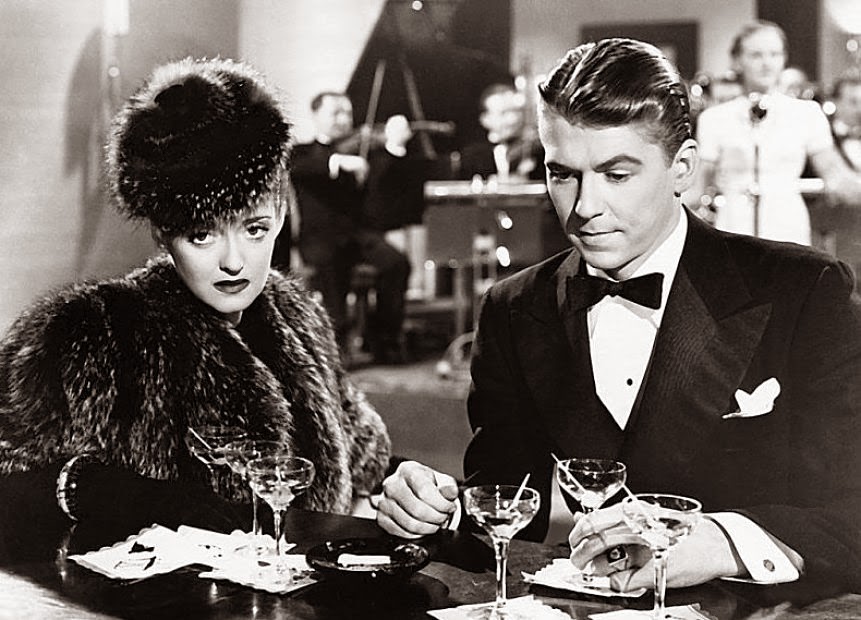
"Dark Victory," the Hal Wallis–directed movie that premiered 75 years ago today, had a star–studded cast — but anyone who comes across it while channel surfing and hopes to see a lot of Humphrey Bogart or Ronald Reagan or George Brent or Geraldine Fitzgerald will be disappointed.

Well, I suppose Brent had more screen time than the others. Not only was he Davis' doctor, but they got married as well. Still, this was purely a Bette Davis vehicle. The others were there, I suppose, because it couldn't be a one–woman show. They had their parts to play, and they played them well.

But make no mistake about it: "Dark Victory" was Davis' movie.

It was a bit melodramatic for my taste. Davis played a young heiress who likes horses, fast cars and partying. She's been ignoring headaches and dizzy spells, but when her vision is affected, she goes to see a doctor (Brent).

It is determined that Davis' character has an inoperable brain tumor. The diagnosis is confirmed by experts.

It is at this point that one sees a big difference between the way patients were handled in the 1930s and the way they are treated today.

In "Dark Victory," the option of deliberately concealing Davis' terminal condition from her is openly discussed by her doctor and best friend (Fitzgerald). It is even the strategy that is used for a time — until Davis' character learns the truth on her own.

I have to think that, in the 21st century, doctors would advocate being honest with their patients, even when the truth is unpleasant, and most patients probably want to play active roles in their treatment, to make choices as long as possible.

Still, it was consistent with a general theme of denial. Early in the movie, Davis' character ignores warning signs; it is never mentioned whether she might have been saved if a doctor had been aware of those symptoms earlier. Perhaps medical science had not found a preventive measure for that condition — perhaps it still hasn't — and medical personnel of that time believed it was kinder to ignore a terminal condition than confront it with the patient.

In the end, Davis' character clung to her denial strategy, sending her husband off knowing that she would soon be dead but never acknowledging the gravity of her condition. (You'd think that, being a physician, especially the one who made the original diagnosis, her husband would be aware of her declining condition. But he never showed any sign of that in the movie.)

I suppose that is in keeping with a long–standing American tradition of suffering in silence.

Frank Nugent wrote in the New York Times that "[a] completely cynical appraisal would dismiss it all as emotional flim–flam ... But it is impossible to be that cynical about it."

Perhaps that makes me cynical then. I found the story to be, as I have said, melodramatic. Davis was nominated for Best Actress, but when I first watched "Dark Victory," I felt she was guilty of overacting — and, in hindsight, I am glad Vivien Leigh won for "Gone With the Wind."

Leigh's was a better performance, anyway.

Sunday, March 10, 2013

'Jezebel' Was Bette Davis' Show


I suspected the truth about "Jezebel" (which premiered 75 years ago today) long before I learned what the truth was.

Bette Davis, like many other famous actresses of that time, was passed over when the role of Scarlett O'Hara in "Gone With the Wind" was cast. The role of Jezebel (the character's name was Julie), I suspected, was Warner Bros.' way of making it up to her.

It was a pretty good consolation prize. William Wyler (who later directed cinema classics like "Mrs. Miniver," "The Best Years of Our Lives," "Ben–Hur" and "Ronan Holiday") was the director, and Henry Fonda and George Brent were her co–stars.

Scarlett and Julie weren't very different, I guess (other than the fact that "Gone With the Wind" was a bestseller and a Pulitzer Prize winner).

Both were tough Southern gals. I have known several real–life Scarletts and Julies in my life. They were seldom, if ever, as affluent as Scarlett and Julie, but they were every bit as headstrong.

There were many other similarities, as well as some significant differences. Scarlett, of course, was from Georgia. Julie hailed from New Orleans.

And Scarlett's story was played out against the backdrop of the Civil War whereas Julie's story took place several years before the war broke out. I'll leave it to individual viewers to ascertain which setting was more dramatic, but both roles were undeniably dramatic.

I guess nearly everyone has seen "Gone With the Wind" so I won't go into much more detail about the character of Scarlett O'Hara. I'll just tell you a little more — and you can decide if there is any resemblance.

Scarlett, of course, was in love with Ashley, but she never married him. Julie had a fiancee whom she lost because she was stubborn, willful, prideful and vain. Sound familiar?

Julie's fiancee was played by Fonda — and I honestly can't think of any other role that Fonda played in his long, distinguished career that was more wooden than Preston Dillard. In fact, I've often wondered if Fonda wouldn't have had more to work with if he had been cast as Ashley.

For all his shortcomings, at least Ashley's character was multidimensional.

I guess that was OK, though. "Jezebel" was about Bette Davis.

But that's just my opinion.

You can take my word for it. Or, better still, you can watch it and judge for yourself. "Jezebel" will be shown on Turner Classic Movies Friday, March 15.