Showing posts with label Ronald Reagan. Show all posts

Monday, December 28, 2015

Not Exactly the Santa Fe Trail


"I have given you fair warning. You can keep your heads or lose 'em as you wish."

John Brown (Raymond Massey)

If you have never seen "Santa Fe Trail," which made its debut 75 years ago today, I guess it is important to know something before you do see it.

The movie has nothing whatsoever to do with the real Santa Fe Trail, which was a 19th–century transportation route that ran from Franklin in western Missouri to Santa Fe in northern New Mexico.

Rather, it was a pretty basic account of the events surrounding John Brown's raid at Harpers Ferry, Virginia (now West Virginia) — about 800 miles east of Franklin — less than two years before the start of the Civil War.

(Well, I suppose a rather tenuous connection could made from the fact that the trail started in Missouri and the railroad that would replace the Santa Fe Trail as a commercial route couldn't be built until Brown was driven from neighboring Kansas, an event that was re–created in "Santa Fe Trail," but making that mental connection would require the viewer to know certain details about American history that were never explored in "Santa Fe Trail" and a garden–variety moviegoer in 1940 was no more likely to know than one in 2015.)

It wasn't entirely literal history, by any stretch of the imagination, but it was a rousing good story, and it had a great cast.

It had Errol Flynn in it so audiences knew it would have lots of action and romance.

It had Olivia de Havilland in it so audiences knew they would be treated to a top–notch performance from an actress who, although her movie career was only a few years old at the time, was already regarded as being an actress in the classical mold.

It had Raymond Massey, who had been established as a classical actor for at least a decade and lent some of his personal credibility to the role of John Brown — even though, as I say, the movie is not the definitive word on the history of either the mid–19th century or John Brown.

And it had Ronald Reagan. No one knew at the time, of course, that Reagan would be elected president 40 years later. In the role of George Armstrong Custer, Reagan had a bit of a rivalry with Flynn's character, Jeb Stuart, that supposedly went back to their days at West Point.

I've been a student of American history most of my life. I will readily concede that I am not an authority on military history or military school history, and I don't know enough about Custer's individual relationships with his fellow cadets to pass judgment — but I do know that Custer had one of the worst personal conduct records in the school's history and was nearly expelled several times. Many of his demerits were received for pulling tricks on classmates so such a rivalry would not be inconceivable.

But Jeb Stuart must have been a stand–in for all those who were pranked by Custer. Stuart and Custer were never classmates. Stuart was born six years before Custer and graduated three years before Custer enrolled at West Point.

For that matter, Stuart was a West Point classmate of several people who had noteworthy military careers, according to the movie, but it played fast and loose with the facts, just as it did in its account of John Brown.

If you believed the movie, Stuart was a classmate of James Longstreet, George Pickett, Phil Sheridan and John Bell "Sam" Hood as well as Custer, but Stuart was a teenager when Longstreet and Pickett graduated from West Point, and Stuart, as I say, had been gone for three years when Custer enrolled there. Stuart was at West Point when Sheridan and Hood were there, but they graduated a year before he did. I have seen no evidence that Stuart knew either one.

Also, I have heard nothing of a romance between Stuart and the woman known as Kit Carson Holliday, the name of de Havilland's character. Stuart was married to a woman named Flora and was reportedly devoted to her until his death during the Civil War.

The only Kit Carsons I ever heard of were men. I can only assume that Kit Carson Holliday was entirely fictional.

Another inconvenient fact. When you look at pictures of John Brown in history books, he always has a long beard, but he didn't grow his beard until after he left Kansas. Nevertheless, in "Santa Fe Trail," he is portrayed with a long beard.

But Hollywood never let the facts get in the way of a good story. (Other than that, Mrs. Lincoln, how did you like the play?)

And, as I say, it was a good story.

It just wasn't literal history.

So if you are a student and you want to write a paper about John Brown or any of the other famous folks who were portrayed in "Santa Fe Trail," I implore you — don't use this movie as one of your sources.

Watch it and enjoy it. It's very entertaining.

But please don't treat it as a reputable factual source.

Monday, February 09, 2015

Joanne Woodward Got One of the First Stars on Hollywood's Walk of Fame 55 Years Ago


Fifty–five years ago today, the official groundbreaking ceremony was held for the Hollywood Walk of Fame. The first star to be dedicated on the popular tourist destination belonged to Joanne Woodward, Academy Award winner for "The Three Faces of Eve."

Well, actually, that is what is said, but it isn't really true. Woodward was one of eight people who originally had stars on the Walk of Fame. The first star placed on the walk was for director Stanley Kramer. Nothing special should be read into that. It is my understanding that a block of more than 1,500 stars was designated, and Kramer's was merely the first to be created. Woodward was the first to pose with her star, though, which is located on Hollywood Boulevard.

Woodward's late husband, actor Paul Newman, is on the Walk of Fame, too.

It is my understanding that more than 2,500 stars are on the Walk of Fame now. Not all of them belong to movie stars, of course. Some are entertainers from TV, others from radio, still others from recorded music and/or the theater. Some, like Gene Autry, had multiple stars along the walk.

And there are special stars awarded to those who have distinguished themselves in other fields — for example, the crew of Apollo 11, the first mission to the moon, and boxer Muhammad Ali.

Former movie star Ronald Reagan is the only U.S. president on the Walk of Fame.

Wednesday, June 04, 2014

The Release of Springsteen's Seventh


"Come back home to the refinery
Hiring man says 'Son, if it was up to me'
Went down to see my V.A. man
He said 'Son, don't you understand now'
Had a brother at Khe Sanh fighting off the Viet Cong
They're still there, he's all gone"


Bruce Springsteen

Bruce Springsteen is one of the most popular performers of all time, and he released his seventh — and most successful — album, "Born in the U.S.A.," 30 years ago today.

"Ten million copies later," writes David Hinckley in the New York Daily News, "Springsteen had graduated from star to supernova."

"Born in the U.S.A." was a considerable shift in tone from Springsteen's previous album, "Nebraska," which I always felt was the darkest of his recordings. It was pretty well received by the critics but lacked the kinds of musical touches that would make it commercially successful.

That wasn't the case with "Born in the U.S.A." The music was more upbeat — even though the subject matter wasn't always as light as it may have seemed on the surface — as Springsteen began to use a more radio–friendly sound.

It had seven hit singles, including the title track, which, briefly, was used (without Springsteen's permission) by Ronald Reagan during his presidential re–election campaign.

"America's future rests in a thousand dreams inside your hearts; it rests in the message of hope in songs so many young Americans admire: New Jersey's own Bruce Springsteen. And helping you make those dreams come true is what this job of mine is all about."

Ronald Reagan
Sept. 19, 1984
Campaign stop in New Jersey

The fact that Reagan referred to "Born in the U.S.A." as a "message of hope" gave it away as a cynical attempt to capitalize on the popularity of a performer. "Born in the U.S.A.," which has often been mistaken (even at the time) for being patriotic, dealt with the negative side of the Vietnam experience.

(Reagan called the Vietnam War "a noble cause" during the 1980 presidential campaign.)

Reporters who covered Reagan's 1984 campaign were almost immediately skeptical that the president had ever listened to Springsteen, much less a particular song, and demanded to know his favorite Springsteen song. After a long delay, Reagan's campaign responded that his favorite Springsteen song was "Born to Run," which was released nearly nine years earlier.

I don't think Reagan mentioned Springsteen or "Born in the U.S.A." again. His opponent in that campaign, former Vice President Walter Mondale, erroneously announced that Springsteen had endorsed him but corrected the claim when Springsteen disputed it.

Personally, I liked "Born in the U.S.A." (the song and the album), but, if I had to select my very favorite song from the album, it might be "Cover Me," which Springsteen actually wrote for Donna Summer.

Springsteen's manager decided he should record it himself, though, which he did, and it was a huge hit in the summer of 1984.

Oddly, though, considering the time in which it was recorded, "Cover Me" had no official music video.

Or I might choose "Glory Days."

"Glory Days" was released as a single about a year after the release of the album. It was the fifth hit single from the album, but it was recorded in the spring of 1982 during the first batch of "Born in the U.S.A." recordings — which, technically, made it one of the oldest songs on the LP.

"Glory Days" climbed to #5 on the charts and was one of the top hits in the summer of 1985.

And it did have its own music video.

Actually, in spite of the fact that it was released in 1984, "Born in the U.S.A." was the top–selling album in 1985. It spent 84 weeks on the Top 10 albums chart. The album spent four weeks at the very top of the charts, sold 30 million copies worldwide and was nominated for four Grammy Awards, winning one. It took only a month for the album to be certified platinum.

In 1984, as CD technology was emerging, "Born in the U.S.A." also became the first CD to be made in the United States.

It was a trail–blazing album in many ways.

Monday, May 12, 2014

The Tribulations of a Real-Life Natural


"You told me once, 'A man has to know where he's goin'!' Where are you goin', Monty?"

Ethel (June Allyson)

Yesterday, I wrote about the debut of "The Natural" — a fictional story about a natural–born baseball player.

Today, my topic is a movie about a real natural — Monty Stratton — whose mostly true story was made into a movie starring James Stewart and June Allyson that made its debut 65 years ago today.

Don't feel bad if you never heard of Stratton. His was a very short career — only five years.

And I say the story was mostly true because there were some liberties taken with it. Of course, that tends to be the case with biographical movies, even those that appear to be meticulous about details.

See, the story of Monty Stratton was that he was a baseball player, a pitcher, during the Depression. Frank Morgan (who was the wizard of Oz 10 years earlier) played the baseball scout who discovered Stratton playing semipro ball when he wasn't working on his Texas farm and persuaded him to come to California for a tryout with the Chicago White Sox during spring training.

The tryout went so well that Stratton made the team, and the scout was hired to coach pitching prospects.

It wasn't a fairy–tale career, though. It certainly had its rocky moments.

One of them, Stratton's actual major–league debut, yielded one of the best lines in the movie — but the scene was manipulated, presumably for what would be an understandable reason.

Stratton made his first major–league appearance on June 2, 1934, coming in as the second and final relief pitcher of the day for the Sox, who lost, 12–0. He didn't pitch as poorly as the two pitchers who preceded him; he only gave up two of the runs. But he was sent down to the minors, anyway, and didn't pitch in the majors again until the following year.

In the movie, he told his wife (Allyson) that the game had been against the New York Yankees. In fact, it was against the Detroit Tigers.

I don't know why the identity of the opponent was changed like that, but my guess is that it had something to do with the facts that (a) the Yankees had been in four of the previous eight World Series (when Stratton made his debut), whereas the Tigers had not been in a World Series in a quarter of a century (although, ironically, the Tigers did go to the World Series in 1934 — and 1935), and (b) the Yankees had guys named Gehrig and Ruth in their lineup.

The Yankees simply were better known (although, in a noteworthy filmmaking mistake, Joe DiMaggio could be seen rounding the bases in the stock footage that was used for Stratton's debut. DiMaggio didn't make his major–league debut until 1936).

"Honey," Stewart said to Allyson, "do you know there's a tailor in Chicago that gives a suit of clothes away to any ballplayer that hits the scoreboard in center field? As of yesterday, the New York Yankees are the best–dressed team in baseball."

If Stratton really did say that to his wife, he was exaggerating. Detroit scored a lot of runs that day, but no home runs were hit. The Tigers had a bunch of singles and half a dozen hits for extra bases. Zero home runs.

Stratton's next four years were more successful than his debut. He did struggle in 1935 and 1936, but he won a total of 30 games in 1937 and 1938. He was an All–Star in 1937 and received votes for Most Valuable Player after the 1938 season.

The future looked bright.

But then Stratton was injured in a hunting accident. It was severe enough to cost him one of his legs, and his baseball career appeared to be over.

That much was true. But, in reality, Stratton shot himself with a revolver. In the movie, the wound was inflicted with a shotgun. I don't know why that change was made — unless it was to avoid having to answer questions about why he had a revolver with him on a hunting trip.

If a Supportive and Long–Suffering Movie Spouse Hall of Fame is ever created, June Allyson is sure to be a charter member. At times, it seems to me that she was the very definition of the label supportive movie spouse in her movies, especially (but not exclusively) the ones in which she was paired with Stewart because some sort of personal trial was sure to follow — and Allyson's spouse was equally certain to be in denial about the situation. Thus, it was up to Allyson to be the stronger of the two.

In "The Stratton Story," it fell to her to decide between her husband's leg and his life. She chose his life, realizing that losing his leg meant the end of his dreams of major–league success.

Then she had to deal with her husband's mood swings and his apparent tendency (though never spoken) to blame her for the loss of his leg. As she so often did, Allyson played the supportive, long–suffering wife, putting up with his peevishness in silence.

Of course, I know it wasn't always that way. Allyson once played Jose Ferrer's malicious and shrewish spouse — at Ferrer's request — and she had several separations from her real–life husband, Dick Powell.

In real life, Stratton did come back. He didn't make it all the way back to the major leagues, but he did pitch in the minor leagues from 1946 to 1953 wearing a prosthetic leg. It was a truly inspiring story that was worthy of inclusion in the American Film Institute's list of the most inspiring films — but was not.

There were times during the movie when I thought it was a little heavy–handed in its foreshadowing — of the loss of his leg especially. The hunting accident wasn't presented until about two–thirds into the movie, but there were allusions to it. Early in the movie, for example, the viewers learned that, on the days he pitched for the semipro team, Stratton walked five miles into town, pitched, then walked five miles home — and then worked on his farm.

Another time, he learned how to dance so he could dance with his wife. Unbeknownst to his wife, he had a membership at a dance studio, of which he could take advantage at studio outlets in every American League city. It was a big subject in the movie.

I have never lost a limb — and I hope I never do — so I can't know how the real Stratton must have felt, but it must be an unimaginable blow to be 26 years old and lose one of your legs, particularly if you are a professional athlete. Stewart's reactions rang true — and, as it was with so many of his performances, it was hard to imagine anyone else playing Monty Stratton once the movie was made.

In fact, though, Ronald Reagan tried to get the part, but he was under contract to Warner Bros., and Warner wouldn't let him do it, fearing the movie would be a flop (in fact, it turned a profit). At one point, Van Johnson was inaccurately reported to be playing the role of Monty Stratton.

In hindsight, Johnson would not have been believable in the role. Reagan might have, but his Stratton almost surely would have differed from Stewart's — and Stratton himself said Stewart "did a great job of playing me, in a picture which I figure was about as true to life as they could make it."

Based on that, I think Stratton was at peace with the liberties that were taken. If he was OK with them, who am I to disagree? It must be tremendously challenging to be asked to portray someone who is still living.

Agnew Moorehead played the role of Stratton's mother. It was the kind of role she played frequently in her career, sort of a semi–animated Whistler's mother, and she was usually quite believable in it, but she was an odd choice because of the difference between her age and Stewart's age (she was roughly 7½ years his senior).

Allyson and Stewart were paired in three movies; "The Stratton Story" was the first. In their second movie, they played Mr. and Mrs. Glenn Miller, and Allyson's ordeal was living through the loss of her husband's life. In the third, she played the spouse of another baseball player (fictional this time) who was injured flying a new aircraft for the Air Force Reserve.

"The Stratton Story" won the only Oscar for which it was nominated — Best Story.

Tuesday, April 22, 2014

Bette Davis' Victory Over the Dark


"Nothing can hurt us now. What we have can't be destroyed. That's our victory — our victory over the dark. It is a victory because we're not afraid."

Judith (Bette Davis)

(1939 is widely regarded as the greatest year ever for the motion picture. Ten movies were nominated for Best Picture that year, and today I take a look at the fourth of those 10 movies to hit the theaters.)
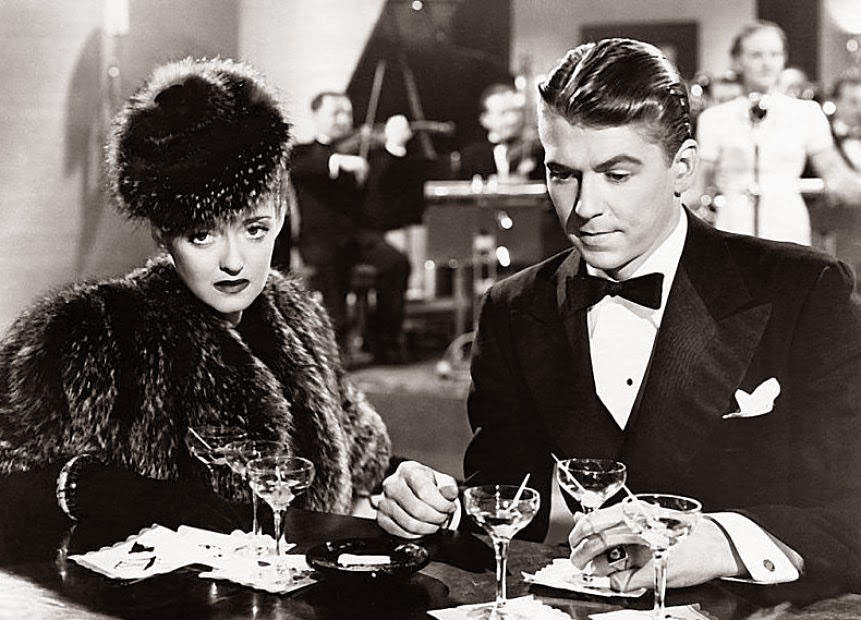
"Dark Victory," the Hal Wallis–directed movie that premiered 75 years ago today, had a star–studded cast — but anyone who comes across it while channel surfing and hopes to see a lot of Humphrey Bogart or Ronald Reagan or George Brent or Geraldine Fitzgerald will be disappointed.

Well, I suppose Brent had more screen time than the others. Not only was he Davis' doctor, but they got married as well. Still, this was purely a Bette Davis vehicle. The others were there, I suppose, because it couldn't be a one–woman show. They had their parts to play, and they played them well.

But make no mistake about it: "Dark Victory" was Davis' movie.

It was a bit melodramatic for my taste. Davis played a young heiress who likes horses, fast cars and partying. She's been ignoring headaches and dizzy spells, but when her vision is affected, she goes to see a doctor (Brent).

It is determined that Davis' character has an inoperable brain tumor. The diagnosis is confirmed by experts.

It is at this point that one sees a big difference between the way patients were handled in the 1930s and the way they are treated today.

In "Dark Victory," the option of deliberately concealing Davis' terminal condition from her is openly discussed by her doctor and best friend (Fitzgerald). It is even the strategy that is used for a time — until Davis' character learns the truth on her own.

I have to think that, in the 21st century, doctors would advocate being honest with their patients, even when the truth is unpleasant, and most patients probably want to play active roles in their treatment, to make choices as long as possible.

Still, it was consistent with a general theme of denial. Early in the movie, Davis' character ignores warning signs; it is never mentioned whether she might have been saved if a doctor had been aware of those symptoms earlier. Perhaps medical science had not found a preventive measure for that condition — perhaps it still hasn't — and medical personnel of that time believed it was kinder to ignore a terminal condition than confront it with the patient.

In the end, Davis' character clung to her denial strategy, sending her husband off knowing that she would soon be dead but never acknowledging the gravity of her condition. (You'd think that, being a physician, especially the one who made the original diagnosis, her husband would be aware of her declining condition. But he never showed any sign of that in the movie.)

I suppose that is in keeping with a long–standing American tradition of suffering in silence.

Frank Nugent wrote in the New York Times that "[a] completely cynical appraisal would dismiss it all as emotional flim–flam ... But it is impossible to be that cynical about it."

Perhaps that makes me cynical then. I found the story to be, as I have said, melodramatic. Davis was nominated for Best Actress, but when I first watched "Dark Victory," I felt she was guilty of overacting — and, in hindsight, I am glad Vivien Leigh won for "Gone With the Wind."

Leigh's was a better performance, anyway.

Tuesday, April 05, 2011

Say Good Night, Bonzo


I've heard that Ronald Reagan regarded it as his least favorite of the films he made during his movie career.

And how anyone else feels about it may depend upon whether that person tended to agree or disagree with Reagan politically.

For his part, Reagan said he never watched it — and who could blame him?

Personally, I would have to say that "Bedtime for Bonzo," which made its debut on this day in 1951, wasn't all that good. I found it predictable ... and, for the most part, boring. It was white bread. Stale white bread, for that matter.

Not everyone felt that way, though. "Forget what you've been led to believe," writes Hal Erickson for AllMovie.com. "Bedtime for Bonzo is a most enjoyable film."

I wouldn't call it "enjoyable." I have other words for it.

It's the old "nature vs. nurture" argument, which could have been presented more effectively. Reagan played a college professor who was trying to teach morals to a chimpanzee. Reagan's character was a bachelor, and he decided that he would need a mother to complete the study.

What followed was, as I say, predictable.

I will admit, though, that there were times when I found the dialogue unexpectedly amusing.

Like the time when Reagan says to co–star Diana Lynn, "You're no dope. You couldn't be. You haven't a university degree and you don't teach logic."

In the context of the rest of Reagan's career and life, that really sounds like something he might have said.

I heard that, 30 years ago, during Reagan's first successful campaign for the presidency, some people wanted to air this movie as a kind of reverse political statement — implying something along the lines of "Do you want someone who once read a bedtime story to a chimp to be president of the United States?"

But then I heard more plausible stories that, because of laws requiring "equal time" for candidates for political office, no TV station would show the film before the election. If they did, they would have to provide the same amount of time and charge the same fee to the opposition — and no one was willing to provide 83 minutes of air time to Reagan's rivals.

That made sense to me. Not once during the 1980 campaign did I see "Bedtime for Bonzo" on the TV schedule.

I eventually saw the movie a few years after Reagan was elected. But I only saw it once. That was enough.

I rarely agreed with Reagan on anything, but I will admit that I agreed with him on that point. "Bedtime for Bonzo" was a waste of time.