Showing posts with label Kirsten Dunst. Show all posts

Thursday, May 04, 2017

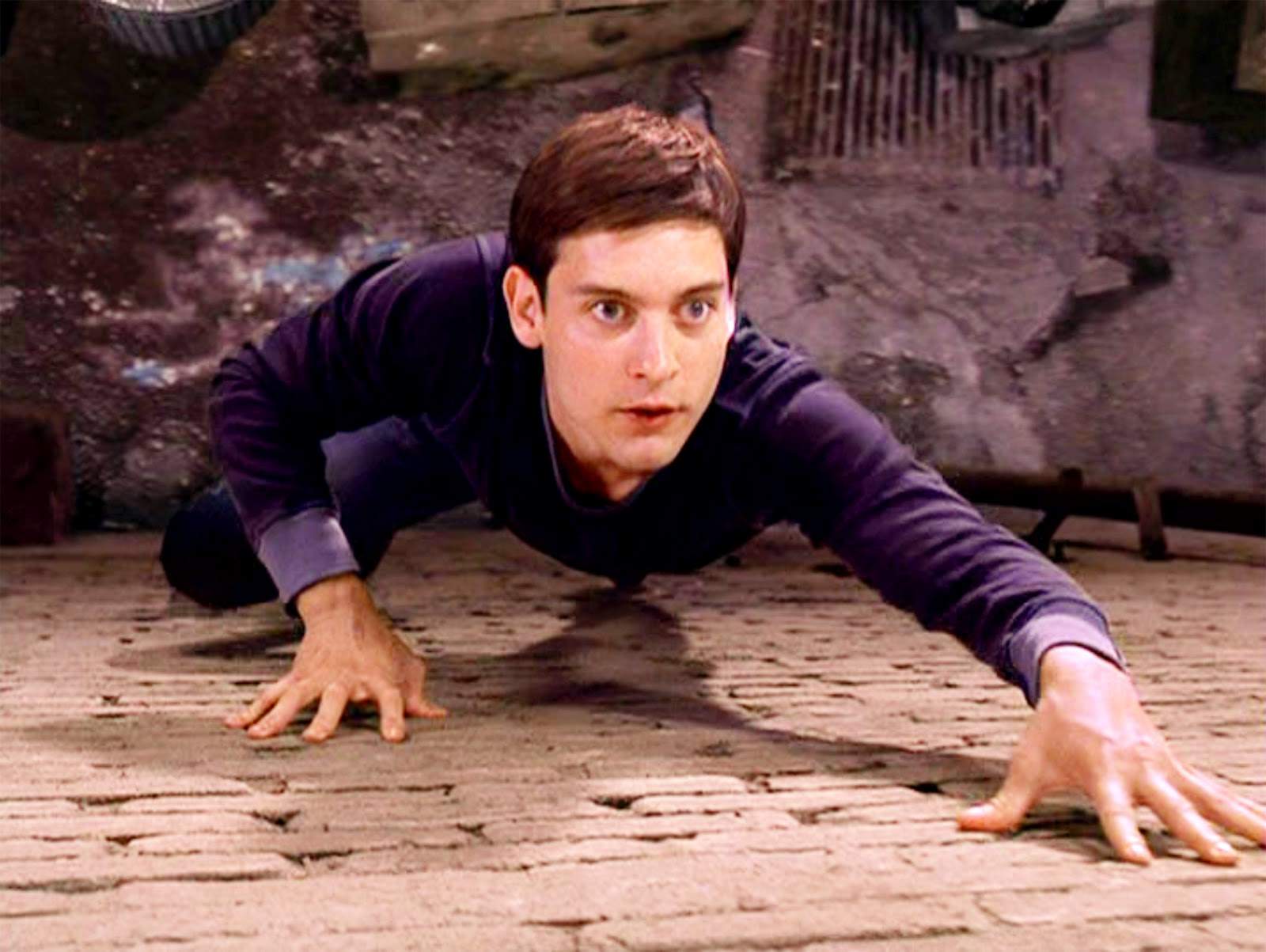
The End of the Spider-Man Trilogy


Sequels are seldom worthy successors to the originals.

Sometimes a second chapter is necessary only so it is possible to move on to a third. I have always thought that was the case with the "Back to the Future" movies, and I definitely feel that way about the "Spider–Man" movies, the third installment of which made its debut on this day in 2007.

As I observed yesterday, I liked the "Spider–Man" movie from 2002 — and I liked its second sequel, the one that premiered 10 years ago today. The second movie, which premiered in 2004, didn't have much going for it, as far as I was concerned.

(The third part of a trilogy isn't always so great. The third chapters of "The Godfather" and original "Star Wars" trilogies easily make that case.)

Not everyone felt that way. Film critic Roger Ebert and I frequently had similar reactions to movies — but not the "Spider–Man" trilogy.

And it all seems to have hinged on the character of Peter Parker (Tobey Maguire). I had no problems with him, but Ebert apparently did.

"The great failing of 'Spider–Man 3' is that it failed to distract me from what a sap Peter Parker is," Ebert wrote. "It lingers so long over the dopey romance between Peter and the long–suffering Mary Jane [Kirsten Dunst] that I found myself asking the question: Could a whole movie about the relationship between these two twentysomethings be made? And my answer was: No, because today's audiences would never accept a hero so clueless and a heroine so docile."

I thought that was a bit harsh, considering that the movie's sole purpose was to entertain — not to make some profound statement.

Well, perhaps that wasn't its sole purpose. I wouldn't rule out the money motive. The original "Spider–Man" became the first movie to exceed $100 million at the box office in its first weekend on American movie screens. Its sequel, which was released in 2004, beat the original's opening–day record by $1 million.

It was logical to expect a similar response to the third movie, and it didn't disappoint — well, not entirely. It was the highest–grossing film of the three movies in the trilogy — but, although the DVD sales grossed more than $120 million, they still came up short of expectations.

Anyway, Ebert and I were never on the same page on the "Spider–Man" movies. He didn't like the first and third movies; I did.

On the other hand, he did like the second movie. "Now this is what a superhero movie should be," he wrote of that first sequel. I thought the only purpose for the second movie (other than to make a lot of money) was to be a bridge between the first and second movies. I still think that, for that matter.

Go figure.

Anyway, I can kind of understand where some folks were coming from in their criticism — the ones who complained that there were too many stories going on at once.

Yes. There were quite a few stories being told.

There were the continuing stories dating back to the original movie — of Peter Parker and M.J., of Parker's newspaper career and his editor (J.K. Simmons) and of the son of the Green Goblin (Willem Dafoe), whose spirit urged his son to seek vengeance (and tried to do so through M.J.).

And there was some new stuff. There was Bryce Dallas Howard (Ron Howard's talented and beautiful daughter) who played Parker's lab partner and temporary love interest.

There was also the introduction of a new villain, played by Thomas Haden Church, who, as it turned out, had been responsible for the death of Parker's uncle (Cliff Robertson). His aunt (Rosemary Harris) was back.

Yep, there was a lot going on. Nothing neat and orderly about it. But isn't that the burden of a superhero?

Wednesday, May 03, 2017

Spinning Spider-Man's Web on the Big Screen


I was never a devotee of comic books.

Oh, sure, there were some I would read when I was a kid — but not regularly. I could take 'em or leave 'em.

I always preferred the comic books that made me laugh as opposed to the ones that I judged to be dramatic, more serious in nature.

It was in that category that I would put characters like Superman, Spider–Man, etc. It seems to me that superheroes are, almost by definition, about serious stuff, and their fans are deadly serious about them. I've known people who were really into the superhero thing. I even worked with a guy once who was petrified of spiders but loved the character Spider–Man. Go figure.

That might explain why I liked the "Super–Man" movie that made its debut on this date in 2002 — even though many people seem to prefer the version from 2012. I've never seen that one, though, so I can't be making any kind of comparison except based on what I've heard from others.

That wouldn't be a satisfactory answer, either, though, because the general consensus seems to be that the 2012 version was better. And it may well have been.

I just felt thoroughly entertained by the version that premiered 15 years ago today. It may not have had the special effects that were available a decade later, but movies have always been that way. They've always had to compensate for the things they didn't have or couldn't do.

"Spider–Man" told a good story. That always makes up for a lot with me. It was like watching a comic book, frame by frame, on the movie screen. I could almost see the balloon dialogue between the characters.

Except there was a difference.

Comic books have always seemed scripted to me. In real life, people aren't usually as quick on their feet as they appear to be in a book, comic or otherwise. In real life, humans sometimes (often, in fact) need at least a little time to absorb what they have heard or seen before making a response — which is rarely as impressive as what appears in print. Books, comic or otherwise, may be intended to appear spontaneous, and many may succeed even though they almost certainly went through several lengthy revisions.

But the acting in "Spider–Man" always had just enough of those human pauses for entirely plausible intervals to make things seem spontaneous — even though the movie was just as scripted as the book(s), comic and otherwise.

Although it might have lacked as much action as Millennials prefer, I thought it was a good call to spend the first half of the movie essentially exploring the character of Peter Parker (Tobey Maguire) rather than assuming that everyone who saw the movie already was familiar with his story. It helped to establish that he had been a neighbor of Mary Jane (Kirsten Dunst) since he was 6 and, by his own admission, had been in love with her all that time.

It was certainly a good call as far as Maguire was concerned. It was the movie that made him a star.

Film critic Roger Ebert and I frequently agreed in our assessments of movies, but we never saw eye to eye on the "Spider–Man" franchise.

Ebert, for example, thought Maguire was miscast. I did not.

"Imagine 'Superman' with a Clark Kent more charismatic than the Man of Steel," Ebert wrote, "and you'll understand how 'Spider–Man' goes wrong. Tobey Maguire is pitch–perfect as the socially retarded Peter Parker, but when he becomes Spider–Man, the film turns to action sequences that zip along like perfunctory cartoons."

I suppose that was the quality I liked best. I always see comic books when I see suuperheroperhero movies, anyway. For me, that made Maguire ideal for the role.

And, although their roles were supporting, Cliff Robertson and Rosemary Harris were well cast as Maguire's aunt and uncle.

Willem Dafoe was perfect as Norman Osborn, the father of Maguire's best friend and a bit of a mad scientist who became Spider–Man's nemesis, the Green Goblin.

I guess the thing about the movie to which I objected was the portrayal of the newspaper editor. Now, I like J.K. Simmons, who played the part. I especially like him in his television role in the Farmers Insurance commercials.

It is likely that he had little input into the character, but I thought it was an unrealistic portrayal. I have worked for several newspapers — and, as a result, several editors. They all had their shortcomings, but they had their redeeming qualities, too. Simmons' character did not.

Tuesday, December 15, 2015

A Most Unusual Board Game


"I've seen things you've only seen in your nightmares. Things you can't even imagine. Things you can't even see. There are things that hunt you in the night. Then something screams. Then you hear them eating, and you hope to God you aren't dessert. Afraid? You don't know what afraid is."

Alan (Robin Williams)

In the aftermath of Robin Williams' suicide last year, it was easy to reel off a list of his greatest acting achievements — "Awakenings," "Dead Poets Society," "The World According to Garp," "The Fisher King," "Good Morning, Vietnam," to name but a few — and start a debate over which was the best.

But, really, identifying those movies is easy because they were recognized at the time as being overall quality productions. Williams was always good — he was nominated for Oscars four times and even won once — but he was often made better by the people around him.

To have a truly representative discussion of his best performances, it seems to me it would be necessary to include movies that weren't generally well regarded, but in which he gave his customary brilliant performances. I wrote about such a movie a few days ago — 1980's "Popeye" — and another such movie premiered on this date in 1995 — "Jumanji."

That isn't really accurate, I guess, to suggest that "Jumanji" wasn't a good movie. "Jumanji" was a good movie, creative and all that. Critics were mixed, but audiences seemed to like it well enough. After all, it made more than $100 million.

At the time, I chose not to see it in the theater. What I had seen in the previews simply didn't appeal to me. I regretted that decision when I finally did see it on the small TV screen, though. The special effects of "Jumanji" really were quite good, well worth seeing on the big screen.

But the acting was pretty good, too.

The focus of the story was a young boy named Alan, the heir to a shoe manufacturing business. Several things happened early to set up the rest of the story, although that wasn't immediately clear. I won't go into detail about them here. If you haven't seen the movie, take my word for it. Everything eventually makes sense — even though there's a lot of crazy stuff that goes on. The movie does its best to trick you — and manages to do so. Be prepared for that.

Young Alan found a board game called Jumanji — how he discovered it is what established this movie as a fantasy — and he and a female friend sat down to play it one afternoon. Turned out Alan got sucked into the world of the game. The adults never figured out what happened to him, and his companion needed years of therapy to come to grips with what she had witnessed.

Fast forward 26 years — when Alan's house was being acquired by a woman (Bebe Neuwirth) and her late brother's children (Kirsten Dunst and Bradley Pierce). The children discovered the game and tried to play it — and, without realizing it, resumed the game that had been started in 1969.

And that summoned Alan back from wherever he had gone 26 years earlier — only he was an adult now, played by Williams. Well, physically he was an adult. Emotionally he was still that child from 1969.

I'm sure that kind of role was too juicy for Williams to pass up.

And really, I can't imagine anyone else playing the role except Robin Williams.

There are roles that are like that. They might have gone to other actors, but they were played so well by the people who were cast in them that you simply can't imagine anyone else playing the role.

Of course, Robin Williams was such a unique talent that it is really hard to imagine anyone else playing any of the roles Williams played in his life. He always put his personal, manic stamp on every role he played — in the movies or on TV.

He was one of a kind, and he is missed.

Monday, December 17, 2012

How to Change the Subject


Tracy (Kirsten Dunst): What would they do to me if I did tell someone about this?

Conrad (Robert De Niro): They could come to your house in the middle of the night and kill you.

I thoroughly enjoyed "Wag the Dog," which debuted on this day in 1997, and to no small extent because I understood and appreciated the nature of the title. But it did require a little explanation.

When I first heard the title, I thought it was the name of a character — you know, like Bozo the Clown. Logically, I figured that it was a dog named Wag and, if the title character was a dog, it must be a cartoon — you know, kind of like Felix the Cat — although perhaps not (this was around the time that "Babe" was in the theaters).

But then I discovered it was a variation of the old saying that "the dog wags the tail, the tail doesn't wag the dog."

When applied to a political context — as it was in this movie — it meant to distract public attention from a matter of great importance to focus on a matter of lesser importance — or, in the case of this movie, a matter that didn't really exist.

In the movie, the president is facing the voters in his bid for re–election. Foolishly, he sexually assaults a member of some Firefly Girl group that is visiting the White House in the closing days of the campaign, and he needs the help of a spin doctor played by Robert De Niro to get him over the hump (as it were) to Election Day.

(In my own defense, the plotline encouraged some really bad puns.)

De Niro, in turn, recruits a Hollywood producer (Dustin Hoffman), who is bitter over never receiving the recognition he craves for the work he has done, to help him create a phony war to distract attention from the abuse allegations.

And, thus, an elaborate deception was born.

Hoffman's character put together such an impressive visual depiction of a war that he himself observed it was "the best work I've ever done in my life, because it's so honest."

Well, honesty was relative.

Or, in the words of the movie's producers, "Why does a dog wag its tail? Because a dog is smarter than its tail. If the tail were smarter, the tail would wag the dog."

Hoffman's undoing was in not being satisfied with the knowledge that it was his "best work." He wanted the credit that had been denied to him throughout his career.

"You're playing with your life," De Niro's character warned him, but he wouldn't listen — and he wound up dying shortly thereafter, officially of a heart attack while sunning himself by his pool.

Overseeing all of this was Anne Heche's character, Winifred the presidential adviser who acted as the buffer between the president and everything else. At times, she was severely tested, as when she was informed that the hand–picked "hero" of the fictional conflict — played by Woody Harrelson — was an unsavory sort who had been convicted of raping a nun.

"Oh, God. Oh, God. Oh, God," she kept muttering.

Hoffman assured her that, as long as the "hero" took his medication, "He's fine."

What if he doesn't take his medication, Heche's character wanted to know.

"He's not fine."

To be fair to Hoffman's character, he did design a credible war backdrop for the cover story, enlisting Kirsten Dunst to play a peasant girl running from assailants with a kitten in her arms (the kitten and the scenery and sound effects would be edited in later — Dunst was told to run through a sound stage carrying a bag of tortilla chips).

In a classic example of the misdirection used by the spin doctor and his associates, De Niro's character urges people like the press secretary to make up denials about non–existent rumors — such as the one about the B–3 bomber.

There is no such thing, of course, and no one had been talking about it, but De Niro's character still protests that he doesn't know how such rumors get started — and the direction of the conversation is changed.

Roger Ebert made an intriguing observation in his review of the movie in the Chicago Sun–Times: "It's creepy how this material is absurd and convincing at the same time. ... Even when a conflict is real and necessary ... the packaging ... is invariably shallow and unquestioning; like sportswriters, war correspondents abandon any pretense of objectivity and detachment, and cheerfully root for our side."

Coincidentally, the movie came out around the same time that Bill Clinton's relationship with Monica Lewinsky was in the news, and he was facing impeachment. The Clinton administration also engaged in some saber rattling against Iraq — which critics alleged was an attempt to shift the focus of the public conversation. It was, they said, a real–life "Wag the Dog."

"['Wag the Dog'] is a satire that contains just enough realistic ballast to be teasingly plausible," Ebert wrote, "like 'Dr. Strangelove,' it makes you laugh, and then it makes you wonder."

It still does.