Showing posts with label Claudette Colbert. Show all posts

Thursday, August 20, 2015

Making an Escape to 'Boom Town'


"Now, how can a guy be breaking the law when he's trying to save the resources of this country? He didn't know that he was doin' anything that you might call conservation, but bein' one of the best oilmen there is, he's got the right hunch about oil. He knows it took billions of years to put it there, and takin' it out at the rate we're goin', there won't be any oil left in the good U.S.A."

Square John (Spencer Tracy)

Interesting thing about the movies — well, actually, this particular stream of consciousness began when I was watching a movie from 1939, which is often regarded as the greatest year in the history of the movies, and it re–emerges from time to time, usually when I am writing about one of the movies of the '30s or '40s.

As I am today.

It was 75 years ago today that "Boom Town" an adventure about some oil wildcatters (Clark Gable and Spencer Tracy), made its debut. It wasn't the best movie ever made, but it was enjoyable enough, and it featured four of the biggest names in Hollywood at the time — Gable, Tracy, Claudette Colbert and Hedy Lamarr. (Frank Morgan, who may be best remembered for his part in "The Wizard of Oz," made it five names.)

And that is where my stream of consciousness comes in.

The movies of the '30s and '40s were almost entirely about escapism. In the '30s, nearly all the movies that dealt with the economic realities of the Great Depression were presented in such a way that the protagonist(s) rose above the circumstances and found success anyway. In other words, those movies encouraged hope. There were a few — like "The Grapes of Wrath" — that told it like it was and pulled few, if any, punches. But, mostly, the movies of that day were about other times, other places, other people. They were adaptations of great works of literature, Day–to–day life in the Depression was bad enough — for awhile, about a quarter of America's adult population was out of work — and money was precious enough that people would seldom pay to sit in a theater and watch other people struggling as they did.

They couldn't afford to go anywhere, so they went to the movies for a couple of hours — to escape. My grandmother once told me that the movie stars of that time were more than movie stars. They were like friends. People had their favorite stars, and they went to see every movie they made. Then as now, studios were interested in pairings that were profitable; what could be more profitable than bringing together four popular stars?

A few modern movie stars inspire that kind of loyalty — but not many. Maybe they are overruled by the prices that are charged for movie tickets these days.

"Boom Town" reunited the stars of "It Happened One Night," the unexpected hit of 1934 — Gable and Colbert. Their partnership didn't have the same sizzle that it had six years earlier, but it must have been great for fans of Gable and Colbert to see them together again — even if it was in an inferior movie. Turned out, it was their last on–screen pairing.

If one is bound and determined to find an agenda in a movie, it probably isn't too hard with "Boom Town." Its message of unfettered capitalism does seem obvious — it may have seemed just as obvious to audiences three–quarters of a century ago — and it also extols the virtues of entrepreneurship.

The story was far from perfect, but it made up for it in sheer star power. Well, unless you were a fan of Spencer Tracy. Seemed he was always getting the short end of the stick from Gable — mostly in matters of the heart.

Both named John, Gable's character was called "Big John" and Tracy's was called "Square John." For starters, Big John stole Square John's girl (Colbert). Then, when Square John discovered that Big John had been having an affair (with Lamarr), he offered to marry the mistress in order to save Big John's marriage.

But in matters of the head, my memory is that Square John always came out on top. They both had their times of booms and busts, but my impression, by the time the movie ended, was that Tracy's character had enjoyed more economic success.

Tracy, I have heard, was fond of Gable, but "Boom Town" was the third — and last — movie they made together. It was a capsule of all the things that Tracy didn't like about working with Gable. He didn't like taking second billing to Gable in movie credits, and he didn't like being Gable's "eunuch."

"Boom Town" was nominated for two Oscars — Best Black and White Cinematography and Best Special Effects.

Monday, November 03, 2014

The Continuing Partnership of Fonda and Ford


This black–and–white trailer accompanied the 1947 re–release of
"Drums Along the Mohawk," director John Ford's first color feature.


"Oh, Almighty God, hear us, we beseech thee, and bring succor and guidance to those we are about to bring to your divine notice. First we are thinking of Mary Walaber. She is only 16 years old, but she is keeping company with a soldier from Fort Dayton. He's a Massachusetts man, and thou knowest no good can come of that."

Reverend Rosenkrantz (Arthur Shields)

John Ford and Henry Fonda teamed up for the first time earlier in 1939 when they made "Young Mr. Lincoln."

They wasted no time making their second film together, "Drums Along the Mohawk," which premiered 75 years ago today.

It had some things in common with "Young Mr. Lincoln," such as the fact that both were set in specific periods in American history. "Young Mr. Lincoln" was about Abraham Lincoln's early life, and "Drums Along the Mohawk" was about life in colonial America.

Fonda and Claudette Colbert played 18th–century newlyweds trying to set up their home in the Mohawk Valley of central New York. It was a region that had a great deal of importance in Revolutionary War times, a passageway between the Atlantic Ocean and the interior of the New World.

Their story was not one for the faint of heart. Colbert's character suffered a miscarriage. Beset from all sides by Indians and the British, they lost their home. Along with other settlers, they were forced to relocate at a fort, from which they could see their homes and lands being destroyed.

You really had to believe in what you were trying to do to survive. For a movie that was made within the limitations of filmmaking in 1939, "Drums Along the Mohawk" did a pretty good job of presenting a realistic portrayal of the travails of colonial life.

Edna May Oliver, who was nominated for Best Supporting Actress (but lost to Hattie McDaniel, who played Mammy in "Gone With the Wind"), played a widow who owned a big farm and hired Fonda to work it. She took in Fonda and Colbert after their farm was burned by Indians.

In a way, it was sort of like the old Green Acres TV show without the jokes. Colbert's character was raised in affluent and comfortable surroundings; she wasn't prepared for the rugged life of a settler. In time, though, she adapted to it and even came to love it.

And, in true John Ford fashion, the movie ended on an upbeat, patriotic note. The Indians had been turned back, and the American flag was raised above the fort.

Sunday, October 05, 2014

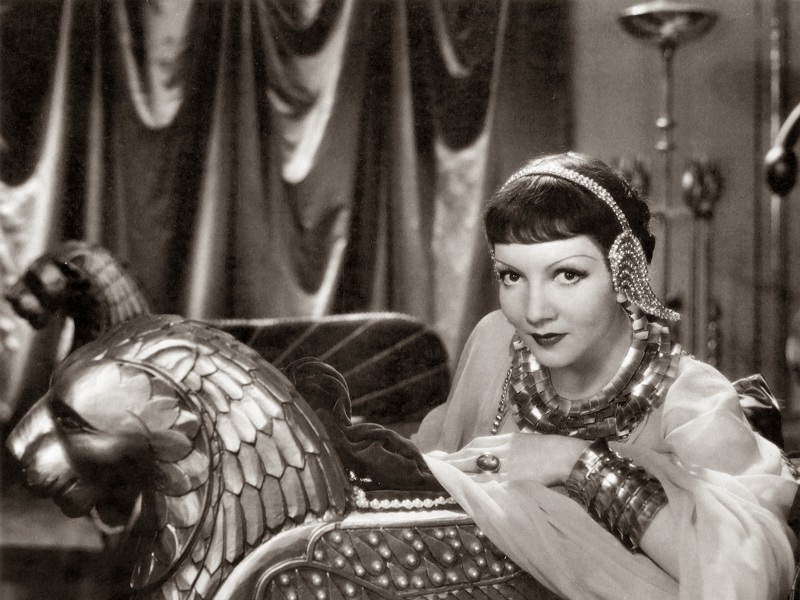
'Cleopatra' Was a Defining Role for Colbert


"Women should be but toys for the great. It becomes them both."

Cleopatra (Claudette Colbert)

For all intents and purposes, Cleopatra was the last pharaoh of ancient Egypt. She was survived by her teenage son for about a week and a half. That made him the last pharaoh — technically — but his rule was spent in captivity and ended with his apparent execution.

More than 2,000 years after her death, Cleopatra is still a fascinating figure in the West. She has been portrayed countless times on the stage in Shakespeare's play "Antony and Cleopatra" and Jules Massenet's opera "Cléopâtre," and she has been portrayed in numerous films, TV productions and video games. She is regarded as one of history's great beauties; she was seen that way by her contemporaries, too.

Thus, it wasn't surprising when one of the big screen's great beauties, Elizabeth Taylor, was cast as Cleopatra in 20th Century Fox's lavish 1963 production.

But I felt that Claudette Colbert's version of "Cleopatra," which was released 80 years ago today, was as good as — if not better than — Taylor's. Just, well, different.

I know I will get arguments about that, but hear me out. As nearly as I could tell, both movies told the same story and emphasized mostly the same events; the '63 version took a lot longer to do it and, when adjusted for current dollars, may have been the most expensive movie ever made.

The role of Cleopatra may well have defined Colbert more than her role in any other movie.

The '34 version may have been guilty of focusing strictly on Cleopatra and not paying as much attention to the men around her — or some of the facts — as the '63 version did. It was Colbert's movie — whereas Taylor, who had already won an Oscar, shared the screen and the credits with two other well–known actors, Richard Burton and Rex Harrison.

I don't know if Colbert is considered one of the screen's great beauties (or even if she was seen as such in her own time), but I do know some of her roles made her something of an early sex symbol.

(That includes her performance in "Cleopatra," although, personally, I have always thought she resembled Lilith Sternin from Cheers! and Frasier in that one.)

Although I have never seen it, I have heard that Colbert's bare breasts could be seen briefly in 1932's "The Sign of the Cross" in a scene that I have heard was a primary catalyst for the strict enforcement of the Hays Code.

When it asserted itself as the authority over movies in the United States, the Motion Pictures Producers and Distributors of America (MPPDA) prohibited, among several other things, "licentious or suggestive nudity — in fact or in silhouette; and any lecherous or licentious notice thereof by other characters."

Colbert's "Cleopatra" was made when the Hays Code was just beginning to flex its muscles — and producer/director Cecil B. DeMille pushed some boundaries.

Colbert was dressed in skimpy costumes that might not have been permitted if the movie had been made only a few months later.

Was that historically accurate? I don't know. I doubt it, just as I doubt that the decor of ancient Rome was as art deco as it was in DeMille's "Cleopatra."

Certain concessions do seem to have been made to the moviegoers of 1934.

In another instance of pushing the envelope, a seemingly naked slave girl holding two incense burners could be seen in the opening credits. The indistinct lighting left much to the imagination.

Nudity was not the focus of "Cleopatra." Sex, however, was.

The emphasis really was on Colbert. The men were mostly props; none would be recognizable to modern movie watchers. Some were regarded as being among the best actors of their time, but they were really only there because Cleopatra needed a Marc Antony and a Julius Caesar — and she couldn't play all the roles.

As I say, I don't know if Colbert had a reputation as a sex symbol in 1934, but she was quite popular. She won an Oscar for her performance in "It Happened One Night," and that movie certainly featured the kinds of things that would seldom, if ever, be permitted on the big screen for another 35 years.

Colbert had quite a range as an actress, and playing Cleopatra was only one style of which she was capable — if the role can be confined to a single style. In one scene, Colbert's Cleopatra could be playful and flirtatious; in the next, she might well be cold and calculating.

If Colbert is remembered for anything, I suppose it is her flair for screwball comedy, and there were elements of that to be seen in her portrayal of Cleopatra.

If nothing else, I thought Colbert was having a lot of fun. Perhaps I was mistaken.

"Cleopatra" definitely was not a screwball comedy. But, when it was done, Colbert resolved never to be typecast in overtly sexual roles again.

That might have been the wisest career move for her. Colbert was nominated for two other Oscars but lost both (the first time to Bette Davis, the second time to Ingrid Bergman). She might not have been nominated at all if she had felt demeaned by her roles.

Did her role in "Cleopatra" demean her? Judge for yourself.

Saturday, February 22, 2014

The First Movie to Sweep the Major Oscars


"I want to see what love looks like when it's triumphant. I haven't had a good laugh in a week."

Peter (Clark Gable)

There may have been movies that premiered before this date in 1934 that could be classified as screwball comedies.

But the genre really began to gain popularity when "It Happened One Night" premiered on this date in 1934. For all intents and purposes, I suppose, the screwball comedy was born 80 years ago today. (As a comedy, the American Film Institute ranks it eighth all time.)

And its influence can be seen in numerous movies in the decades that followed, even though the screwball comedy's heyday was in the 1930s. The blueprint for the genre — a headstrong, runaway heiress gets hooked up with someone, frequently a reporter, who can gain something from the relationship — has shown up in various forms over the years.

"Roman Holiday," for instance, had a runaway princess (Audrey Hepburn) in the company of a reporter (Gregory Peck) who needed a scoop to revive his career.

That, in a nutshell, was the plot of "It Happened One Night." (There were a few differences, but not many.)

But, because it was so different from other movies in the still–emerging motion picture art form, it didn't enjoy the enthusiastic support of some of its principal participants. Claudette Colbert, for example, had worked with director Frank Capra before, and the experience had not been pleasant. She wasn't going to work with him again, but she relented on the conditions that her pay be doubled and that her work on the project be done in time for her to take a planned vacation.

Capra claimed that Clark Gable was hesitant to participate in the project as well.

And Capra himself reportedly said it was "the worst picture in the world."

Ellie (Claudette Colbert): I'll stop a car, and I won't use my thumb!

Peter (Clark Gable): What're you gonna do?

Ellie: It's a system all my own.

Thus, it caught just about everyone by surprise when "It Happened One Night" became the first movie to sweep Best Picture, Best Actor (Gable), Best Actress (Colbert), Best Director (Capra) and Best Adapted Screenplay (Robert Riskin) at the Academy Awards. It was a feat that would not be duplicated for more than 40 years — until 1975, when "One Flew Over the Cuckoo's Nest" won all five Oscars.

Modern movie viewers who have watched other movies from the 1930s undoubtedly will notice that "It Happened One Night" was more daring than its contemporaries, and there is a good reason for that. "It Happened One Night" was made just before enforcement of the Motion Picture Production Code (also known as the Hays Code for Will Hays, Hollywood's censor–in–chief of the day) began.

Consequently, there was more of a sense of freedom in "It Happened One Night" than there was in most of the screwball comedies of the 1930s. Certainly, there was more bare skin than one sees in most movies from that decade. No nudity, but scenes in which skin — like Gable's bare chest and Colbert's bare leg — was shown.

In other movies of the '30s (and for decades after), you rarely, if ever, saw an unmarried couple sleeping in the same room, much less the same bed (even married movie couples didn't do that).

Gable and Colbert didn't sleep in the same bed, but they did sleep in the same room.

And they used a clever strategy for maintaining their individual privacy — they hung a blanket between the beds.

Peter (Clark Gable): Remember me? I'm the fellow you slept on last night.

Ellie (Claudette Colbert): You needn't concern yourself about me. I can take care of myself.

Peter: You'll never get away with it, Miss Andrews.

I never understood the objections that some actors had to the quality of the script. I thought it was smart, clever.

To be fair, some movie stars who turned down the roles that ultimately went to Gable and Colbert claimed that the actual script in the movie was not the same script they had been shown.

Be that as it may, there was an undeniable chemistry between Gable and Colbert in "It Happened One Night," and that more than anything else made it such an appealing movie.

The story transcended global politics — both Josef Stalin and Adolf Hitler were said to be fans of "It Happened One Night."

They weren't the only ones. Before "It Happened One Night" swept the Oscars, it swept the country. It was a smash hit for Columbia Pictures. Made for an investment of $325,000, it earned $2.5 million at the box office.

It's hard to imagine a better return on your investment in 1934.