Showing posts with label screwball comedy. Show all posts

Wednesday, February 07, 2018

Playin' Those Mind Games


"The key to this game is being able to read people."

Ben (Matthew McConaughey)

When I was a boy, I had a big crush on Goldie Hawn. She was still young and beautiful in those days, had moved on from television work and had already won an Oscar in a still–nascent acting career.

Her daughter, Kate Hudson, co–starred with Matthew McConaughey in "How to Lose a Guy in 10 Days," which premiered on this day in 2003. I would have regarded that title as an oxymoron if Goldie Hawn had starred in such a movie when I was a boy. I couldn't possibly understand why anyone wouldn't want to be with Goldie Hawn. I just thought she was so dang cute.

And, before I saw the movie, I found it pretty hard to comprehend about Goldie's daughter, too. Hudson looks a lot like her mother. She probably looked more like her mother a few years earlier when she was nominated for Best Supporting Actress (for "Almost Famous"). Unlike her mother, though, she did not win the Oscar — and she hasn't been nominated for one since.

It was hardly surprising that neither she nor McConaughey was nominated for "How to Lose a Guy in 10 Days," considering that it had all the elements of a screwball comedy, which are audience pleasers but seldom regarded as Oscar material.

Except it couldn't pull it off.

Hudson was a how–to writer for a women's magazine. McConaughey worked for an ad agency. They were thrown together by work–related wagers. Hudson was doing research for a how–to in reverse — all about the things that women do to drive men away. McConaughey's wager, to make a woman fall in love with him in 10 days, was tied to his pitch for a multimillion–dollar account.

Egged on by their respective bosses (Bebe Neuwirth and Robert Klein) Hudson and McConaughey pursued their hidden agendas, feeding off each other with reckless abandon — until that inevitable moment when they learned the truth — you know, the just desserts payoff that defines the screwball or romantic comedy and essentially justifies all that has come before.

From this premise, I will admit, the writers came up with some clever angles, and I do know a few young women who consider "How to Lose a Guy in 10 Days" the greatest romantic comedy of all time — but that's really a stretch when you consider the truly great romantic comedies of the past.

Perhaps in the realm of the modern romantic comedy (roughly, the last two decades), it might be considered the best, but that is because romantic comedies themselves have changed in that time — and not for the better, in the eyes of some. Modern romantic comedies tilt rather heavily toward stereotypes that, by their definition, exclude chunks of the audience. Classic screwball/romantic comedies relied on truly bizarre circumstances that were not exclusive.

Weird things happen. Really weird things happen in rom–coms and screwball comedies.

For instance, more people could relate to Cary Grant's conundrum in "My Favorite Wife," in which his wife, who had been missing for seven years and was presumed dead, showed up just as he was about to remarry, than to Hudson and McConaughey, two upper–class, well–paid and well–educated young people playing mind games with each other.

And when they weren't playing with each other, they were watching the NBA Finals from practically courtside seats. Sometimes they killed two birds with one stone. Pretty unrealistic.

Of course, rom–coms have always been unrealistic. It is their exaggerated circumstances that usually make them work. But there are those who believe they have taken a darker turn of late.

I have read of the unhealthy effects of modern rom–coms on real–life relationships and how they interfere with people's ability to communicate with each other. That makes sense to me.

Frankly, though, "How to Lose a Guy in 10 Days" wasn't good enough, by those standards, to have that kind of influence on people.

I thought it was mostly silly — and, seen in that light, it may have been a worthy successor to the Rock Hudson–Doris Day flicks. Rom–coms are nothing if not silly.

But I really didn't feel that Hudson and McConaughey had that kind of chemistry.

Consequently, when their moments of comeuppance came, I found it hard to care. Their behavior may have justified those moments but not the two hours I invested in watching the movie.

(By the way award–winning composer Marvin Hamlisch made a cameo appearance during the comeuppance. I liked Hamlisch, and I suppose someone had to play such a role, but I lost a little of my regard for him when I saw him in this movie.)

Sometimes I wonder if that isn't expecting too much from a rom–com. The romantic/screwball comedy genre is and always has been escapism, and "How to Lose a Guy in 10 Days" delivered in that regard.

Mostly.

It had that light–hearted wink wink nudge nudge kind of humor that is so characteristic of such a movie, but, in this case, it struck me as almost sad the way these characters reeked of insincerity.

I guess the joke was that neither was sincere to begin with.

Sunday, December 24, 2017

A Minor Matter of Make-Believe


"You should be very glad I'm not 12. I was a very straightforward child. I used to spit."

Susan (Ginger Rogers)

One of the things I enjoy most about my informal study of movies is observing how styles — both acting and directorial — evolve over time.

Take Billy Wilder, for example. He was a fledgling director when his comedy "The Major and the Minor" premiered on this date 75 years ago. There were many great movies in his future, movies that would bring him fame and fortune and half a dozen Oscars.

But the seeds for the things he did in those classic triumphs — like "Some Like It Hot" — were planted in his earliest efforts.

The female star of "The Major and the Minor" was Ginger Rogers. She was 31 years old — and had to play a woman who posed as a girl of 12 to get half fare on a train ticket. That was the premise of the story.

It was a preposterous premise.

No one who saw Ginger Rogers could be expected to believe she was 12 years old at that time. It was so remarkable that the tag line for the movie — the line that appeared on every poster — was "Is she a kid — or is she kidding?"

But I saw a clip of Wilder speaking about what he learned from "The Major and the Minor." He said he learned that audiences could accept and go along with outrageous notions — like a 31–year–old woman being mistaken for a girl less than half her age — under certain circumstances — like if you made viewers feel they were being let in on something.

That lesson served him well when he made "Some Like It Hot" more than 15 years later. After all, no one would have mistaken Jack Lemmon or Tony Curtis for women, but audiences could accept them as men who were posing as women because they knew why they were doing it.

It was the same logic, I suppose, that made dress–wearing Klinger one of the most popular characters on the TV show M*A*S*H. (Of course, Klinger wasn't posing as a woman nor was he a transvestite. He was pretending to be crazy so he would be discharged from the Army.)

It was probably easier to accept the gag when you saw how much Rogers seemed to be enjoying playing the part. In fact, I have heard that it was her favorite of all her movies — surprisingly, above "Kitty Foyle," which brought Rogers her Best Actress Oscar two years earlier.

Being an Oscar winner brings with it certain privileges, and by 1942 Rogers was in position to insist on certain things. One of the things she insisted on was having Wilder as the movie's director. It was a significant moment in his career.

"We had a lot of fun making the picture. It was that kind of story. And even though it was his first film, from day one, I saw that Billy knew what to do. He was very sure of himself. He had perfect confidence," Rogers said. "I've never been sorry I made the film. 'The Major and the Minor' really holds up. It's as good now as it was then."

Another person from the movie who would play a big part in Wilder's success was Rogers' male co–star, Ray Milland, who played a paternal Army major from a military academy. The story goes that, upon winning the job of the movie's director, Wilder pulled up at a red light next to Milland and called out to him that he was making a movie. Did Milland want to be in it? Milland said he would, and Wilder sent him a copy of the script. Milland liked it and made the movie.

A few years later, the two of them worked on another movie together, "The Lost Weekend." It won four Oscars — Best Picture, Best Actor and two for Wilder (Best Director and Best Adapted Screenplay).

Just goes to show you that your life can change direction suddenly, probably when you least expect it. A seemingly chance encounter at a red light may well have been the catalyst for both men's careers — although I rather suspect both men would have succeeded even if their cars had not been next to each other at a stoplight.

Milland's character was just about the only one who didn't seem to know that Rogers was quite a bit older than she was letting on. He met Rogers on a train, bought the idea that she was really a 12–year–old girl and took her under his wing, encouraging her to call him Uncle Phillip.

Talk about asking the audience to suspend disbelief.

Even Diana Lynn, who played the younger sister of Milland's fiancĂ©e, knew that Rogers wasn't 12. Only Milland didn't know — or at least suspect — the truth.

But in true screwball comedy fashion, everything worked out in the end. Milland realized that Rogers was a grown woman, not a 12–year–old girl, promptly fell in love with her and seemed to be en route to a quickie wedding in Reno while traveling to the West Coast.

Only possible in Hollywood, the land of make believe.

Friday, September 01, 2017

'Bobby-Soxer' Was Entertaining


"The Bachelor and the Bobby–Soxer," which made its debut 70 years ago today, was a silly story, but it had a strong cast that made it worth watching.

And, while it was silly, the story was interesting enough to keep audiences engaged — and the cast didn't hurt.

Cary Grant was one of the hottest stars in America (ranked #2 all time by the American Film Institute). The bobby–soxer was played by Shirley Temple, once the hottest star in the country (when she was a child) and ranked #18 among actresses by AFI. Myrna Loy didn't make AFI's list, but she found fame in the "Thin Man" movies in the years preceding "The Bachelor and the Bobby–Soxer."

All in all, a top–notch cast, and they produced an entertaining movie.

The first character the audience met was Loy, who played a judge at a time when female jurists must not have been too common. They can't be a lot more common today; the American Bar Association reported in 2014 that women made up slightly more than one–third of the American legal profession.

Loy may or may not have been seen as a trailblazer for women who aspired to careers in the law, but her portrayal may have been groundbreaking. I'm not aware of actresses who played judges in the movies before she did — although there may well have been some.

Anyway ...

Loy was presiding over a case in which Grant played a wrongfully accused defendant.

Grant's character was a bachelor artist who was charged with starting a brawl at a nightclub. When it became clear that the fight started between two women, both of whom wanted to be with Grant, Loy released Grant with a warning.

And Grant went on his merry way to deliver a lecture at a high school attended by Temple, who happened to be Loy's younger sister. As I observed earlier, Temple was the bobby–soxer of the story.

Now without going into too much detail — but for the benefit of any folks under 75 who are reading this — a bobby–soxer was a teenage girl — specifically one easily influenced by social trends or fads. Each generation has its own names for specific types of people, and bobby–soxer was the term used for impressionable teenage girls in the '40s.

Temple's character was susceptible to the messages — both real and imagined — from guest lecturers, and she fell in love with Grant, whom she (literally) saw as a knight in shining armor as he delivered his lecture on art.

Now that kind of puppy love has been around for a long time, and teenage girls, whatever your generation called them, always seem to be especially vulnerable to it.

Temple's character was a rather extreme case — even for a bobby–soxer. She manufactured a reason to be with Grant — as a model for one of his paintings. In a complex screwball comedy kind of way, Temple was discovered at Grant's apartment by Loy; Grant was arrested — and offered a deal. If he would pretend to date Temple and let the infatuation burn itself out, the charges would be dropped.

So he agreed.

But as the scenario played out, Grant and Loy began to fall for each other, much to the dismay of the assistant district attorney, who wanted Loy for himself. To get Grant out of the way, he agreed to drop all charges against Grant, thus freeing him of any further obligation to see Temple.

In the end, all the right people ended up with each other — as inevitably they must in a screwball comedy. Temple went back to her long–suffering high school boyfriend, and Grant and Loy were together as well.

Comedies, especially screwball comedies, are seldom rewarded with Oscar nominations, but "The Bachelor and the Bobby–Soxer" didn't just receive a nomination. It had an even rarer achievement when it won the Oscar for Best Original Screenplay.

Friday, March 10, 2017

On the Loose in San Francisco


Judy (Barbra Streisand): I know I'm different, but from now on I'm going to try and be the same.

Howard (Ryan O'Neal): The same as what?

Judy: The same as people who aren't different.

Peter Bogdanovich's "What's Up, Doc?" which premiered on this day in 1972, was inspired lunacy. It was a screwball comedy in the proud tradition of screwball comedies.

I will always remember the first time I saw it. I saw it on the big screen with my parents and my brother.

When I was growing up, I could always tell when something truly amused my father. If he was only mildly amused — or if he wasn't really amused but wanted to be polite — he would chuckle lightly. But if something really struck him as funny, he would laugh a full–throated, no–holds–barred laugh.

The latter was the way he laughed when we saw "What's Up, Doc?"

Oh, sure, it was pure silliness. But it was the kind of silliness that is seen less and less these days.

At some point along film's evolution, the humor in slapstick grew to rely on bathroom jokes and what used to be called four–letter words; obviously there is some overlap of the two. Not so with "What's Up, Doc?"

Granted, I think most, if not all, of this shift came along after "What's Up, Doc?" was showing in movie theaters, and that might have been why there was so little of either in that movie.

I recall few four–letter words in the dialogue, and the only bathroom humor occurred when Streisand was caught taking a bath in O'Neal's bathroom.

It had a rapid–fire script with one–liners that you could easily miss if you were laughing. That meant that you had to see it a second time — and perhaps a third or fourth time and keep the urge to laugh in check — to get the full benefit of the writing.

I have seen it many times since that first viewing. I never get tired of the snappy dialogue or the acting. The last time I saw it, it seemed to me that the dialogue was still as fresh and funny as it was 45 years ago.

As it always is in truly good screwball comedies, the premise was simple. A musicologist (Ryan O'Neal) and his fiancee (Madeline Kahn) were in San Francisco where O'Neal's character was to receive a grant. This grant was intended to help him study his theory of ancient man's use of rocks in making music.

O'Neal had a plaid overnight bag in which he carried his collection of prehistoric rocks that he used in his studies. The story centered around that bag and three others that looked just like it. One belonged to Barbra Streisand, who played what appeared to be a bit of a drifter. Her bag seemed to contain nothing but underwear. One belonged to a wealthy hotel guest who carried her jewels in it — and, consequently, had attracted the attention of a thief — and the fourth belonged to an apparent whistle blower who had top–secret documents in his bag — and someone was trying to take the papers from him.

All four wound up at the same hotel in San Francisco.

From there, it was probably best for the viewer to simply watch things unfold and not dwell on the details. Things moved too fast to ponder details for too long.

It's that rapid pace that made "What's Up, Doc?" such a pleasure to watch. As critic Roger Ebert observed, "[Y]ou can't direct comedy at a snail's pace. It has to move and crackle."

And Bogdanovich certainly didn't direct at a snail's pace. Ostensibly his intent was to pay homage to Howard Hawks and the screwball comedies of his day. In that regard, he certainly succeeded. But Bogdanovich had studied the form well and had his own ideas so the movie was a delightful blend of familiar screwball devices and new ones.

My favorite scene has always been when O'Neal's hotel room had been destroyed in screwball comedyesque fashion, and he was visited the next morning by the manager of the hotel (the always droll John Hillerman), who introduced himself to O'Neal as "the manager of what's left of the hotel."

He told O'Neal he had a message for him from the staff of the hotel. What is it? O'Neal wanted to know.

"Goodbye," the manager replied.

"That's the entire message?" O'Neal asked.

"Yes," Hillerman replied. "We would appreciate it if you would check out."

"When?" O'Neal asked.

"Yesterday."

Kahn made her first feature–film appearance in "What's Up, Doc?" and gave audiences a taste of her considerable talent and the many great performances to come. Sadly her life and career were cut short by ovarian cancer in 1999.

Kahn's character was, in Ebert's word, "spinsterish," and she played it very well, considering she was only about 30 at the time. And she really stood out when she was on the screen, but I don't recall her being much of a factor in the climactic sequence of the film.

I guess no screwball comedy would be complete without some kind of chase (typically car, I suppose), and "What's Up, Doc?" had one with all the characters from the various subplots racing in various types of automobiles through the streets of San Francisco and nearly all ending up in San Francisco Bay.

Car chases are fairly traditional movie elements, but again, Bogdanovich put his own spin on things. For awhile, Streisand and O'Neal were on a delivery boy's bicycle that wound up, somehow, inside a Chinese dragon. You need to watch the movie to see how that was accomplished.

Some of the more delightful elements of "What's Up, Doc?" do require some explanation because only a select group of people will get them otherwise.

Most of these elements were musical. "What's Up, Doc?" was not a musical, but it had a lot of musical references — which was appropriate since it was centered on a musicologists' convention.

The most obvious was the use of the Cole Porter song "You're the Top" in the opening and closing sequences. Less obvious to most would be the other Porter songs that could be heard in the hotel lobby.

In the chase scene, remember when I mentioned the Chinese dragon? Well, in that scene, the Chinese marching band played "La Cucaracha" on German glockenspiels.

Screwy, huh?

And then there were Bogdanovich's nods to the movie industry. The best ones came at the end. While looking for Streisand (whose name in the movie was Judy), O'Neal said, "Judy? Judy? Judy?" a nod to a phrase that is often associated with Cary Grant, the star of "Bringing Up Baby," a classic screwball comedy.

Grant never said the line. But Humphrey Bogart did say, "Of all the gin joints in all the towns in all the world, she walks into mine." In "What's Up, Doc?" Streisand did, too, substituting "he" for "she" but using an acceptable Bogart voice.

And in the best movie homage, Streisand told O'Neal, "Love means never having to say you're sorry." That, of course, was Ali MacGraw's famous line in "Love Story," the movie that made O'Neal a star. In "What's Up, Doc?" his response was, "That's the dumbest thing I've ever heard."

Sunday, October 09, 2016

A Libeled Lady Is Like a Woman Scorned


"You can't build a life on hate or a marriage on spite. Marriage is too important. Mine only lasted an hour, but I know."

Connie (Myrna Loy)

Since I worked for newspapers for many years, I have a residual fondness for movies about newspapers and newspaper people — as long as the stories are reasonably plausible.

And the story in "Libeled Lady," which premiered on this day in 1936, was plausible. Reasonably so, anyway.

It is important to remember that it was a screwball comedy, a genre that was at its peak in the '30s and '40s. That raised the bar for the quality of the movie. And it didn't tell a true story, which freed it to tell wildly exaggerated jokes without having to be accountable to the harsh truths of the business. Screwball comedies existed to entertain, not enlighten.

It is also important to remember how serious the issue of libel is. At the larger newspapers, entire legal departments are maintained on the premises almost entirely to deal with the subject of libel, how to avoid it, what to do when faced with legal action and so on. When I was in college, nearly all of my journalism classes had sections devoted to the subject of libel. I can't claim to know what it is like in journalism classes at four–year schools these days, but I don't think it was possible to graduate with a degree in journalism when I was in school if one did not have at least some comprehension of the subject of libel.

Screwball comedies were like the forerunners to Saturday Night Live, I suppose. They could take something serious like libel and turn it into a joke that kept feeding on itself. The story of "Libeled Lady" really was ridiculous, silly, but it was built on a deadly serious theme.

The movie was good enough that it earned an Academy Award nomination for Best Picture. It lost to "The Great Ziegfeld."

I believe it deserved the nomination, but what was it about the movie that merited a Best Picture nomination? Most of the time you can get an idea from the other nominations the movie received. Was it the acting? The directing? The film editing? The music? The story? What was it?

Well, you can't tell from the Oscar nominations because "Libeled Lady" received no other nominations. By modern standards, though, a Best Picture nomination for a comedy — especially a screwball comedy — is a considerable achievement by itself.

The Oscars tend to look down on comedies today even though the number of permissible Best Picture nominations has been 10 — the same as in the '30s — for several years. In the years when only five movies could be nominated for Best Picture, comedies were rarely among the nominees. These days stars tend to get pigeonholed as comedic or dramatic actors, and there is little crossover.

But in the '30s, everyone did screwball comedies — even (or perhaps that should be especially) if they also did dramatic movies. Screwball comedies were popular escapism in the Depression. They were money in the bank.

And "Libeled Lady" heavily promoted the fact that it had four bankable stars — William Powell, Myrna Loy, Spencer Tracy and Jean Harlow.

Harlow and Powell were a couple off the screen, and Harlow wanted a particular role so that she and Powell would end up together. But the studio wanted to pair Powell with Loy to capitalize on the popularity of their Thin Man movies, the second of which premiered on Christmas Day 1936, and several other movies they made together, including "The Great Ziegfeld." (It was probably a prudent decision. Powell and Loy made more than a dozen movies together.)

Even so, in the role she played, Harlow did get to play a wedding scene with Powell. Considering that Harlow died before she and Powell could marry in real life, that was probably a fitting consolation prize.

Screwball comedies often have elements of film noir, but they are frequently comparable to some of the great stage comedies of all time as well. Some people may see elements of "Lysistrata" or "The Importance of Being Earnest" when they watch a screwball comedy. I usually see elements of "A Midsummer Night's Dream" or "Much Ado About Nothing."

And, for me, "Libeled Lady" has always had a distinctly Shakespearean feeling to it.

Tracy played a newspaper editor whose newspaper had published a libelous story about an heiress (Loy), claiming that she broke up a marriage. The editor wanted to set her up so she would have to drop the lawsuit she had filed against him. He recruited a former reporter (Powell) to try to maneuver Loy into a situation where they were alone together and could be confronted by Powell's wife — and the press conveniently on hand to document it all. That would establish her track record as a home wrecker.

The problem was that Powell's character wasn't married.

No problem. Tracy volunteered his girlfriend (Harlow) to marry Powell — over her very vocal objections — and then play the aggrieved spouse.

Trouble was, Powell and Loy's characters really did fall in love. And Harlow came to conclude that she preferred being married to Powell to waiting for a newspaperman who had been stringing her along for years. When she confronted Powell and Loy, she really was aggrieved.

Powell and Loy persuaded Harlow that she was really in love with Tracy, so all was well that ended well.

To borrow a phrase.

Sunday, December 14, 2014

'The Gay Bride' Was Carole Lombard's Niche


Daniel (Sam Hardy): Mary, how about a little kiss?

Mary (Carole Lombard): Mr. Dingle, you forget I'm in mourning!

Daniel: What's that got to do with it?

Mary: Well, how would you feel if you were dead, and I kissed somebody else?

"The Gay Bride," a screwball comedy that made its debut on this date in 1934, wasn't the best movie Carole Lombard ever made. In fact, I have heard that she regarded it as her worst movie.

But Carole Lombard made it better than it would have been with anyone else playing her role. She played a chorus girl who was determined to marry a man of considerable means. Then as now, money was at the top of many a girl's list of desirable qualities in a potential mate.

(Interesting trivia point here: Lombard's future real–life husband, Clark Gable, was considered for the male lead.)

There was an earthy quality to Lombard's performances — perfect for screwball comedies — in the early to mid–'30s that disappeared a few years later when she appears to have been aiming for Oscar's recognition that she was an actress of substance. Her characters were blunt in their approaches to their lives. They knew what they wanted, and they weren't bashful about going for it.

Even if the odds were against them.

I guess that was how Lombard approached her own life.

Lombard almost certainly had her life under better control than the character she played in "The Gay Bride." I mean, even if she neglected her own life for extended periods, she would still have things under better control than Mary the chorus girl. Men were dying around her, right and left.

Of course, I guess it didn't help that she was engaged to a rum–running gangster whose livelihood was threatened by the repeal of Prohibition — and she had been warned that that type didn't tend to have long lives.

As I say, Lombard is said to have considered it her worst movie. I don't really think it was her worst, but it was a lot closer to her worst than to her best.

It wasn't a problem with the story. In general, it was a pretty good story, but the movie was indecisive. It couldn't commit to being a screwball comedy, which is how it was perceived at the time and how it is still seen today, or quasi–drama so it tried to walk a tightrope between the two and never really managed to become either.

Still, it is pretty clear when you watch "The Gay Bride" today that Lombard really was meant for screwball comedy. She tried to get more dramatic roles later in her career when she was trying to get Oscar to legitimize her skill as an actress — but it was her skill at screwball comedy that made her the highest–paid actress in Hollywood in the late 1930s.

And it is for that skill that she is mostly remembered today.

Sunday, October 05, 2014

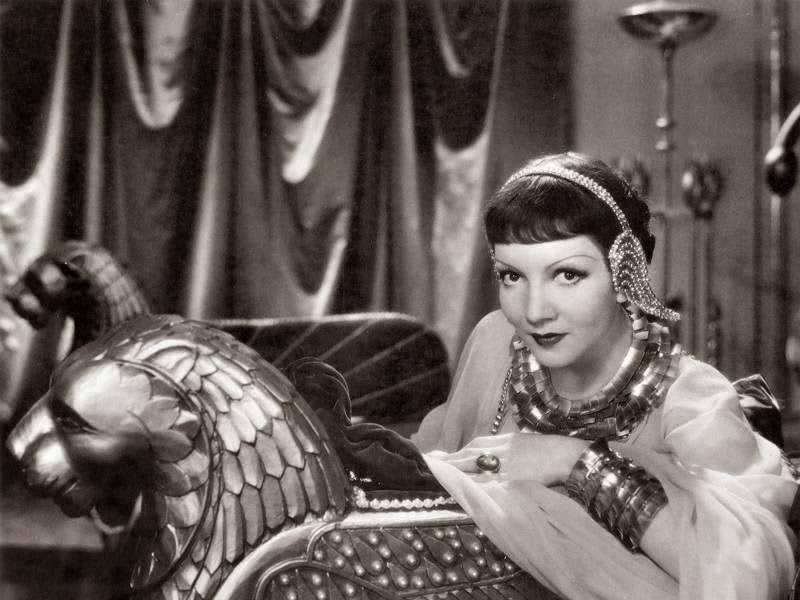
'Cleopatra' Was a Defining Role for Colbert


"Women should be but toys for the great. It becomes them both."

Cleopatra (Claudette Colbert)

For all intents and purposes, Cleopatra was the last pharaoh of ancient Egypt. She was survived by her teenage son for about a week and a half. That made him the last pharaoh — technically — but his rule was spent in captivity and ended with his apparent execution.

More than 2,000 years after her death, Cleopatra is still a fascinating figure in the West. She has been portrayed countless times on the stage in Shakespeare's play "Antony and Cleopatra" and Jules Massenet's opera "Cléopâtre," and she has been portrayed in numerous films, TV productions and video games. She is regarded as one of history's great beauties; she was seen that way by her contemporaries, too.

Thus, it wasn't surprising when one of the big screen's great beauties, Elizabeth Taylor, was cast as Cleopatra in 20th Century Fox's lavish 1963 production.

But I felt that Claudette Colbert's version of "Cleopatra," which was released 80 years ago today, was as good as — if not better than — Taylor's. Just, well, different.

I know I will get arguments about that, but hear me out. As nearly as I could tell, both movies told the same story and emphasized mostly the same events; the '63 version took a lot longer to do it and, when adjusted for current dollars, may have been the most expensive movie ever made.

The role of Cleopatra may well have defined Colbert more than her role in any other movie.

The '34 version may have been guilty of focusing strictly on Cleopatra and not paying as much attention to the men around her — or some of the facts — as the '63 version did. It was Colbert's movie — whereas Taylor, who had already won an Oscar, shared the screen and the credits with two other well–known actors, Richard Burton and Rex Harrison.

I don't know if Colbert is considered one of the screen's great beauties (or even if she was seen as such in her own time), but I do know some of her roles made her something of an early sex symbol.

(That includes her performance in "Cleopatra," although, personally, I have always thought she resembled Lilith Sternin from Cheers! and Frasier in that one.)

Although I have never seen it, I have heard that Colbert's bare breasts could be seen briefly in 1932's "The Sign of the Cross" in a scene that I have heard was a primary catalyst for the strict enforcement of the Hays Code.

When it asserted itself as the authority over movies in the United States, the Motion Pictures Producers and Distributors of America (MPPDA) prohibited, among several other things, "licentious or suggestive nudity — in fact or in silhouette; and any lecherous or licentious notice thereof by other characters."

Colbert's "Cleopatra" was made when the Hays Code was just beginning to flex its muscles — and producer/director Cecil B. DeMille pushed some boundaries.

Colbert was dressed in skimpy costumes that might not have been permitted if the movie had been made only a few months later.

Was that historically accurate? I don't know. I doubt it, just as I doubt that the decor of ancient Rome was as art deco as it was in DeMille's "Cleopatra."

Certain concessions do seem to have been made to the moviegoers of 1934.

In another instance of pushing the envelope, a seemingly naked slave girl holding two incense burners could be seen in the opening credits. The indistinct lighting left much to the imagination.

Nudity was not the focus of "Cleopatra." Sex, however, was.

The emphasis really was on Colbert. The men were mostly props; none would be recognizable to modern movie watchers. Some were regarded as being among the best actors of their time, but they were really only there because Cleopatra needed a Marc Antony and a Julius Caesar — and she couldn't play all the roles.

As I say, I don't know if Colbert had a reputation as a sex symbol in 1934, but she was quite popular. She won an Oscar for her performance in "It Happened One Night," and that movie certainly featured the kinds of things that would seldom, if ever, be permitted on the big screen for another 35 years.

Colbert had quite a range as an actress, and playing Cleopatra was only one style of which she was capable — if the role can be confined to a single style. In one scene, Colbert's Cleopatra could be playful and flirtatious; in the next, she might well be cold and calculating.

If Colbert is remembered for anything, I suppose it is her flair for screwball comedy, and there were elements of that to be seen in her portrayal of Cleopatra.

If nothing else, I thought Colbert was having a lot of fun. Perhaps I was mistaken.

"Cleopatra" definitely was not a screwball comedy. But, when it was done, Colbert resolved never to be typecast in overtly sexual roles again.

That might have been the wisest career move for her. Colbert was nominated for two other Oscars but lost both (the first time to Bette Davis, the second time to Ingrid Bergman). She might not have been nominated at all if she had felt demeaned by her roles.

Did her role in "Cleopatra" demean her? Judge for yourself.

Saturday, February 22, 2014

The First Movie to Sweep the Major Oscars


"I want to see what love looks like when it's triumphant. I haven't had a good laugh in a week."

Peter (Clark Gable)

There may have been movies that premiered before this date in 1934 that could be classified as screwball comedies.

But the genre really began to gain popularity when "It Happened One Night" premiered on this date in 1934. For all intents and purposes, I suppose, the screwball comedy was born 80 years ago today. (As a comedy, the American Film Institute ranks it eighth all time.)

And its influence can be seen in numerous movies in the decades that followed, even though the screwball comedy's heyday was in the 1930s. The blueprint for the genre — a headstrong, runaway heiress gets hooked up with someone, frequently a reporter, who can gain something from the relationship — has shown up in various forms over the years.

"Roman Holiday," for instance, had a runaway princess (Audrey Hepburn) in the company of a reporter (Gregory Peck) who needed a scoop to revive his career.

That, in a nutshell, was the plot of "It Happened One Night." (There were a few differences, but not many.)

But, because it was so different from other movies in the still–emerging motion picture art form, it didn't enjoy the enthusiastic support of some of its principal participants. Claudette Colbert, for example, had worked with director Frank Capra before, and the experience had not been pleasant. She wasn't going to work with him again, but she relented on the conditions that her pay be doubled and that her work on the project be done in time for her to take a planned vacation.

Capra claimed that Clark Gable was hesitant to participate in the project as well.

And Capra himself reportedly said it was "the worst picture in the world."

Ellie (Claudette Colbert): I'll stop a car, and I won't use my thumb!

Peter (Clark Gable): What're you gonna do?

Ellie: It's a system all my own.

Thus, it caught just about everyone by surprise when "It Happened One Night" became the first movie to sweep Best Picture, Best Actor (Gable), Best Actress (Colbert), Best Director (Capra) and Best Adapted Screenplay (Robert Riskin) at the Academy Awards. It was a feat that would not be duplicated for more than 40 years — until 1975, when "One Flew Over the Cuckoo's Nest" won all five Oscars.

Modern movie viewers who have watched other movies from the 1930s undoubtedly will notice that "It Happened One Night" was more daring than its contemporaries, and there is a good reason for that. "It Happened One Night" was made just before enforcement of the Motion Picture Production Code (also known as the Hays Code for Will Hays, Hollywood's censor–in–chief of the day) began.

Consequently, there was more of a sense of freedom in "It Happened One Night" than there was in most of the screwball comedies of the 1930s. Certainly, there was more bare skin than one sees in most movies from that decade. No nudity, but scenes in which skin — like Gable's bare chest and Colbert's bare leg — was shown.

In other movies of the '30s (and for decades after), you rarely, if ever, saw an unmarried couple sleeping in the same room, much less the same bed (even married movie couples didn't do that).

Gable and Colbert didn't sleep in the same bed, but they did sleep in the same room.

And they used a clever strategy for maintaining their individual privacy — they hung a blanket between the beds.

Peter (Clark Gable): Remember me? I'm the fellow you slept on last night.

Ellie (Claudette Colbert): You needn't concern yourself about me. I can take care of myself.

Peter: You'll never get away with it, Miss Andrews.

I never understood the objections that some actors had to the quality of the script. I thought it was smart, clever.

To be fair, some movie stars who turned down the roles that ultimately went to Gable and Colbert claimed that the actual script in the movie was not the same script they had been shown.

Be that as it may, there was an undeniable chemistry between Gable and Colbert in "It Happened One Night," and that more than anything else made it such an appealing movie.

The story transcended global politics — both Josef Stalin and Adolf Hitler were said to be fans of "It Happened One Night."

They weren't the only ones. Before "It Happened One Night" swept the Oscars, it swept the country. It was a smash hit for Columbia Pictures. Made for an investment of $325,000, it earned $2.5 million at the box office.

It's hard to imagine a better return on your investment in 1934.