Showing posts with label superhero. Show all posts

Thursday, May 04, 2017

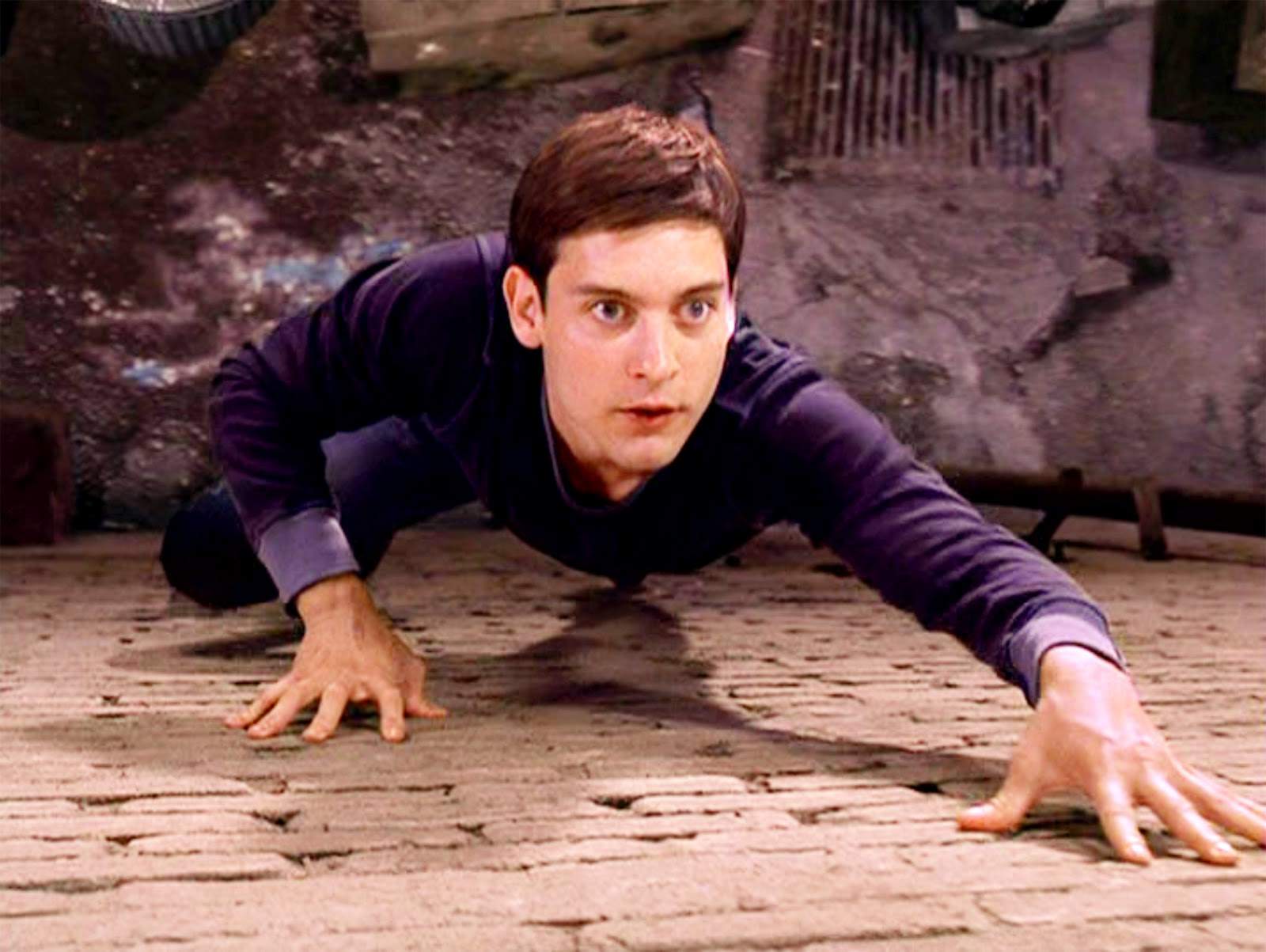
The End of the Spider-Man Trilogy


Sequels are seldom worthy successors to the originals.

Sometimes a second chapter is necessary only so it is possible to move on to a third. I have always thought that was the case with the "Back to the Future" movies, and I definitely feel that way about the "Spider–Man" movies, the third installment of which made its debut on this day in 2007.

As I observed yesterday, I liked the "Spider–Man" movie from 2002 — and I liked its second sequel, the one that premiered 10 years ago today. The second movie, which premiered in 2004, didn't have much going for it, as far as I was concerned.

(The third part of a trilogy isn't always so great. The third chapters of "The Godfather" and original "Star Wars" trilogies easily make that case.)

Not everyone felt that way. Film critic Roger Ebert and I frequently had similar reactions to movies — but not the "Spider–Man" trilogy.

And it all seems to have hinged on the character of Peter Parker (Tobey Maguire). I had no problems with him, but Ebert apparently did.

"The great failing of 'Spider–Man 3' is that it failed to distract me from what a sap Peter Parker is," Ebert wrote. "It lingers so long over the dopey romance between Peter and the long–suffering Mary Jane [Kirsten Dunst] that I found myself asking the question: Could a whole movie about the relationship between these two twentysomethings be made? And my answer was: No, because today's audiences would never accept a hero so clueless and a heroine so docile."

I thought that was a bit harsh, considering that the movie's sole purpose was to entertain — not to make some profound statement.

Well, perhaps that wasn't its sole purpose. I wouldn't rule out the money motive. The original "Spider–Man" became the first movie to exceed $100 million at the box office in its first weekend on American movie screens. Its sequel, which was released in 2004, beat the original's opening–day record by $1 million.

It was logical to expect a similar response to the third movie, and it didn't disappoint — well, not entirely. It was the highest–grossing film of the three movies in the trilogy — but, although the DVD sales grossed more than $120 million, they still came up short of expectations.

Anyway, Ebert and I were never on the same page on the "Spider–Man" movies. He didn't like the first and third movies; I did.

On the other hand, he did like the second movie. "Now this is what a superhero movie should be," he wrote of that first sequel. I thought the only purpose for the second movie (other than to make a lot of money) was to be a bridge between the first and second movies. I still think that, for that matter.

Go figure.

Anyway, I can kind of understand where some folks were coming from in their criticism — the ones who complained that there were too many stories going on at once.

Yes. There were quite a few stories being told.

There were the continuing stories dating back to the original movie — of Peter Parker and M.J., of Parker's newspaper career and his editor (J.K. Simmons) and of the son of the Green Goblin (Willem Dafoe), whose spirit urged his son to seek vengeance (and tried to do so through M.J.).

And there was some new stuff. There was Bryce Dallas Howard (Ron Howard's talented and beautiful daughter) who played Parker's lab partner and temporary love interest.

There was also the introduction of a new villain, played by Thomas Haden Church, who, as it turned out, had been responsible for the death of Parker's uncle (Cliff Robertson). His aunt (Rosemary Harris) was back.

Yep, there was a lot going on. Nothing neat and orderly about it. But isn't that the burden of a superhero?

Wednesday, May 03, 2017

Spinning Spider-Man's Web on the Big Screen


I was never a devotee of comic books.

Oh, sure, there were some I would read when I was a kid — but not regularly. I could take 'em or leave 'em.

I always preferred the comic books that made me laugh as opposed to the ones that I judged to be dramatic, more serious in nature.

It was in that category that I would put characters like Superman, Spider–Man, etc. It seems to me that superheroes are, almost by definition, about serious stuff, and their fans are deadly serious about them. I've known people who were really into the superhero thing. I even worked with a guy once who was petrified of spiders but loved the character Spider–Man. Go figure.

That might explain why I liked the "Super–Man" movie that made its debut on this date in 2002 — even though many people seem to prefer the version from 2012. I've never seen that one, though, so I can't be making any kind of comparison except based on what I've heard from others.

That wouldn't be a satisfactory answer, either, though, because the general consensus seems to be that the 2012 version was better. And it may well have been.

I just felt thoroughly entertained by the version that premiered 15 years ago today. It may not have had the special effects that were available a decade later, but movies have always been that way. They've always had to compensate for the things they didn't have or couldn't do.

"Spider–Man" told a good story. That always makes up for a lot with me. It was like watching a comic book, frame by frame, on the movie screen. I could almost see the balloon dialogue between the characters.

Except there was a difference.

Comic books have always seemed scripted to me. In real life, people aren't usually as quick on their feet as they appear to be in a book, comic or otherwise. In real life, humans sometimes (often, in fact) need at least a little time to absorb what they have heard or seen before making a response — which is rarely as impressive as what appears in print. Books, comic or otherwise, may be intended to appear spontaneous, and many may succeed even though they almost certainly went through several lengthy revisions.

But the acting in "Spider–Man" always had just enough of those human pauses for entirely plausible intervals to make things seem spontaneous — even though the movie was just as scripted as the book(s), comic and otherwise.

Although it might have lacked as much action as Millennials prefer, I thought it was a good call to spend the first half of the movie essentially exploring the character of Peter Parker (Tobey Maguire) rather than assuming that everyone who saw the movie already was familiar with his story. It helped to establish that he had been a neighbor of Mary Jane (Kirsten Dunst) since he was 6 and, by his own admission, had been in love with her all that time.

It was certainly a good call as far as Maguire was concerned. It was the movie that made him a star.

Film critic Roger Ebert and I frequently agreed in our assessments of movies, but we never saw eye to eye on the "Spider–Man" franchise.

Ebert, for example, thought Maguire was miscast. I did not.

"Imagine 'Superman' with a Clark Kent more charismatic than the Man of Steel," Ebert wrote, "and you'll understand how 'Spider–Man' goes wrong. Tobey Maguire is pitch–perfect as the socially retarded Peter Parker, but when he becomes Spider–Man, the film turns to action sequences that zip along like perfunctory cartoons."

I suppose that was the quality I liked best. I always see comic books when I see suuperheroperhero movies, anyway. For me, that made Maguire ideal for the role.

And, although their roles were supporting, Cliff Robertson and Rosemary Harris were well cast as Maguire's aunt and uncle.

Willem Dafoe was perfect as Norman Osborn, the father of Maguire's best friend and a bit of a mad scientist who became Spider–Man's nemesis, the Green Goblin.

I guess the thing about the movie to which I objected was the portrayal of the newspaper editor. Now, I like J.K. Simmons, who played the part. I especially like him in his television role in the Farmers Insurance commercials.

It is likely that he had little input into the character, but I thought it was an unrealistic portrayal. I have worked for several newspapers — and, as a result, several editors. They all had their shortcomings, but they had their redeeming qualities, too. Simmons' character did not.

Monday, June 23, 2014

'Batman' Was Entertaining, and That's What Mattered


"You ever danced with the Devil by the pale moonlight?"

The Joker (Jack Nicholson)

I can remember the first time I saw Tim Burton's "Batman," which premiered 25 years ago today.

I was on my way to St. Louis to visit some friends, and, en route, I stopped off in Little Rock for a few days to visit some other friends. While I was there, they suggested that we all go see "Batman," which had been in the theaters for about a week.

So we did.

My friend Steve was eager to hear Jack Nicholson deliver — in context — the line we had been hearing in trailers: "Where does he get those wonderful toys?" I was just eager to see the movie. It had been getting a lot of press, and it was shaping up to be the summer blockbuster that year.

And I liked it.

Roger Ebert didn't. He said the movie was "a triumph of design over story, style over substance — a great–looking movie with a plot you can't care much about."

Well, see, that's where we come to a parting of the ways. My friends and I enjoyed it — maybe because we didn't bring such lofty expectations to the experience.

I thought Nicholson had a blast playing the Joker. Maybe he didn't, but he certainly seemed to be having a blast. (Considering the reported terms of his contract, which insisted on a high salary and a chunk of the box office receipts — which must have been considerable, given that the movie made more than $400 million — he had every reason to enjoy himself.)

"Batman? Batman? Can somebody tell me what kind of a world we live in where a man dressed up as a bat gets all of my press?"

The Joker (Jack Nicholson)

I don't know if Michael Keaton had a blast playing Batman — but he must have had fun and a certain sense of satisfaction, since my understanding is that he was primarily pigeonholed as a comedic actor before "Batman" was released. He put that reputation to rest and started landing some more dramatic roles, presumably as a result.

(Ebert wrote that Keaton's performance as Batman and Bruce Wayne was "so monosyllabic and impenetrable that we have to remind ourselves to cheer for them.")

As for Kim Basinger, well, she was 35 and a darned good distraction. I don't think her performance as Vicki Vale was her best — that would probably be her Oscar–winning turn in 1997's "L.A. Confidential" — or, for that matter, her most demanding.

Basinger wasn't the first choice for the role; Sean Young was. But Young fell from a horse and broke her arm during rehearsals. Burton chose to drop the horseback scene entirely — and go with Basinger instead.

"[A]lthough [Basinger] and Wayne carry on a courtship and Batman rescues her from certain death more than once," Ebert wrote, "there's no chemistry and little eroticism."

I'm not sure I would go that far, but I must concede that Ebert had a valid point when he wrote, "The strangest scene in the movie may be the one where Vicki is brought into the Batcave by Alfred, the faithful valet, and realizes for the first time that Bruce Wayne and Batman are the same person. How does she react? She doesn't react. The movie forgets to allow her to be astonished."

Or a photojournalist.

To me, that may have been the most blatant false note. The true identity of a masked superhero is always a huge mystery, whether in a comic book or a movie — and the source of endless speculation among both those who wish him well and those who wish him ill. As much as I enjoyed "Batman," it was impossible for me to believe that Basinger, playing a photographer working with a newspaper that was eager for scoops, had zero interest in the subject, even when she figured it out.

Which she must have done. Vicki Vale was simply too sharp to miss something like that.

I saw the sequel to "Batman""Batman Returns" — and Basinger's character wasn't in it (except in conversation). Her almost casual discovery of Bruce Wayne's other identity was never addressed.

Maybe my friends and I didn't particularly care about the plot — but we were entertained by it.

And maybe that is all that mattered.