Showing posts with label Cliff Robertson. Show all posts

Thursday, May 04, 2017

The End of the Spider-Man Trilogy


Sequels are seldom worthy successors to the originals.

Sometimes a second chapter is necessary only so it is possible to move on to a third. I have always thought that was the case with the "Back to the Future" movies, and I definitely feel that way about the "Spider–Man" movies, the third installment of which made its debut on this day in 2007.

As I observed yesterday, I liked the "Spider–Man" movie from 2002 — and I liked its second sequel, the one that premiered 10 years ago today. The second movie, which premiered in 2004, didn't have much going for it, as far as I was concerned.

(The third part of a trilogy isn't always so great. The third chapters of "The Godfather" and original "Star Wars" trilogies easily make that case.)

Not everyone felt that way. Film critic Roger Ebert and I frequently had similar reactions to movies — but not the "Spider–Man" trilogy.

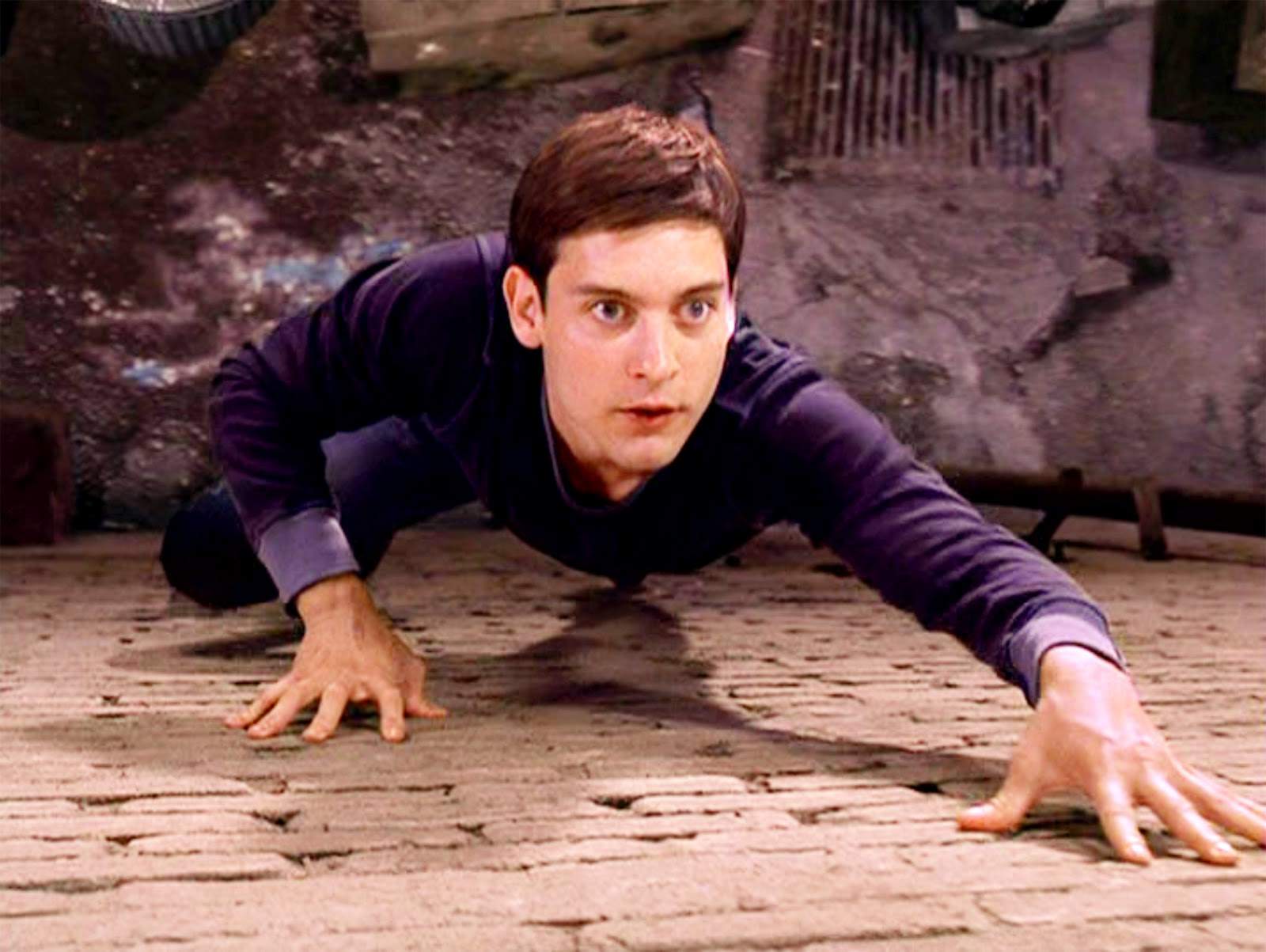
And it all seems to have hinged on the character of Peter Parker (Tobey Maguire). I had no problems with him, but Ebert apparently did.

"The great failing of 'Spider–Man 3' is that it failed to distract me from what a sap Peter Parker is," Ebert wrote. "It lingers so long over the dopey romance between Peter and the long–suffering Mary Jane [Kirsten Dunst] that I found myself asking the question: Could a whole movie about the relationship between these two twentysomethings be made? And my answer was: No, because today's audiences would never accept a hero so clueless and a heroine so docile."

I thought that was a bit harsh, considering that the movie's sole purpose was to entertain — not to make some profound statement.

Well, perhaps that wasn't its sole purpose. I wouldn't rule out the money motive. The original "Spider–Man" became the first movie to exceed $100 million at the box office in its first weekend on American movie screens. Its sequel, which was released in 2004, beat the original's opening–day record by $1 million.

It was logical to expect a similar response to the third movie, and it didn't disappoint — well, not entirely. It was the highest–grossing film of the three movies in the trilogy — but, although the DVD sales grossed more than $120 million, they still came up short of expectations.

Anyway, Ebert and I were never on the same page on the "Spider–Man" movies. He didn't like the first and third movies; I did.

On the other hand, he did like the second movie. "Now this is what a superhero movie should be," he wrote of that first sequel. I thought the only purpose for the second movie (other than to make a lot of money) was to be a bridge between the first and second movies. I still think that, for that matter.

Go figure.

Anyway, I can kind of understand where some folks were coming from in their criticism — the ones who complained that there were too many stories going on at once.

Yes. There were quite a few stories being told.

There were the continuing stories dating back to the original movie — of Peter Parker and M.J., of Parker's newspaper career and his editor (J.K. Simmons) and of the son of the Green Goblin (Willem Dafoe), whose spirit urged his son to seek vengeance (and tried to do so through M.J.).

And there was some new stuff. There was Bryce Dallas Howard (Ron Howard's talented and beautiful daughter) who played Parker's lab partner and temporary love interest.

There was also the introduction of a new villain, played by Thomas Haden Church, who, as it turned out, had been responsible for the death of Parker's uncle (Cliff Robertson). His aunt (Rosemary Harris) was back.

Yep, there was a lot going on. Nothing neat and orderly about it. But isn't that the burden of a superhero?

Wednesday, May 03, 2017

Spinning Spider-Man's Web on the Big Screen


I was never a devotee of comic books.

Oh, sure, there were some I would read when I was a kid — but not regularly. I could take 'em or leave 'em.

I always preferred the comic books that made me laugh as opposed to the ones that I judged to be dramatic, more serious in nature.

It was in that category that I would put characters like Superman, Spider–Man, etc. It seems to me that superheroes are, almost by definition, about serious stuff, and their fans are deadly serious about them. I've known people who were really into the superhero thing. I even worked with a guy once who was petrified of spiders but loved the character Spider–Man. Go figure.

That might explain why I liked the "Super–Man" movie that made its debut on this date in 2002 — even though many people seem to prefer the version from 2012. I've never seen that one, though, so I can't be making any kind of comparison except based on what I've heard from others.

That wouldn't be a satisfactory answer, either, though, because the general consensus seems to be that the 2012 version was better. And it may well have been.

I just felt thoroughly entertained by the version that premiered 15 years ago today. It may not have had the special effects that were available a decade later, but movies have always been that way. They've always had to compensate for the things they didn't have or couldn't do.

"Spider–Man" told a good story. That always makes up for a lot with me. It was like watching a comic book, frame by frame, on the movie screen. I could almost see the balloon dialogue between the characters.

Except there was a difference.

Comic books have always seemed scripted to me. In real life, people aren't usually as quick on their feet as they appear to be in a book, comic or otherwise. In real life, humans sometimes (often, in fact) need at least a little time to absorb what they have heard or seen before making a response — which is rarely as impressive as what appears in print. Books, comic or otherwise, may be intended to appear spontaneous, and many may succeed even though they almost certainly went through several lengthy revisions.

But the acting in "Spider–Man" always had just enough of those human pauses for entirely plausible intervals to make things seem spontaneous — even though the movie was just as scripted as the book(s), comic and otherwise.

Although it might have lacked as much action as Millennials prefer, I thought it was a good call to spend the first half of the movie essentially exploring the character of Peter Parker (Tobey Maguire) rather than assuming that everyone who saw the movie already was familiar with his story. It helped to establish that he had been a neighbor of Mary Jane (Kirsten Dunst) since he was 6 and, by his own admission, had been in love with her all that time.

It was certainly a good call as far as Maguire was concerned. It was the movie that made him a star.

Film critic Roger Ebert and I frequently agreed in our assessments of movies, but we never saw eye to eye on the "Spider–Man" franchise.

Ebert, for example, thought Maguire was miscast. I did not.

"Imagine 'Superman' with a Clark Kent more charismatic than the Man of Steel," Ebert wrote, "and you'll understand how 'Spider–Man' goes wrong. Tobey Maguire is pitch–perfect as the socially retarded Peter Parker, but when he becomes Spider–Man, the film turns to action sequences that zip along like perfunctory cartoons."

I suppose that was the quality I liked best. I always see comic books when I see suuperheroperhero movies, anyway. For me, that made Maguire ideal for the role.

And, although their roles were supporting, Cliff Robertson and Rosemary Harris were well cast as Maguire's aunt and uncle.

Willem Dafoe was perfect as Norman Osborn, the father of Maguire's best friend and a bit of a mad scientist who became Spider–Man's nemesis, the Green Goblin.

I guess the thing about the movie to which I objected was the portrayal of the newspaper editor. Now, I like J.K. Simmons, who played the part. I especially like him in his television role in the Farmers Insurance commercials.

It is likely that he had little input into the character, but I thought it was an unrealistic portrayal. I have worked for several newspapers — and, as a result, several editors. They all had their shortcomings, but they had their redeeming qualities, too. Simmons' character did not.

Thursday, September 24, 2015

Who Ya Gonna Trust?


Kathy (Faye Dunaway): Do you trust him?

Turner (Robert Redford): [shaking his head] Trust.

Kathy: Does he trust you?

Turner: He's in the suspicion business. He can't trust anybody.

Kathy: How could anybody fool them?

Turner: Maybe nobody did.

Kathy: Then ...

Turner: Maybe there's another CIA ... inside the CIA.

As Roger Ebert wrote about "Three Days of the Condor," which premiered on this day 40 years ago, the story was "all too believable" in the aftermath of Watergate.

That was kind of an ironic observation, given that, within a year, Redford would co–star with Dustin Hoffman in a movie about the early days of the Watergate investigation. (A friendly warning: If you haven't seen "Three Days of the Condor" before, the images of the World Trade Center that keep popping up can be a little unsettling even though they were really only props in the movie, and it was made about 26 years before the terrorist attacks brought them down.)

His co–stars in "Three Days of the Condor" were Faye Dunaway, Cliff Robertson and Max von Sydow. The director was Sydney Pollack.

"How soon we grow used to the most depressing possibilities about our government," Ebert wrote, "and how soon, too, we commercialize on them. Hollywood stars used to play cowboys and generals. Now they're wiretappers and assassins, or targets."

Considering the times we live in, that makes me wonder what we'll be seeing on our movie screens in the not–so–distant future.

In this movie, Redford played a target, a seemingly naive character who worked as a reader for the American Literary Historical Society, which was actually a front for the CIA. And Redford was a CIA analyst (code name: Condor) who read books and periodicals from around the world looking for concealed meanings. In the early part of the movie, he filed a report on a spy thriller he had been reading, commenting on unusual plot twists and the number of languages into which it had been translated in spite of the fact that it wasn't commercially successful.

Then, one day, when Redford was out getting sandwiches for the office, someone came in and shot up the place. When he returned, he found everyone dead.

From that point on, you really had to follow the story carefully because, in true spy thriller fashion, people got shot on a frequent basis. Characters you thought you knew. Characters you didn't know at all.

Faye Dunaway entered the story as kind of an innocent bystander. Redford spotted her in a store and, needing a place to hide, forced her to take him to her apartment, where he held her prisoner while trying to decide on his next move. As time went by, they became lovers.

Max von Sydow played a shadowy contract killer who had been behind the shootings in Redford's office. He turned his attention to Redford, the one who got away.

Cliff Robertson played Redford's section chief, but Redford had never met him and, knowing the environment in which they both worked, didn't exactly trust him.

Perhaps now you can see why Ebert said the movie was believable. And I believed the story, too — except for the part about Redford and Dunaway becoming lovers after he had abducted her at gunpoint. Let me clarify that. I didn't believe it at the time I saw it; since that time, I have heard of a number of incidents in which an abductee did fall in love with the abductor. Seems to me that is called the Stockholm syndrome — when a hostage bonds with the abductor. Anyway, it has more credibility with me now.

And I suppose that must have been what the movie was portraying in the side story about Redford and Dunaway.

Hey, it had to be. Dunaway took a shower and, when she came out of the bathroom, witnessed Redford shooting a guy who had been sent by his superiors to kill Redford. And she stayed with him.

You really had to pay attention to the story, or you would miss something important. For some people, that is simply too much work. For them, movies are for escapism, something that should wash over you while you devote little effort to the experience. Spy thrillers (well, the really good ones, anyway) aren't that way in print, and they aren't that way in the movies.

"Three Days of the Condor" seemed like the kind of movie Oscar usually rewards, but it only received one nomination — for Film Editing — and lost to "Jaws."

Monday, September 30, 2013

Reading Other People's Minds


Dr. Michael Anthony Brace (Christopher Walken): Why do you have to die to let go?

Natalie Wood was finishing the movie "Brainstorm" when she died in November 1981.

As a result, much of the movie had to be rewritten and earlier footage had to be used.

It was, perhaps, inevitable that "Brainstorm" would be promoted in the media, when it was finally released 30 years ago today, as Natalie Wood's last film — even though the character she played was, at best, a supporting character.

The star was actually Christopher Walken, who was a hot box–office draw by that time, having appeared in some of the best movies of the '70s and early '80s ("Annie Hall," "The Deer Hunter," "Pennies From Heaven"). Walken was a scientist who experimented with a device that could read a person's thoughts and transfer them to video tape.

One of Walken's colleagues, Louise Fletcher, had a heart attack while by herself. Figuring (apparently correctly) that help could not reach her in time, she put the device on her head and allowed it to record the experience of her death.

When he tried to play back the recording of Fletcher's character's death, Walken's character nearly died as he realized that not only could the device record experiences visually but it could also make the viewer have the same physical experience the wearer had.

Kind of a twist on the old 3–D effect, wouldn't you say?

In the case of Fletcher's tape, that meant the viewer would experience the physical sensation of a heart attack.

Of course, there were other kinds of experiences that were candidates for abuse when committed to this futuristic tape. What was a brave new world in the early '80s has, in many ways, come to pass today.

In fact, I have often thought in recent years that it was practically prescient the way "Brainstorm" anticipated things like artificial intelligence and virtual experiences.

In the movie, one member of the research team had sex with his girlfriend while wearing the device. An older team member, seeking to re–capture his youth, got the tape that had been made and spliced the lovemaking segment to run continuously, nearly killing him.

Thus the potential for misuse/abuse of this technology was established.

I've been an admirer of Natalie Wood for a long time, and I was kind of sorry that this was her final movie. It isn't that I didn't care for the subject matter. On the contrary, I thought it was almost visionary, even at the time but certainly as the years have passed.

No, the thing I regretted was that Wood was a supporting character. Nothing wrong with that. I've known of many great actors and actresses who were supporting actors. But Wood was a leading lady. She always gave great performances, and sometimes they were in supporting roles, but she was mostly a star as an adult, yet she played Walken's estranged wife. Fletcher, as Walken's like–minded research colleague, had more of a presence in the film, as did Cliff Robertson as CEO of the research team.

Otherwise, it probably was an appropriate capper to Wood's career. She was too young to die, and the circumstances surrounding her death were as baffling as they come, but that fed into the plotline pretty well.

Of course, some of it had to be redone after Wood died, but I felt the writers deserved credit for, as they say in this part of the country, "making chicken salad out of chicken s**t."