Showing posts with label nudity. Show all posts

Wednesday, February 07, 2018

An American in Paris


Bernardo Bertolucci's "Last Tango in Paris," a French–Italian movie that premiered across the United States on this day in 1973, caused quite a stir — such a stir that Premiere Magazine included it in its "100 Movies That Shook the World" list.

It received an X rating, which has come to be associated with pornography but was initially given to legitimate feature films (1969's "Midnight Cowboy," for example) that had content deemed too extreme for children. That applied not only to sexual content but to violent content as well.

Film critic Roger Ebert gushed about "Last Tango in Paris" after its New York premiere in late 1972: It was "one of the great emotional experiences of our time," he wrote. "It's a movie that exists so resolutely on the level of emotion, indeed, that possibly only Marlon Brando, of all living actors, could have played its lead. Who else can act so brutally and imply such vulnerability and need?"

And need, Ebert wrote, was what the movie was really about. It had some explicit nudity and not–quite–as–explicit sex, which got all the headlines — and that was used as the promotional hook to lure audiences to theaters — but I think Ebert was on to something when he said the movie was about need.

"There is a lot of sex in this film," Ebert wrote, "more, probably, than in any other legitimate feature film ever made — but the sex isn't the point, it's only the medium of exchange."

Brando's character, a middle–aged American widower living in Paris, certainly had needs. And Ebert was right about his vulnerability. When the movie began, Brando's wife was already dead, a suicide victim, so the viewers never saw anything of the marriage other than what was said about it on the screen, and the reason for the suicide was never revealed so the viewers never really knew why she did it. Still there were some ominous clues scattered about the story.

That isn't the best way to judge a marriage, obviously, but the union clearly left a lot to be desired — and the vulnerability of Brando's character had deep roots in that. That was clear when Brando ranted while standing at his wife's coffin at her wake.

Brando's character had been abused, and it had been a lifelong story of abuse. It started with his alcoholic parents, and it continued from there into a marriage that was abusive, if not physically then certainly emotionally.

The role had its flaws, but I thought the character suffered from arrested development from his youth that carried into his adult years. That was why Ebert observed that Brando's character was "a man whose whole existence has been reduced to a cry for help — and who has been so damaged by life that he can only express that cry in acts of crude sexuality."

The nudity and the sexuality amounted to no more than stage props for the story. "Last Tango in Paris" wasn't about those things.

Well, let me amend that.

It was about sex in the sense that some people use sex as a haven and a weapon, not as an expression of love for another person, and the lovers in "Last Tango in Paris" were like that.

The relationship between Brando and a young French woman (Maria Schneider), though, was mostly physical. At Brando's character's insistence, they knew nothing of each other, not even each other's names. But that didn't mean they didn't use sex as a haven and a weapon as well, even as a physical release — but never as an expression of genuine affection.

I have heard people call it Brando's greatest performance, and I have my issues with that. It was a nuanced performance, I will concede that, but I am far more likely to align myself with Ebert, who wrote that he didn't know if it was Brando's greatest performance, but the movie "certainly contains his most emotionally overwhelming scene" — his rant next to his wife's coffin. Ebert wrote that Brando delivered "one of the most moving speeches of love I can imagine."

In that scene, Ebert wrote, Brando "makes it absolutely clear why he is the best film actor of all time. He may be a bore, he may be a creep, he may act childish about the Academy Awards — but there is no one else who could have played that scene flat–out, no holds barred, the way he did, and make it work triumphantly."

Brando was rewarded with an Oscar nomination for Best Actor (which he lost to Jack Lemmon). Bertolucci was nominated for Best Director (and lost to George Roy Hill).

Schneider, who later said she felt raped by the experience, received no Oscar consideration.

Tuesday, January 12, 2016

Another Milestone for Archie


All in the Family was always blazing new trails in American television. Most of the time, those trails provoked conversations about isms — you know, communism, racism, sexism, that kind of thing.

In the episode that aired on this night in 1976, Archie (Carroll O'Connor) blazed a different kind of trail for network television — full frontal nudity. Not his own. The nudity of his infant grandson in the series. I'll get back to that in a minute.

What happened was that Mike (Rob Reiner) was taking Gloria (Sally Struthers) out for the evening. It was three weeks since the episode in which the baby was born, and it must have been three weeks in the timeline of the series as well because Mike mentioned that it was the first time in three weeks that they had been able to go out.

That part seemed to be rushing things, I thought. Now, I have never been married, and I have never lived with a new mother — at least, not since I was 3 and my brother was born, and I had no comprehension of time in those days — so I don't know how long it usually takes for a new mother to be sufficiently recovered from labor to go out for the evening, but three weeks seems a little premature to me. Perhaps I am wrong about that.

Anyway, the Stivics were going out for the evening, and Mike had retained one of his students to babysit. Archie wasn't wild about that, especially after the babysitter's boyfriend showed up, presumably so they could study together while she watched the baby. Archie thought they were more interested in studying each other than studying for class — and it followed that they would be more interested in studying each other than keeping an eye on the baby.

So Archie ran them off.

That presented a problem for Archie. There was no one to babysit except him — and he was hosting a poker party at his house. Edith, as I recall, was visiting her aunt who was in her 80s and, apparently, in poor health so Edith didn't appear in the episode.

Archie brought his grandson over to his house, and the poker party soon gave way to efforts to figure out why the baby kept crying. Was he hungry? Did he need to be changed? The card players gave a barbershop quartet rendition of "Rock–A–Bye, Baby" to try to put him to sleep.

The answer came quickly enough. The baby made a noise that everyone thought, at first, was a burp. But after a few seconds, the looks on their faces confirmed what Archie soon observed: "That wasn't no burp."

His poker buddies made their exit, leaving Archie to change the baby.

And that is when the full frontal nudity part came in.

It wasn't a lingering shot. It was very brief, actually. But it was a first for network television — and it was controversial in 1975, much more so than it is 40 years later.

As I understand it, summer reruns and subsequent syndicated airings had that scene edited out.

But viewers in Canada can still see the episode unedited.

As far as I was concerned, it was always a nonissue. It was such a fleeting moment, like Janet Jackson's wardrobe malfunction during the Super Bowl. It was over before most viewers could comprehend what they had seen.

But, as I say, it was controversial, as sexual topics always are.

Tuesday, December 22, 2015

Not Exactly a Christmas 'Gift'


"Miss Wilson, I don't believe in what you do. I'll just be straight with you. Not only that, I don't like it. But, we've got to the end of the road of our investigation ... and looked under every rock there is to look under ... and we'd like you to tell us what you can to help us."

Sheriff (J.K. Simmons)

"The Gift," which premiered 15 years ago today, seemed to slip in beneath most people's radars. That is a shame because it really was a suspenseful tale.

Many of those who went to see it during the Christmas season in 2000 may well have expected to see a holiday–oriented tale if all they knew of it was its title. Boy, were they in for a surprise.

Cate Blanchett played a young widow, a psychic who did card readings for people in a small town in Georgia. In the early minutes of the movie, audiences must have been certain that Hilary Swank, who played a victim of spousal abuse, would be likely to turn up dead. Instead it was Katie Holmes, the fiancee of Greg Kinnear who was having torrid affairs with apparently everyone, who turned up missing.

It was enough to give anyone a headache — and then there was Blanchett's long–dead grandmother (Rosemary Harris) who popped up to remind her to trust her instincts.

There were enough creepy things going on to make sure everyone knew this wasn't a Christmas movie.

Now before I proceed, I should try to address what I see as a conflict in terminology. I said that Blanchett played a psychic although I suppose when I was a child I would have called her a fortune teller because questions about the future are what card readings always seemed to me to be about when I was growing up. You know, questions like will I fall in love and get married? or will I be successful? Magic 8–Ball stuff.

And I gather that Blanchett's character did her share of that with many of her clients, but the clients the audience saw were always having their pasts revealed — Swank's abuse as well as the abuse of another character, Buddy (Giovanni Ribisi), who had been abused as a child by his father.

My point is that I'm not sure if psychic and fortune teller mean the same thing or different things.

It is in the area of revelation of the past that I associate the term psychic — if only because I hear from time to time of psychics being brought on to help criminal investigators who have run into a wall in their probes into disappearances.

That is what happened in "The Gift."

Holmes' disappearance brought Blanchett into the apparently stalled investigation. She had a vision of Holmes being attacked and killed and then thrown into a pond on property belonging to Swank's husband (Keanu Reeves), and that led to Reeves' arrest and eventual conviction after Holmes' body was retrieved from his pond.

This brings me to one of my quibbles with the movie. It appeared that Reeves was arrested, then almost immediately put on trial. I know the Constitution guarantees every defendant the right to a speedy trial, but that is much faster than the legal process usually works.

(Speaking as someone who, like many novice reporters, covered police and fire beats, things don't happen as quickly as they seem to happen in the movies.)

But Reeves' character wasn't guilty, as Blanchett learned in another vision, and she went to the prosecutor (Gary Cole) to ask him to reopen the case. She couldn't see who the killer was, she said, but there seemed to be no shortage of prospects, including Swank, who knew that Holmes had been sleeping with her husband and, consequently, "she deserved what she got."

Such can be the moralizing posture of a small Southern town.

When I saw "The Gift," I was inclined — and I still am — to think of it as being successful in its bid to be suspenseful, in no small part because of the cast that was assembled. Otherwise, though, I kind of felt it became a rather predictable whodunnit in the second half of the movie.

Film critic Roger Ebert was more glowing in his praise. "The movie is ingenious in its plotting, colorful in its characters, taut in its direction and fortunate in possessing Cate Blanchett," Ebert wrote. "If this were not a crime picture (if it were sopped in social uplift instead of thrills), it would be easier to see the quality of her work. By the end, as all hell is breaking loose, it's easy to forget how much everything depended on the sympathy and gravity she provided in the first two acts."

There is truth in that.

Blanchett's character provided a balance in the telling of the story — at one point Buddy told her she was the "soul" of the town, and I think the same could be said of her influence on the movie.

But what many people — mostly, I suppose, adolescent males — found and still find memorable about "The Gift" was it contained Holmes' first nude scene.

Ebert's opinion notwithstanding, the movie received no recognition from the Oscars — doesn't seem to be too surprising. The Oscars seldom give nominations to comedies or supernatural thrillers.

That doesn't mean, of course, that they aren't worthy of recognition. It's merely a long–standing Academy bias.

Thursday, July 09, 2015

Let a Smile Be Your Umbrella


"Isn't she lovely? Aren't they all lovely? Isn't everyone lovely?"

Ted (Dick McGarvin)

When I first saw "Smile," which premiered on this day 40 years ago, I was a hot–blooded teenage boy. If I had been asked before going into the theater what the movie was about, I wouldn't have been able to say much. I knew it was about a beauty pageant, and I recognized the names of a couple of the young female stars — but, frankly, I was just hoping to see them in bikinis.

After all, pageant contestants wear swimsuits during part of the competition. "Smile" was a satire about a fictional beauty pageant, and I figured that the contestants wouldn't necessarily be wearing the one–piece bathing suits that beauty pageant contestants traditionally wear. Bikinis might be part of the satire.

Anyway, that was my logic on the Saturday afternoon that I saw it.

It was 1975, and I guess the Hays Code that had dictated how movies were made for 40 years was still in charge — but its grip was slipping. In the movies I had seen previously, nudity was never shown, merely suggested.

"Smile" was rated PG, and nudity was still mostly implied in R–rated movies, let alone PG–rated ones, in 1975. It's fair to say I wasn't expecting to see any skin that afternoon that you couldn't normally see on any sidewalk or beach in the summer.

It's also fair to say that has changed considerably in the last 40 years. It is no big deal now if there are scenes of partial nudity in PG movies and full frontal nudity in R movies; in fact, it is almost routine. It was very different in 1975.

Anyway, I was watching the movie, still hoping to see some bikini shots, when there was a brief — ever so brief — scene in which a couple of the girls could be seen changing their clothes and for a second or two, parts of the female anatomy that were usually covered in the movies — and in public — were not.

To put it in the context of the story, the son of one of the pageant organizers (Bruce Dern) was going to use his Polaroid camera to take candid pictures of the girls in the dressing room, then he would sell the pictures. But his plans went awry when he was caught after snapping only a few pictures of Annette O'Toole and Melanie Griffith, who played two of the contestants.

Much of the movie, you see, was centered around the week of preparations for the pageant. In addition to their individual work, the girls all had to participate in a range of musical productions. The actual competition part took very little screen time.

One of the girls (I think it was O'Toole) wore panties with the day of the week embroidered on them. They punctuated the film, informing viewers which day of the pageant week they were about to see unfold, but only the words were visible on screen. The viewers never really knew — until the very end — that they had been looking at embroidered panties.

In his review, film critic Roger Ebert recalled the county fairs of his youth, which featured livestock judging and a beauty pageant (on different nights). "[E]ven in those days before women's liberation," he wrote, "it struck me that the two competitions had points in common. Even some of the judges were the same."

Ebert acknowledged that the cows "weren't expected to sing, dance or play musical instruments, nor did they change costumes. But both they and the girls in the beauty contest were essentially being sized up as meat on the hoof, and that depressed me. Here were girls I'd grown up with, and this dreary and demeaning ritual was forcing them to walk around in bathing suits on a stock–car track."

I gathered from the start of Ebert's review that he didn't go into the movie in the same frame of mind that I did. And I'm quite sure he did not. My state of mind reflected the sexist attitudes that dominated many areas of life when I was growing up. It is probably too easy, too simple to say I was the product of the times in which I was raised, and perhaps I am passing the buck when I say that. But it is true to a great extent.

Ebert's assessment was that the movie was "a sometimes funny, more often harrowing look at a teen–age beauty competition."

In many respects, I suppose, "Smile" must be viewed in an unflattering light.

The girls in the movie, Ebert observed, were "judged in all the categories such events pretend are important — talent, grades, personality, 'pep' — but everyone seem[ed] in tacit agreement that physical appearance is the crucial criterion."

In other words, it's what's on the outside that really matters.

And that really shouldn't come as a surprise, should it? I mean, after all, that is what those pageants really are all about, isn't it? Some of the girls were oblivious to it, but some were hip to what was going on, sharing their beauty secrets with their assigned roommates. In hindsight, cynical is probably the best word to describe the story.

Still, it is worth remembering something that Dern's character says when asked if anything ever gets him down.

"I get my apple cart upset sometimes," he says. "I just learned a long time ago to accept a little less from life, that's all."

Saturday, June 20, 2015

Trouble in Paradise


"There's so many things I don't understand, like why do the fish stop swimming and lie on top of the tide pools after a heavy rain? Why do you hear the waves inside the big shells? Why are all these funny hairs growing on me?"

Richard (Christopher Atkins)

In the weeks leading up to the premiere 35 years ago today of "The Blue Lagoon," I remember seeing many tantalizing and provocative movie trailers and TV commercials that emphasized the forbidden love aspect of two young cousins, a boy and a girl, being marooned alone on an island and surviving there for years, ultimately succumbing to sexual curiosity and the urgings of nature. I guess it wasn't quite as forbidden for cousins as it would have been for a brother and a sister. (They were cousins in the turn–of–the–century novel upon which the movie was based, too. The makers of this movie, as I shall discuss shortly, apparently had no interest in altering the original story in any way.)

Incidentally, film critic Roger Ebert said it was "the dumbest movie of the year," and that really is a difficult conclusion to contradict — especially when you read his summary of the story:
"It could conceivably have been made interesting, if any serious attempt had been made to explore what might really happen if two 7–year–old kids were shipwrecked on an island. But this isn't a realistic movie. It's a wildly idealized romance, in which the kids live in a hut that looks like a Club Med honeymoon cottage, while restless natives commit human sacrifice on the other side of the island. (It is a measure of the filmmakers' desperation that the kids and the natives never meet one another and the kids leave the island without even one obligatory scene of being tied to a stake.)"

Ebert's conclusion is rather remarkable, considering that, while 1980 produced some of the finest movies in recent memory, it also saw such bombs as "Can't Stop the Music," "Herbie Goes Bananas," "Little Darlings," "Motel Hell" and "Wholly Moses!" Competition for designation as the year's dumbest movie was pretty steep.

The girl was played by Brooke Shields, who was just barely 15 when the movie hit the theaters but was already an old pro in front of the camera. She wasn't even a week old when her mother declared that she wanted her daughter to be in show business. She was a child model before her first birthday and continued modeling even after she started appearing in movies.

In fact, it was around the time of the premiere of "The Blue Lagoon" that Shields appeared in a suggestive advertising campaign for Calvin Klein jeans. "You want to know what comes between me and my Calvins?" she purred. "Nothing."

In addition to sending Calvin Klein's sales into orbit, I'm sure the publicity didn't hurt the movie. It earned nearly $59 million in the United States and Canada after being made for less than $5 million. It was the ninth–most successful movie of 1980. It even received an Oscar nomination (Best Cinematography) — and, from what I could see of it when I watched it on TV several months later, it deserved it. How could it miss with all that great scenery?

Of course, there was the matter of nudity — as there had been a few years earlier when Shields, then 12 years old, played a prostitute in "Pretty Baby," in which she allegedly did some scenes in the nude. I've only seen that movie once — like "The Blue Lagoon," it was on TV — and my memory is that the scenes involving Shields were dimly lit, but that did not keep people from complaining about the implications of child pornography. At the time, I heard that Shields actually did her nude scenes wearing a flesh–colored body suit.

I guess Shields and her mother learned from that experience. Or maybe the makers of "The Blue Lagoon" learned from it. Perhaps both. There was nudity in "The Blue Lagoon," but it was indistinct and fleeting, like underwater views of the young couple swimming, or otherwise obscured, as in a scene showing them beneath a waterfall. Shields herself tried to put to rest the allegations by saying that older body doubles were used for the nude scenes of her and co–star Christopher Atkins.

I don't know if that is true or not, but it made a satisfactory story for those who desperately wanted to believe that no one would abuse underage people like that. That was kind of a strange mindset, given what was driving people to the theaters to see "The Blue Lagoon."

"Let's face it," Ebert wrote. "Going into this film knowing what we've heard about it, we're anticipating the scenes in which the two kids discover the joys of sex. This is a prurient motive on our part, and we're maybe a little ashamed of it, but our shame turns to impatience as [director Randal] Kleiser intercuts countless shots of the birds and the bees (every third shot in this movie seems to be showing a parrot's reaction to something)."

The two young versions of Shields and Atkins were shipwrecked along with a cook who gave them guidance until he died, leaving the children to fend for themselves — which they did quite well, thanks to his instructions. He warned them about berries on the island that he believed to be poisonous, but he used words ("never–wake–up berries") that 7–year–olds would understand. They sounded odd coming from the lips of teenagers later in the movie — until you remembered that they hadn't had any instruction from adults in quite some time.

That was one of the things Ebert either forgot or failed to comprehend for one reason or another. The absence of adult supervision could be seen in many ways, but the staying power of the cook's lessons was evident, too. For example, at the end of the movie, the boy and the girl and the baby they conceived were adrift at sea, and they ate some of those berries the cook warned them about, fully expecting to die. It just so happens that, after they had eaten the berries and, as the cook described, fallen asleep (or lapsed into unconsciousness), who should come by in a ship but the boy's father, who, according to the original story, had been looking for his son ever since the first ship was lost.

Ebert thought the movie left the viewers hanging because it was never determined whether the berries had merely put them all to sleep or fatally poisoned them. The movie did leave the audience hanging, but the problem was, so did the book.

"The movie cops out," Ebert complained. "The burden of contriving an ending was apparently too much for such a feeble movie to support."

He was wrong to blame that entirely on the movie. The original sin was Irish author Henry De Vere Stacpoole's more than 70 years earlier. But that certainly doesn't absolve Kleiser and everyone else in the cast and crew of all responsibility for giving their audience an ambiguous ending to the movie — they could have changed it if that had been what they wanted, and, apparently, it was not. They chose a faithful re–telling of Stacpoole's story — and it can only be interpreted as a choice. Stories are "re–imagined" in the movies all the time. Sometimes they are done well. Sometimes not. But it is a choice to do that.

It's a calculated risk, especially if the movie is likely to draw armies of fans who are dedicated to the original book(s). For example, it is my guess that millions of the people who went to see the "Lord of the Rings" movies were fans of the J.R.R. Tolkien books and were likely to notice even the slightest deviation from the original text. In this case, however, I doubt that there were armies of Stacpoole fans going to see how faithfully his story was told; apparently, the story was told as it had been told for decades — there were other film versions before the 1980 edition. I've never seen them, but it is my understanding that none of them changed the ending, either.

Would a different ending have improved the movie? I don't know. A movie is what it is, with the beginning, middle and ending — and all the other decisions — the director made. Speculating on whether a movie would have been better if any part of it had been changed is an exercise in hypotheticals. Suppose someone else had played Atticus Finch in "To Kill a Mockingbird." Would it have been better or worse?

That is a matter of personal taste and opinion. The only thing that could be said for certain would have been that the movie was different.

And that was what the makers of "The Blue Lagoon" could have given their audiences 35 years ago — something that was different from what previous generations had been given. But they played it safe. Ebert thought that was a copout. What do you think?

Thursday, December 25, 2014

Foundering in 'The Life Aquatic'


"Nobody knows what's going to happen. And then we film it. That's the whole concept."

Steve Zissou (Bill Murray)

Roger Ebert summed things up for me pretty neatly in his review of "The Life Aquatic with Steve Zissou," which premiered 10 years ago today.

"My rational mind informs me that this movie doesn't work," Ebert wrote. "Yet I hear a subversive whisper: Since it does so many other things, does it have to work, too? Can't it just exist? ... Wes Anderson's 'The Life Aquatic with Steve Zissou' is the damnedest film. I can't recommend it, but I would not for one second discourage you from seeing it."

Anderson directed and produced this parody of famed ocean explorer Jacques Cousteau disguised as documentary. He achieved greater critical and commercial success with 2001's "The Royal Tenenbaums," but his style may never have been as clearly defined as it was in "The Life Aquatic."

Steve Zissou (Bill Murray) had a bizarre assortment of crew members and general hangers–on aboard.

For example ...

Zissou's ex–wife (Anjelica Huston) and her ex–husband (Jeff Goldblum) were on board — as was a fellow who believed he was Zissou's long–lost son (Owen Wilson). Cate Blanchett played a journalist who was covering the expedition. She also happened to be pregnant.

Another member of the crew crooned David Bowie songs in Portuguese.

And there was a girl who could be seen from time to time on board the ship (which looked like something dreamed up by Jules Verne). She seldom spoke and was noteworthy mostly for being topless in almost all of her screen time. Being topless had nothing to do, really, with the plot. It just seemed to be the way she rolled.

It was that kind of movie.

Seems to me everyone on board had a reason for being there that was unique (or nearly so) to him or her.

Steve Zissou was driven to track down and kill a shark that ate one of Zissou's team members.

Zissou's alleged long–lost son was there, essentially, to remove the alleged part from that description. The crew members were there because, well, it was their job to carry out whatever eccentric and obsessive mission Zissou was on. Willem Dafoe played the most prominent of the crew members.

I'm not really sure why Zissou's ex–wife (and the alleged mother of the alleged long–lost son) was there — and it is really a mystery to me why the ex–wife's other ex–husband was there at all. I'm sure a lot of it was explained when I saw it, but I saw it the day after Christmas 2004 — which was also the day of the great tsunami that killed thousands. In the aftermath of that event, which was unfolding when I was in the theater, movie details escaped me.

Anyway, along the way, Zissou's vessel encountered Filipino pirates and financial woes. And when the crew finally did catch up to the shark, as Ebert observed, "they fall silent and just regard it, because it's kind of beautiful. This could have been a scene from '20,000 Leagues Under the Sea' if Captain Nemo had been a pothead."


Like Ebert, I wouldn't discourage anyone from seeing "The Life Aquatic." In hindsight, though, it strikes me as being disjointed and unfocused much of the time — a good idea that had a lot of unrealized potential.

Sunday, October 05, 2014

A Not-So-Perfect 10


George (Dudley Moore): If you were dancing with your wife, or girlfriend you knew in high school, and you said to her, 'Darling, they're playing our song,' do you know what they'd be playing?

Don (Brian Dennehy): What?

George: 'Why Don't We Do It In The Road.'

Appropriately, Blake Edwards' "10," which made its debut 35 years ago today and had a wedding as its subtext, offered something — or, rather, someone — old and something (someone) new. (The something borrowed and something blue parts might apply, too. Kinda depends on how those terms are defined.)

Bo Derek, the comely co–star, wasn't exactly new to movie audiences — but she might as well have been. Her very first movie appearance was also rather brief — 1977's "Orca." Audiences didn't have a lot of time to see her in that one.

"10" was her second movie, and it gave her considerably more exposure. It doesn't appear to have led to better roles in better movies, though. Seems that "10" was the high point of her career.

According to her co–star, Dudley Moore, she was a perfect 10. Hence, the title.

Whether she really was a perfect 10 was — as beauty always is — in the eye of the beholder. But there was certainly a widespread public impression that she was. After being in "10," Derek was featured naked in men's magazines and appeared in movies that always seemed to show her in varying stages of undress; to be fair, perhaps there were exceptions to that, but none come to mind. (After awhile, she kind of faded from public view, seemingly having cashed in on her 15 minutes of fame.) Her braided hairstyle was adopted by young girls across the nation.

America was in the grip of a full–fledged Bo frenzy. "10" made her a superstar.

Moore, on the other hand, wasn't new. He had been appearing in movies for more than 10 years, and many moviegoers probably recognized his face, but he only managed to make his career breakthrough with "10," which he followed with "Arthur" a couple of years later. For awhile there, Moore, too, was a superstar.

In "10," Moore played a middle–aged man who was going through a midlife crisis. He seemed to have everything a man could want — a successful career, a beautiful home, a Rolls–Royce, a beautiful girlfriend (Julie Andrews). But it wasn't enough.

He fell victim to that nagging suspicion that nearly everyone must have at some point — that life was passing him by. As is so often the case with men, a big part of his melancholy had to do with his belief that an exciting sex life was history for him.

He found himself stealing glances at provocatively dressed young girls as they walked along the street, then looking away if it seemed they were on to him, and he was jealous of a neighbor he watched through his telescope. This neighbor seemed to be having orgies every day and every night.

One day, Moore caught a glimpse of Derek on her way to her wedding — and was smitten with her. (She wasn't actually a 10, he told his therapist. More like an 11.)

So smitten that he followed the newlyweds on their honeymoon to Mexico — and wound up rescuing the groom, who had fallen asleep on his surfboard and drifted out to sea.

The groom wasn't injured — in spite of a near–encounter with a shark — but he was badly sunburned and had to spend a couple of days in the hospital.

In his absence, Moore's character gallantly paid Derek a visit and took her out to dinner. Upon their return to her room, she started to seduce him (which took little effort) — and kicked off a modest boom in popularity for Maurice Ravel's "Bolero" in the process.

It was ironic, I suppose, that "10" came to be closely associated with "Bolero." The movie's only Oscar nominations were for its music — Best Original Score and Best Original Song, both the work of Henry Mancini.

As Derek and Moore were becoming intimate, the phone rang. It was the groom, and he spoke to both, apparently never guessing what he had interrupted.

When the phone call was over, Moore's character began having second thoughts and realized that the sexual relationship meant something completely different to Derek than it did to him. Maybe it was a generational thing. Anyway, he returned to America and tried to resume his previous relationship, reconciling with Andrews.

I guess that was the most surprising (and, in many ways, most rewarding) twist of all for me. It may seem hackneyed now, but, when I first saw it, it was surprising that, with the buildup for the movie, Moore chose in the end to stick with the faithful lover.

Maturity and personal values won over immaturity and impulsive infatuation. Moore's character was more mature than anyone guessed. Who knew?

I would be remiss if I didn't mention Dee Wallace, whom I have admired for many years. She is primarily known for roles that featured her more prominently, particularly as the young mother in "E.T.," and, more often than not, I have thought that she did quite well, but her performance in a supporting role in "10" really was remarkable, even by her own standards.

Wallace played a young woman who met Moore on his impulse trip to Mexico, and they hit it off in the hotel lounge. They returned to his room where they started to make love — but Moore's character was obsessed with Derek, and he was unable to perform with Wallace. She took it personally, and Moore tried to tell her it was a mistake to take it that way.

Wallace tried to relieve Moore of any guilt, explaining that something like that had happened with another boyfriend — who had since married and fathered several children. She told him not to blame himself, and there was something genuinely moving about her assertion that "Some of us just don't bring out the man in men." That was a reminder of the often unrealistic expectations we — and society — place on ourselves.

It was a stark contrast to the mood of the rest of the movie, which sometimes bordered on exploitation of Derek and other sexy young bodies. But the script was smarter than that. It managed to resist the temptation to pander. And it offered a generous helping of surprises, like Wallace's introspective observation and Moore's principled decency.

I thought Wallace deserved a nomination for Best Supporting Actress, but she didn't get one.

Frankly, I always thought it was ironic that Derek came to be regarded as a sex symbol after appearing in "10." Other actresses in the movie (some of them uncredited) showed far more skin than Derek did. Through the first three–quarters of the movie, her most revealing scenes were in a decidedly unsexy one–piece swimsuit (ironically, CNN's Emanuella Grinberg recently asserted that the one–piece is staging a comeback), and her nude scenes with Moore were dimly lit.

Perhaps it was an example of the triumph of effective marketing.

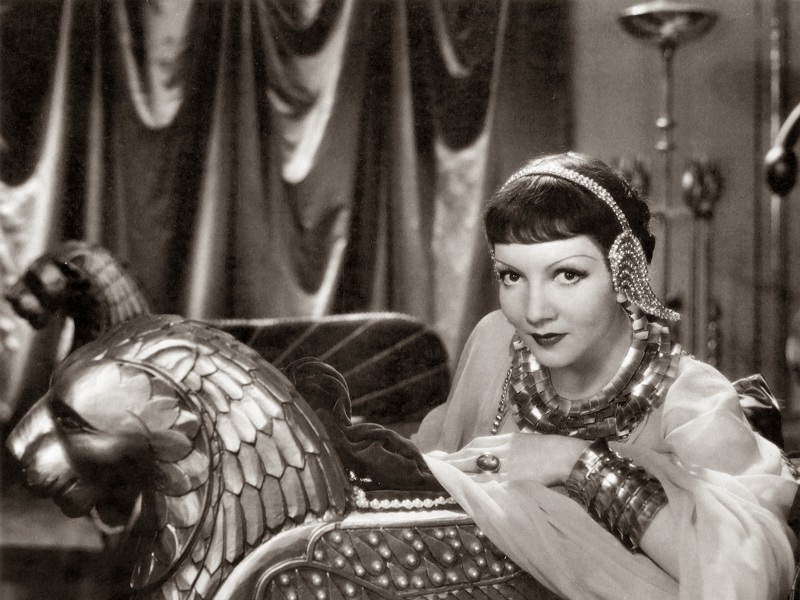
'Cleopatra' Was a Defining Role for Colbert


"Women should be but toys for the great. It becomes them both."

Cleopatra (Claudette Colbert)

For all intents and purposes, Cleopatra was the last pharaoh of ancient Egypt. She was survived by her teenage son for about a week and a half. That made him the last pharaoh — technically — but his rule was spent in captivity and ended with his apparent execution.

More than 2,000 years after her death, Cleopatra is still a fascinating figure in the West. She has been portrayed countless times on the stage in Shakespeare's play "Antony and Cleopatra" and Jules Massenet's opera "Cléopâtre," and she has been portrayed in numerous films, TV productions and video games. She is regarded as one of history's great beauties; she was seen that way by her contemporaries, too.

Thus, it wasn't surprising when one of the big screen's great beauties, Elizabeth Taylor, was cast as Cleopatra in 20th Century Fox's lavish 1963 production.

But I felt that Claudette Colbert's version of "Cleopatra," which was released 80 years ago today, was as good as — if not better than — Taylor's. Just, well, different.

I know I will get arguments about that, but hear me out. As nearly as I could tell, both movies told the same story and emphasized mostly the same events; the '63 version took a lot longer to do it and, when adjusted for current dollars, may have been the most expensive movie ever made.

The role of Cleopatra may well have defined Colbert more than her role in any other movie.

The '34 version may have been guilty of focusing strictly on Cleopatra and not paying as much attention to the men around her — or some of the facts — as the '63 version did. It was Colbert's movie — whereas Taylor, who had already won an Oscar, shared the screen and the credits with two other well–known actors, Richard Burton and Rex Harrison.

I don't know if Colbert is considered one of the screen's great beauties (or even if she was seen as such in her own time), but I do know some of her roles made her something of an early sex symbol.

(That includes her performance in "Cleopatra," although, personally, I have always thought she resembled Lilith Sternin from Cheers! and Frasier in that one.)

Although I have never seen it, I have heard that Colbert's bare breasts could be seen briefly in 1932's "The Sign of the Cross" in a scene that I have heard was a primary catalyst for the strict enforcement of the Hays Code.

When it asserted itself as the authority over movies in the United States, the Motion Pictures Producers and Distributors of America (MPPDA) prohibited, among several other things, "licentious or suggestive nudity — in fact or in silhouette; and any lecherous or licentious notice thereof by other characters."

Colbert's "Cleopatra" was made when the Hays Code was just beginning to flex its muscles — and producer/director Cecil B. DeMille pushed some boundaries.

Colbert was dressed in skimpy costumes that might not have been permitted if the movie had been made only a few months later.

Was that historically accurate? I don't know. I doubt it, just as I doubt that the decor of ancient Rome was as art deco as it was in DeMille's "Cleopatra."

Certain concessions do seem to have been made to the moviegoers of 1934.

In another instance of pushing the envelope, a seemingly naked slave girl holding two incense burners could be seen in the opening credits. The indistinct lighting left much to the imagination.

Nudity was not the focus of "Cleopatra." Sex, however, was.

The emphasis really was on Colbert. The men were mostly props; none would be recognizable to modern movie watchers. Some were regarded as being among the best actors of their time, but they were really only there because Cleopatra needed a Marc Antony and a Julius Caesar — and she couldn't play all the roles.

As I say, I don't know if Colbert had a reputation as a sex symbol in 1934, but she was quite popular. She won an Oscar for her performance in "It Happened One Night," and that movie certainly featured the kinds of things that would seldom, if ever, be permitted on the big screen for another 35 years.

Colbert had quite a range as an actress, and playing Cleopatra was only one style of which she was capable — if the role can be confined to a single style. In one scene, Colbert's Cleopatra could be playful and flirtatious; in the next, she might well be cold and calculating.

If Colbert is remembered for anything, I suppose it is her flair for screwball comedy, and there were elements of that to be seen in her portrayal of Cleopatra.

If nothing else, I thought Colbert was having a lot of fun. Perhaps I was mistaken.

"Cleopatra" definitely was not a screwball comedy. But, when it was done, Colbert resolved never to be typecast in overtly sexual roles again.

That might have been the wisest career move for her. Colbert was nominated for two other Oscars but lost both (the first time to Bette Davis, the second time to Ingrid Bergman). She might not have been nominated at all if she had felt demeaned by her roles.

Did her role in "Cleopatra" demean her? Judge for yourself.

Wednesday, July 16, 2014

'Eyes Wide Shut' Was Psychological More Than Sexual


Some people think "Eyes Wide Shut," which premiered 15 years ago today, was a fitting finale for director Stanley Kubrick.

Some folks don't.

I saw many trademark Kubrick touches in the movie, and the story was very much in his style — if Kubrick had a style. His movies differed so much in content from each other that I suppose it really isn't accurate to refer to his style in any context other than camerawork.

He could do comedy, he could do satire, and he could do drama.

He had something of a reputation, and so did the source material for his movie, an Austrian novella, "Dream Story," that was published more than 70 years earlier. "Eyes Wide Shut" dealt with the thoughts and personal conversions a Manhattan doctor experienced after his wife told him she had fantasized about having an affair.

Kubrick died shortly after the completion of filming.

I've never read the book so I don't know if the two are described in it as attractive or plain. I suppose it doesn't matter too much in a book, where a reader can imagine characters to be anything that isn't spelled out for them by the author.

It is different in a movie. A character's appearance leaves little to the imagination in a movie. If the book isn't specific — and even if it is — the viewer has to accept the appearance that is given in the movie. Through casting, acting, direction, even story revision, all of the heavy lifting is done for the observer; his/her images will be those created by the writer(s), director and actors.

In casting his movie, Kubrick put two actors in the roles of the husband and wife whose reputations for sexually charged performances preceded them — Nicole Kidman and Tom Cruise. At the time, they happened to be real–life spouses, which probably raised their level of intensity in the movie. They split up a couple of years later.

Anyway, the talk before "Eyes Wide Shut" made its debut was that it was going to be a sexy movie. Given the nature of the trailers that had been showing in theaters, that is certainly easy to understand.

But it occurred to me as I watched it that Kubrick may have taken a page from Alfred Hitchcock's playbook.

Hitchcock was known for his cameo appearances in his movies; when it was brought to his attention that audiences had been watching for his cameo and didn't settle in for the story until they saw him, Hitchcock began positioning his cameos earlier and earlier in his movies.

In Kubrick's case, audiences were expecting nudity so my guess is that he tossed them a crumb. The audience saw Kidman changing clothes for a party very early (and very briefly) in the movie.

To me, it was as if Kubrick was saying, "OK, there's the nudity. Now, let's focus on the story."

As nearly as I could tell, the story was about jealousy and obsession.

(I've seen this movie six or seven times, at least. I'm still not sure what it was trying to say. It seems to be saying something different each time I watch it.)

That wasn't the end of the nudity, of course.

In fact, the story was about sex and titillation — as well as jealousy and obsession — and nudity, too, but the nudity didn't tend to take the viewers where they probably thought they were going. It may seem like a strange dichotomy, but sex and nudity don't necessarily go hand in hand in the movies — especially a Kubrick movie. Nudity in "Eyes Wide Shut" was treated almost casually. So was sex, for that matter.

Make no mistake, though, there was lots of nudity — and there was some sex, too — but it was interesting that the next time the audience saw Kidman (only about a minute later), she was doing something decidedly not erotic (although some might argue that it was intimate) — sitting on the toilet — while Cruise put the finishing touches on his appearance.

And they were conversing in the way that married people do. She asked about her hair. Did it look all right? He said it looked great. She said he hadn't looked at it — so he did and repeated his compliment.

The night after the party — which was a nice blend of significant moments and red herrings — Cruise and Kidman fired up a joint and engaged in some candid conversation, in which Kidman told Cruise she had fantasized about having an affair — with an anonymous naval officer she had seen during their vacation in Cape Cod a year earlier.

Kidman felt drawn to him, like a moth to a flame. "If he wanted me," she told Cruise, "I would give up everything." She expressed relief that one day he disappeared and never returned. It meant she wouldn't have to make such a choice.

That mental image really lit a fire under Cruise, and he embarked on a two–night odyssey through New York's sexual underworld.

The odyssey took him to many places, and he didn't have to look too hard to find opportunities to be unfaithful to Kidman. Such opportunities found him.

He dabbled in them, was tempted by them, nearly succumbed to them at times.

I guess this was the thing about "Eyes Wide Shut" that I found especially fascinating — Cruise's transformation from a kind of stuffy yet high–minded sort to a no–holds–barred sexual adventurer, all because his wife had told him that she had fantasized about having an affair.

And yet ...

He never gave in to the temptation.

At one point, while making arrangements for a costume to wear to an orgy (which was hosted by an unidentified secret society), Cruise met a young girl (Leelee Sobieski), the daughter of the owner of the costume shop. When Cruise came back the next day to return the costume, the shop owner strongly implied that his daughter was available for sexual favors.

(Some people think Sobieski, who was 13 when filming began and 16 when it ended, bears a resemblance to Helen Hunt, who was one of the most popular actresses in Hollywood at the time. I could see hints of a young Hunt in Sobieski's face in "Eyes Wide Shut," but, overall, as she has grown older, I see less and less of it.

(I guess that was consistent for me. I once worked with a woman who told me she was a dead ringer for Julia Roberts. I didn't see that, either.)

Other interesting angles of the story:

Sydney Pollack played the wealthy patient who hosted the first party and was revealed to have been one of the guests at the orgy. Originally, Harvey Keitel was cast in that role, but he dropped out — as did Jennifer Jason Leigh, who was cast to play Marion, the daughter of one of Cruise's old friends — because of another commitment.

Marion's father was dying, and Cruise was summoned to his side. In the movie, Marion tells Cruise she loves him and kisses him. Marie Richardson played the role instead.

Some movie reviewers classified "Eyes Wide Shut" as an erotic thriller. It was even marketed that way. But that really was misleading.

The final product was really more of a psychological thriller, partly because of things that were done in the editing process.

Apparently, the sexual content was even more graphic than people saw on their movie screens, but, to avoid an NC–17 rating, certain techniques were used to mute it.

That was done after Kubrick had died. Who knows if he would have agreed to what was done?

Of that attempt to mute the content, film critic Roger Ebert wrote, "[I]t is done well, even though it should not have been done at all. ... 'Eyes Wide Shut' should have been released as [Kubrick] made it."

Sounds a lot like the argument I made against "colorizing" black–and–white movies. A movie is a work of art, and the director is the artist. Since the advent of color in the movies, it has always been an artistic decision whether to use it — although the cost played an important role in that decision for many years.

The content of a movie is even more of an artistic decision so I agree with Ebert. The edits should not have been done at all — even if leaving the film as it was meant an NC–17 rating.

Sunday, May 25, 2014

A Near Masterpiece


"The two basic items necessary to sustain life are sunshine and coconut milk. Did you know that? That's a fact. In Florida, they got a terrific amount of coconut trees there. In fact, I think they even got 'em in the gas stations over there. And ladies? You know that in Miami, you got — you listenin' to me? — you got more ladies in Miami than in any resort area in the country there. I think per capita on a given day, there's probably 300 of 'em on the beach. In fact, you can't even scratch yourself without gettin' a belly button up the old kazoo there."

Ratso (Dustin Hoffman)

"Midnight Cowboy," which premiered on this day in 1969, was "one of a handful of films that stay in our memory after the others have evaporated," wrote Roger Ebert 25 years after its debut.

But, after apparently taking the opportunity to revisit it after a quarter of a century, Ebert asserted that it was "a good movie with a masterpiece inside, struggling to break free."

When the movie was in the theaters in 1969, Ebert wrote that it "comes heartbreakingly close to being the movie we want it to be."

Perhaps there is a subtle nuance or two that I am missing, but it sounds to me like he had pretty much the same reaction to the movie in 1994 that he had in 1969.

It was a near masterpiece, I guess you could say. The American Film Institute ranked it 43rd on its list of the top 100 movies of all time — and AFI chose Ratso's iconic line, "I'm walking here! I'm walking here!" as its #27 movie quote (just ahead of "Play it, Sam" from "Casablanca").

It may be something of an urban legend that Hoffman improvised that line. The producer disputed that account in the movie's two–DVD package.

While that point may be up for debate, there is no debating this: "Midnight Cowboy" holds the distinction of being the only X–rated movie to win the Best Picture Oscar.

Two other X–rated movies — also from the early days of movie ratings — were nominated for Oscars but did not win ("A Clockwork Orange" and "Last Tango in Paris").

Given the considerable changes in both the public's perception of and the requirements for an X rating, I feel pretty safe in asserting that an X–rated movie will never be nominated for — let alone win — an Oscar again.

"Midnight Cowboy" did not remain an X–rated movie. It was re–evaluated and given an R rating, which is more appropriate, on its reissue a few years later.

It did have a pretty strong sexual content (and most people probably would agree that sex is a must in the modern definition of X–rated filmmaking), but the sex was rather tame compared to today's movies. I have seen more explicit nudity in PG–rated movies than I saw in "Midnight Cowboy."

True, one of the characters, Joe Buck (played by Jon Voight), was a gigolo, and some of the story was about his adventures (and misadventures) in New York. But the sexual content that led to the X rating had more to do with the implication that Voight's character might have been homosexual.

That is the important distinction. In 1969, an X rating was treated like a legitimate film rating, which it was. It meant that the content definitely was not suitable for children, because of either extreme violence or extreme sexual activity, and that they could not be allowed to see such a movie, even if accompanied by an adult.

In those days, people who were at least 16 could watch an R–rated movie without an adult.

Then the adult film industry latched onto the X rating; over time, it ceased to be recognized as a legitimate movie rating. It became code for pornographic movie. Mainstream commercial theaters stopped showing X–rated movies, and reputable actors stopped appearing in them.

And the bar was raised on R–rated movies. The Motion Picture Association of America raised the minimum age for admission without an adult to 17.

But sex wasn't the only consideration in 1969. The rating also was the result of the gritty, realistic depiction of New York street life in those days.

Ultimately, the R rating, as I say, was the most appropriate one for "Midnight Cowboy." The material wasn't anywhere near mild enough for a PG rating, but X was too extreme.

The acting really was impressive. Both Hoffman and Voight were nominated for Oscars but lost to John Wayne (for "True Grit").

Wednesday, June 16, 2010

The Original Slasher Flick Turns 50


"We all go a little mad sometimes."

Norman Bates
Psycho (1960)

It was 50 years ago today that Alfred Hitchcock's "Psycho" premiered on America's big screens.

It contained what is, arguably, the most famous scene in movie history — the shower scene in which Janet Leigh is stabbed repeatedly by a shadowy, seemingly female figure.

And untold millions were reluctant to take showers after they saw it — like those who saw "Jaws" for the first time 15 years later and thereafter refused to go to the beach.

The slasher flick was born.

And, in the half–century that has followed, it has seemed that no horror movie, whether it had any redeeming qualities or not, was worthy of the designation if it didn't include at least one scene in which someone, usually a young female, was violently — and, usually, fatally — assaulted while in the most vulnerable position possible — either naked and, frequently, in the shower or while sleeping in some scanty, revealing outfit.

Few movies have that kind of societal influence, and fewer still have had the capability of wielding that kind of influence for so long. But Hitchcock seemed to make a career out of that kind of thing. "Psycho" may have been the most flagrant example, but I'm sure even something as unthreatening as the appearance of a sparrow or a wren made some people nervous after they saw "The Birds." Even a modest aversion to heights became exaggerated in many minds after seeing "Vertigo." No doubt the possibility of mistaken identity took root in many active imaginations after watching "North by Northwest" or "To Catch a Thief."

(One can only imagine what Hitch in his prime might have done with home computers and the internet and identity theft. But modern suspense–movie audiences seem to require more explicit nudity than their forebears, and I suspect Hitchcock might have been a little uncomfortable. He came from a different generation. He cast beautiful people in his movies, but only once, to my knowledge, was any nudity [briefly and from behind] visible in one of his films.

(Maybe that was the influence of the times. Maybe he would have felt freer to use nudity in his films if he had been born 30 or 40 years later. Certainly those directors who openly sought to emulate him didn't hesitate to use nudity in their films, even if it was an anonymous double.

(I have heard, actually, that the infamous shower scene in "Psycho" did not show Leigh naked. She wore a flesh–colored bodysuit, and some parts of the scene were accomplished using either a body double or some sort of mannequin. In truth, when you watch that scene, it is often hard to say who — or even what — you are seeing.)

And, well, I guess the less said about admittedly guilty pleasures, like the voyeurism in "Rear Window," the better.

But "Psycho" was different.

Hitchcock created many brilliant suspense films, most of which were unique but, until "Psycho," a few things were generally true of all the films he made:
  • When someone was killed, there was usually some sort of clear external motivation — be it financial gain or freedom from a disagreeable spouse or whatever.

    What distinguished "Psycho" from those earlier efforts was the fact that there was no clear motive for the disappearance (that turned out to be murder) of Janet Leigh, once the obvious suspects were cleared. Those who got too close to the truth became targets as well, which was a well–established Hitchcockian theme, but the tangential killings were not a means to obtain the money Leigh's character had stolen.

    And who could possibly imagine that that nice Tony Perkins had been assuming his dead mother's persona, dressing in her clothes, wearing a wig?

  • The violence in previous films was seldom seen. If any of it was seen, it was brief and it was not graphic — kind of like in "Casablanca," when Peter Lorre tried to escape from his pursuers and was shot for his efforts. Audiences saw the gun fired and they saw Lorre in profile. They never saw the wound or blood pouring from it or anything like that.

  • By 1960, color in movies was not the novelty it had been 20 years earlier, when color sequences were interwoven with black–and–white sequences in "The Wizard of Oz," nor was it the costly production option it was when it was used in the making of "Gone With the Wind."

    Hitchcock had used color in several of his previous movies so it's not like he was a holdout when he made "Psycho."

    But I don't think he ever used black and white again — except in his TV programs.

  • Hitchcock's movies often had psychological themes, but no other Hitchcock movie was as overtly psychological as "Psycho."

    In fact, until Leigh's character was murdered in the shower, just about everyone in the film had betrayed his/her own particular obsession — be it love or money or whatever. The most peculiar obsession, though — that of Perkins' character — was treated as a closely guarded secret, as I'm sure it would be in real life, and thus it was a shock when it was revealed at the end.
Well, horror/suspense movies have become more intense in the last 50 years, even the ones that have really sought to live up to Hitch's standards and weren't just seeking to make a lot of money from cheap exploitation.

"Psycho" has held up well, and it can still deliver chills.

Happy birthday to a classic.

Just don't think about it while you're in the shower.