Showing posts with label 1939. Show all posts

Tuesday, December 30, 2014

'Of Mice and Men': Steinbeck's Tale Wasn't P.C.


Lennie (Lon Chaney Jr.): I wish we had some ketchup.

George (Burgess Meredith): Whatever we ain't got, that's what you want!

(1939 is widely regarded as the greatest year ever for the motion picture. Ten movies were nominated for Best Picture that year, and today I take a look at the last of those 10 movies to hit the theaters.)
"Of Mice and Men," which made its debut 75 years ago today, was a gritty tale — and, frankly, a rather unlikely project for producer Hal Roach, who was mainly known for his comedies. But because of a lawsuit, Roach agreed to produce a film version of the John Steinbeck story.

The main characters, George (Burgess Meredith) and Lennie (Lon Chaney Jr.), were traveling ranch hands, trying to collect enough money to buy their own place. Well, that was George's dream. All Lennie wanted to do was "tend the rabbits." Lennie seemed gentle enough, but he just didn't know his own strength — which was considerable.

They were mutually dependent. Lennie was mentally handicapped but possessed remarkable physical strength. George was the idea guy, the brains of the outfit. Lennie had an obsession with soft things, an obsession that caused some problems. George told Lennie they were "bad things" that he mustn't do, and Lennie lived in fear of violating George's rules.

"Of Mice and Men" was remade twice, the last time in 1992. I sometimes wonder if it could be made a fourth time — and I usually conclude that it couldn't because, on the surface, it seems to fail the politically correct litmus test.

The theme of abuse — of a mentally retarded man, of a black man, of a self–absorbed woman — might pass the test, but the almost stereotypical treatment of those characters could negate their effectiveness in the 21st century.

Steinbeck himself observed, for example, that the young and pretty wife of the boss' son was "not a person, she's a symbol. She has no function except to be a foil — and a danger to Lennie." For that reason, Steinbeck gave her no name in the book, but she had one in the movie — Mae. To pass muster in the 21st century, I think her character might need to be fleshed out even more.

Played by Betty Field in the 1939 movie, Mae wasn't as one–dimensional on the screen as she was on the pages of Steinbeck's novella. She was still a shallow character — but she was played smartly by Field, who was appearing in only her second movie.

A problem for the P.C. crowd might also be the callous treatment of the aging dog. The dog's owner was persuaded to let one of the hands shoot him because he was old. It neatly foreshadowed the end of the book and the movie, when George killed Lennie in what might almost be seen as a mercy killing today.

I don't want to spoil it for you if you haven't read the book or seen the movie. But you should do both if you have done neither, and, if you have only done one, you should do the other. "The Grapes of Wrath" wasn't the only thing that Steinbeck ever wrote — but it was the only one that became a Best Picture winner.

I've seen all 10 of the movies that were nominated for Best Picture in 1939, and, with this blog post, I have now written about all 10 as well. I don't disagree that the winner, "Gone With the Wind," was a great movie, but if I had been alive at the time and I had been given a vote, I think I might have voted for "Of Mice and Men." I thought the story was better, and, actually, I thought the acting was, too, even though the acting wasn't recognized by the Oscars.

For people of my generation, Meredith was already an established star of movies and TV. We have rarely seen him when he was as young as he was in "Of Mice and Men," but he was barely in his 30s when it was made.

Chaney was already a movie veteran, having appeared in nearly 60 movies by the time "Of Mice and Men" was made. His claim to fame is his work as the Wolf Man in the 1940s, but, before he did that, he lobbied for — and got — the role of Lennie.

I didn't realize, as a child, that one of the cartoons that always entertained me was, in fact, a vicious parody of Chaney's performance. I laughed at it, not knowing what it was spoofing. Since I have seen "Of Mice and Men," I know why my father laughed, too.

It feels wrong to laugh at it now. I guess that is the influence of the P.C. crowd, but, really, it isn't fair to hold Steinbeck or Looney Tunes to modern standards when they functioned in the world that existed more than 70 years ago.

So laughing at the Looney Tunes cartoon may be something of a guilty pleasure, like laughing at some of the skits on Saturday Night Live.

Monday, December 29, 2014

Why Didn't 'Hunchback' Receive More Oscar Recognition in '39?


"I'm about as shapeless as the man in the moon."

Quasimodo (Charles Laughton)

Several film versions have been made based on Victor Hugo's "The Hunchback of Notre Dame," but few would deny that the version that premiered 75 years ago today was the best — even if it took considerable liberties with the source material.

How could it not be great? It starred Charles Laughton, a two–time Oscar nominee and one–time winner, and pretty newcomer Maureen O'Hara, appearing in only her fourth movie. The story was based on one of Hugo's best–known works.

And RKO Pictures constructed on its movie ranch a huge (and expensive) re–creation of medieval Paris and Notre Dame Cathedral — specifically for the making of "The Hunchback of Notre Dame."

Yet, even at a time when the Academy Awards allowed as many as 10 movies to be nominated for Best Picture, "The Hunchback of Notre Dame" wasn't one of that year's nominees.

How could such a thing be possible?

Nor was Laughton nominated for Best Actor — and, in addition to giving an Oscar–worthy performance, he had to wear a ton of makeup at a time when Los Angeles was experiencing one of the most severe heat waves in its history (daytime highs were often close to 110°).

I think he could have been nominated instead of Mickey Rooney, who was nominated for "Babes in Arms." But that's just my opinion.

How could such things have happened?

Be forewarned, ye who have read Hugo's book. There were differences between the book and the movie, apparently dreamed up to suggest similarities between 15th–century France and 20th–century Europe. Consequently, the bad guy in the story, Jehan (played by Cedric Hardwicke), was not the lustful religious charlatan of the novel. In the book, his name was Claude, and he was an archdeacon; his brother was named Jehan.

The names were reversed in the movie — why, I do not know. The characters weren't really changed. The bad one was still powerful; he just wasn't a powerful religious figure.

In the context of the times in which the movie was made, Jehan was a tyrant, a stand–in for Hitler, destroying printing presses for fear they would encourage the people to think for themselves.

I guess that was an easy conclusion for the screenwriters to reach. After all, the villain of the piece, whatever his name, was a persecutor of gypsies — among others.

And O'Hara's character, a gypsy dancing girl, aroused passions in Jehan, passions he could not control.

Laughton played Quasimodo, the hunchback who rang the bells (and had been deafened by them). He could speak, but he didn't often want to.

Except when he was with Esmeralda (O'Hara).

Esmeralda was sweet and kind — and, to be blunt, a bit naive. In Hugo's book, she was about 16. O'Hara was 19 when the movie premiered. Pretty close as these things go in Hollywood.

When Quasimodo was pilloried for abducting Esmeralda, it was Esmeralda who brought him water. I guess she was influenced by the fact that, although Quasimodo was physically repulsive and regardless of his shortcomings, she could see that he represented man's noblest virtues in this passion play. In a rather obvious juxtaposition, Jehan was nefarious and sexually inhibited.

If you have read the book but haven't seen the movie, I should also warn you that many of the secondary stories were discarded, presumably to focus attention on the relationship between the dancing girl and the hunchback.

Still, the movie captured the flavor of the story well enough. Too bad the same couldn't be said of its showing at the Oscars.

"The Hunchback of Notre Dame" received only two Oscar nominations — and won neither.

Monday, December 15, 2014

Burning Down the House


"Frankly, my dear, I don't give a damn."

Rhett Butler (Clark Gable)

(1939 is widely regarded as the greatest year ever for the motion picture. Ten movies were nominated for Best Picture that year, and today I take a look at the ninth of those 10 movies to hit the theaters.)
That is the greatest movie quote of all time, according to the American Film Institute, and it is hard to argue with that conclusion.

AFI had some great quotes on that list — "I'm going to make him an offer he can't refuse," "I've got a feeling we're not in Kansas anymore," "Go ahead, make my day" — but Clark Gable got the nod for the greatest quote.

As I say, it's hard to argue with. But it isn't the only memorable line in "Gone With the Wind," which premiered on this day in 1939. Of course, that almost goes without saying. The movie is darn near four hours long. There had to be at least one more memorable line in there, right? In fact, Scarlett (Vivien Leigh) had several. I'll bet one or two leap to mind with virtually no effort.

Overall, AFI ranked "Gone With the Wind" sixth — behind some other movies with memorable quotes.

But, in the history of movies, few could match "Gone With the Wind" for both memorable lines and iconic images.

Like the burning of Atlanta.

I remember an episode of M*A*S*H in which Hawkeye had been trying unsuccessfully to seduce a nurse with whom he had, apparently, had a previous relationship, and the nurse was taking a "been there, done that" approach.

"'Gone With the Wind' is a great movie, Hawkeye," I remember her saying to him, "but after you've seen 'em burn Atlanta several times, it's not so hot anymore."

See, I disagree with that. Great line for a sitcom, but, in reality, it doesn't hold up. At least, not for me. I think "Gone With the Wind" is great moviemaking, especially given the technological constraints of that time, and it never gets old for me.

"Gone With the Wind" is great storytelling, too, even if there are some historical inaccuracies. In the realm of fiction, one is permitted certain liberties, and "Gone With the Wind" has never, to my knowledge, been marketed as nonfiction.

No one ever pretended that Rhett and Scarlett really existed. But people who were like them — or mostly like them — did exist in the Old South, and Rhett and Scarlett represented them. Good fiction makes it possible to do that plausibly, and much of "Gone With the Wind" was, indeed, good fiction. But some of it was not.

I have always been impressed with the way "Gone With the Wind" presented the pre–war arrogance of the South juxtaposed against the post–war South, humbled by loss. Wow, what a contrast.

For the Southerners who survived the war, it must have been astonishing to experience the reversal of fortune at every level of Southern society. Not every Southerner was a slave owner, of course. That was something that only those with land and money could afford; then as now, not everyone had land and money.

So, while, yes, it is true that "Gone With the Wind" was historically inaccurate at times, it was spot–on accurate at others. Some historians may tell you that does a disservice to the story of the Civil War.

I don't agree with that. To teach, it is often necessary to put a little jam on the bread.

Monday, November 17, 2014

'Another Thin Man' Helped Depression-Era Audiences Escape


Nora (Myrna Loy): How did you find me here?

Nick (William Powell): I saw a great group of men standing around a table. I knew there was only one woman in the world who could attract men like that. A woman with a lot of money.

For the third time in five years, movie audiences were treated to William Powell and Myrna Loy as the wisecracking detective spouses, Nick and Nora Charles, in "Another Thin Man," which premiered on this day in 1939.

Powell and Loy made six "Thin Man" movies together, but they were paired in 14 movies all told. Well, to be accurate, they were co–stars in 13; the last one was Powell's movie, and Loy made a cameo appearance. Even so, without a doubt, they were one of the big screen's most prolific couples.

In a way, I think the "Thin Man" movies proved what a great actress Myrna Loy was. I guess you have to put her performances as Nora Charles up against her performances in other movies with other leading men to see what I'm talking about but try to stay with me here. Powell was a center–of–attention kind of guy, and Loy tailored her performance to let him do his thing. For want of a better label, she was Powell's straight man.

In her other movies, she had different personae to complement her leading man, be he Fredric March, Spencer Tracy or Clark Gable. Each brought different strengths and weaknesses to their roles, and Loy was always able to be whatever she needed to be to make it work.

Now, I liked the original "Thin Man" movie (which was based on a Dashiell Hammett novel), and I liked the sequel that was made two years later, too. In some ways, I liked the sequel better — because it did the things that a good sequel ought to do. It expanded on themes that were introduced in the original, and it even had a surprising twist at the end. Can't ask for more than that from a sequel.

In some ways, though, I felt the story was getting a little tired by the third installment. It was aptly named, but it needed a question mark to be correct, I suppose, and maybe an underline — Another Thin Man?

The third movie came out three years after the second one so it was only right to wonder what Nick and Nora had been up to. Well, as the audience discovered early, they had been fruitful and multiplied. The audience was already familiar with the Charleses' pet terrier, Asta, from the first two movies; now, there was a fourth member of the group, 8–month–old Nick Jr.

I am still not sure how I feel about that addition. In hindsight, it sort of strikes me as the kind of thing the writers for TV shows do when their programs are running out of gas. They insert a new character or they transport the cast to a new setting, hoping to open up new story lines and revive a sagging audience.

On TV, this tactic usually only buys the series a little more time, perhaps another season or two, at best. But it didn't seem to hurt the "Thin Man" franchise. It went on to produce three more movies in eight years.

It was a formula that happened to work very well. It was like some TV series that continue to thrive even after adding new characters. It was that way with Happy Days, which added characters and even a phrase to the popular vocabulary that defined desperation ("jumping the shark") yet continued to thrive.

Audiences knew what they were getting with Nick and Nora. The plot of the movie only existed to give the audience what it wanted.

It was strictly entertainment, nothing Oscar–worthy about it. And, in fact, "Another Thin Man" received no Oscar nominations — unlike the original "Thin Man," which received four Oscar nominations five years earlier.

Well, 1939 was an especially difficult year for movies to get popular attention, but I don't think "Another Thin Man" really deserved any nominations that year. It was just good escapist fare for Americans who were still trying to free themselves from the grip of the Great Depression.

Sunday, November 09, 2014

Garbo Laughs!


"The last mass trials have been a great success. There are going to be fewer but better Russians."

Ninotchka (Greta Garbo)

(1939 is widely regarded as the greatest year ever for the motion picture. Ten movies were nominated for Best Picture that year, and today I take a look at the eighth of those 10 movies to hit the theaters.)
In the first half of "Ninotchka," which premiered 75 years ago today, Greta Garbo lived up to her reputation for being somber and melancholy. But her character, a Soviet envoy, was seduced by the capitalist Count Leon (Melvyn Douglas) in the second half of the movie, and all bets were off.

The pitch for the movie 75 years ago was "Garbo Laughs!" and it was jarringly easy to make her laugh. All Douglas really had to do was take a pratfall, and she was laughing with the best of them.

But in that first half of the movie, she was a real stoneface.
Ninotchka (Greta Garbo): [on a street corner] How long must we wait here?

Leon (Melvyn Douglas): Well, until the policeman blows his whistle again.

Ninotchka: At what intervals does he whistle?

Leon: What?

Ninotchka: How many minutes between the first and second whistle?

Leon: You know that's very funny. I never thought of that before.

Ninotchka: You've never been caught in a similar situation?

Leon: Yes, I have, now that I've come to think about it. It's staggering. Good heavens. If I add it all up, I must have spent years waiting for signals. Imagine, an important part of my life wasted between whistles.

Ninotchka: In other words, you don't know.

Leon: No.

Ninotchka: Thank you.

Leon: You're welcome.


Garbo and Douglas had an impressive chemistry — which was appropriate, given that Garbo's character told Douglas that love was nothing more than a "chemical reaction." It's really no wonder that the story worked as well as it did. It was directed by Ernst Lubitsch, and it was co–written by Billy Wilder. Plus, its female lead is the fifth–greatest female star of all time, according to the American Film Institute. AFI also ranks "Ninotchka" #52 among the comedies. "Ninotchka" ranked even higher (#40) among the love stories. How could it go wrong?

My guess is that it must have caught a lot of people by surprise that Garbo was so skilled at comedy; paired with Douglas, perhaps the most sought–after romantic lead of his day, the result was a sophisticated romantic comedy that is often overlooked, I think, by people who regard themselves as students of film.

That's a shame because "Ninotchka" is still funny, especially if it is kept in context when it is watched. It was one of the first movies to poke fun at the humorless culture of the Russian Revolution — and how vulnerable people in such a culture were after they had been exposed to the freedom of the West.

Ninotchka: Why should you carry other people's bags?

Porter: Well, that's my business, Madame.

Ninotchka: That's no business. That's social injustice.

Porter: That depends on the tip.

"Ninotchka" received four Oscar nominations. In addition to its nomination for Best Picture, it was nominated for Best Actress, Best Story and Best Screenplay, but it didn't win any of them.

Thursday, November 06, 2014

Remembering the First Time


"And Then There Were None," the Agatha Christie mystery that was published 75 years ago today, was the first Agatha Christie book my parents permitted me to read.

I always thought that was sort of amusing. I mean, I had already read a lot of books that really were been beyond my years, as my grandmother would say. But my parents — and my grandmother, too, for that matter — were enablers, giving me books that someone my age probably had no business reading. My parents were educators. They believed in reading, and they encouraged me to read anything and everything.

Except Agatha Christie. They kind of held back on that one, maybe because they still read her books when I was young. Maybe they wanted to keep that just for themselves. I have read most of Agatha Christie's books, and they would have been far easier for me to comprehend than many of the books I read.

I suppose if my first experience with Agatha Christie had not been such a positive one, I might never have read another one of her books.

But I selected "And Then There Were None." It didn't feature any of Christie's well–known detectives. I didn't know at the time that it is regarded by many as her masterpiece. Accordingly, it is Christie's best–selling book. It is also the best–selling mystery ever — and one of the best–selling books of all time.

No, I didn't know any of that when I first sat down to read it. I was only about 12, maybe 13, and I don't remember what attracted me to it. Maybe I liked the title — which was the American version of a well–known nursery rhyme. Maybe I liked the artwork on the cover of the paperback copy I read. As I say, I don't remember now what drew me to it, but I do remember it was my first Christie book.

It really was an absorbing book. Ten people were invited to spend the weekend on a remote island. Each was lured there by a different ruse. As I recall, one was drawn by the possibility of a job, another by the offer of an all–expenses paid vacation, etc.

In fact, each was being drawn into an ambush. Each had been judged guilty (unofficially) of causing the death of another but not in a way that could lead to criminal charges. The person who had invited them to the island planned to execute all, one by one, as their punishment for their crimes.

And, one by one, each one was killed. Or so it seemed.

Actually, the person who was responsible was one of the "guests." He enlisted the help of another guest in faking his own death; he said that, believed to be dead, he would be free to search the island for whoever was doing it. Consequently, he earned the trust of that other guest, who wound up being bumped off shortly thereafter, as I recall. Moral: Be careful who you trust.

Once all the others were dead, the culprit committed suicide — but not before leaving a note explaining to the authorities what had happened.

I thought it was a clever book, and I began taking on other Christie books. I have enjoyed most of them, but I have never experienced the same thrill I got with that first book.

Monday, November 03, 2014

Another Nice Mess From Laurel and Hardy


Ollie: Hey Stan ... oh, Stan ... over here ...

Stanley: [sees a horse in a pasture with Oliver's hat and mustache] Ollie ... is it really you?

Ollie: [as horse] Of course it's me. Well, here's another nice mess you've gotten me into.

Stanley: Gee I'm glad to see you!

When I was a boy, I remember watching Laurel and Hardy on Saturday afternoons with my father.

I'm sure I must have seen most, if not all, of their movies before I was 10 years old.

Dad would giggle like a little kid. I remember thinking it was cool to share that with him. Well, it was something like that.

We haven't watched Laurel and Hardy together in years. I wonder if he would still giggle. Maybe he would. I know I do.

Over a 30–year period, from 1921 to 1951, Stan Laurel and Oliver Hardy appeared in more than 100 movies together. Nearly three dozen were silent shorts, nearly four dozen were sound shorts and more than two dozen were full–length feature movies.

They were absolutely prolific when they were under contract to Hal Roach Studios. That's where they made most of their movies and enjoyed the peak of their popularity, but they left Roach, and "The Flying Deuces," which premiered 75 years ago today, was the first non–Roach movie they had made together in nearly 20 years.

It wasn't bad. It's just that the material was so familiar. It should have been. The plot was a loose remake of a movie the two made for Roach about eight years earlier called "Beau Hunks." Frankly, "Beau Hunks" was better.

I still giggle at it, though. It's beyond my control. The last time I watched "The Flying Deuces," I admit I giggled at some moments. I was alone when I watched it so I can't chalk it up to any kind of psychological peer pressure. I even mentally scolded myself for giggling.

But I giggled, anyway.

In RKO Pictures' "The Flying Deuces," Laurel and Hardy played a couple of friends who joined the French Foreign Legion so Ollie could forget a girl.

Ollie and Stan were two fish market workers from Des Moines who were on vacation in France. While staying at an inn, Ollie was smitten with the innkeeper's daughter (Jean Parker) — and was crushed to learn she was already married. In fact, Ollie was suicidal until Stanley talked him out of it.

So Ollie and Stan joined the French Foreign Legion to forget.

Ollie: Just how much do we get paid for all this?

Commandant: One hundred centimes a day.

Stanley: That's not bad ...

Ollie: How much is that in American money?

Commandant: American money? About three cents a day.

Ollie: If you think you're going to get that kind of work outta me for three cents a day, brother, you're crazy.

Commandant: Is that right?

Stanley: That's right because we don't work for less than 25 cents a day! Do we, Ollie?

But it wasn't what they were told it would be so they just quit. That was used primarily to set up one–liners or song–and–dance numbers.

Ollie got to sing "Shine On, Harvest Moon" while Stanley did a soft–shoe dance.

And Stanley pulled a Harpo Marx, using his bed springs as a harp to play "The World Is Waiting for the Sunrise" — while he and Ollie were scheduled to be executed at sunrise.

That scene was one of the most memorable moments in the movie. After being told that he was to be executed for desertion the next morning, Ollie said, "Shot at sunrise!"

"I hope it's cloudy tomorrow!"
Stanley said.

The two managed an implausible escape — followed by an even more implausible plane ride with the two of them at the controls.

The ride ended with the plane crashing. Stanley climbed out of the wreckage, disheveled but apparently unhurt. Ollie wasn't so lucky, and the audience could see his semi–transparent spirit flying away.

Not long after, Stanley encountered a horse with Ollie's mustache and derby. Ollie had earlier said he would like to be reincarnated as a horse; apparently, he was.

Why do I laugh? I guess it's because, like the audiences of that time, I know what to expect when I see a Laurel and Hardy movie — and I want to see it. I want to hear Laurel making his involuntary sounds of alarm when something goes wrong. I want to hear Hardy say, "Well, this is another fine mess you've gotten me into!" And I laugh when they do.

OK, Hardy said, "Here's another nice mess," but why quibble?

The Continuing Partnership of Fonda and Ford


This black–and–white trailer accompanied the 1947 re–release of
"Drums Along the Mohawk," director John Ford's first color feature.


"Oh, Almighty God, hear us, we beseech thee, and bring succor and guidance to those we are about to bring to your divine notice. First we are thinking of Mary Walaber. She is only 16 years old, but she is keeping company with a soldier from Fort Dayton. He's a Massachusetts man, and thou knowest no good can come of that."

Reverend Rosenkrantz (Arthur Shields)

John Ford and Henry Fonda teamed up for the first time earlier in 1939 when they made "Young Mr. Lincoln."

They wasted no time making their second film together, "Drums Along the Mohawk," which premiered 75 years ago today.

It had some things in common with "Young Mr. Lincoln," such as the fact that both were set in specific periods in American history. "Young Mr. Lincoln" was about Abraham Lincoln's early life, and "Drums Along the Mohawk" was about life in colonial America.

Fonda and Claudette Colbert played 18th–century newlyweds trying to set up their home in the Mohawk Valley of central New York. It was a region that had a great deal of importance in Revolutionary War times, a passageway between the Atlantic Ocean and the interior of the New World.

Their story was not one for the faint of heart. Colbert's character suffered a miscarriage. Beset from all sides by Indians and the British, they lost their home. Along with other settlers, they were forced to relocate at a fort, from which they could see their homes and lands being destroyed.

You really had to believe in what you were trying to do to survive. For a movie that was made within the limitations of filmmaking in 1939, "Drums Along the Mohawk" did a pretty good job of presenting a realistic portrayal of the travails of colonial life.

Edna May Oliver, who was nominated for Best Supporting Actress (but lost to Hattie McDaniel, who played Mammy in "Gone With the Wind"), played a widow who owned a big farm and hired Fonda to work it. She took in Fonda and Colbert after their farm was burned by Indians.

In a way, it was sort of like the old Green Acres TV show without the jokes. Colbert's character was raised in affluent and comfortable surroundings; she wasn't prepared for the rugged life of a settler. In time, though, she adapted to it and even came to love it.

And, in true John Ford fashion, the movie ended on an upbeat, patriotic note. The Indians had been turned back, and the American flag was raised above the fort.

Sunday, October 19, 2014

'Mr. Smith' Was Capra-Corny


"It's a 40–foot dive into a tub of water, but I think you can do it."

Saunders (Jean Arthur)

(1939 is widely regarded as the greatest year ever for the motion picture. Ten movies were nominated for Best Picture that year, and today I take a look at the seventh of those 10 movies to hit the theaters.)
Back in February, Peggy Noonan wrote a column in which she mentioned the Netflix series "House of Cards." Now, in the interest of full disclosure, I must say that I have never seen an episode of this series, but, according to Noonan, the show "reinforces the idea that the capital has no room for clean people. The earnest, the diligent, the idealistic, they have no place there."

She could have been describing "Mr. Smith Goes to Washington," which premiered 75 years ago today.

Jimmy Stewart gave a lot of great movie performances during his career, and, while it would be hard to pick out the very best, I'm usually inclined to pick the one he gave in "Mr. Smith Goes to Washington."

In so many ways, it was a great civics lesson. It was a fictional story, of course, like The West Wing TV series of which I was so fond, and, like The West Wing, it dealt with real–life matters — like filling legislative vacancies and filibusters and things like that.

But it was also a Frank Capra story — which means it was made with a heaping helping of feel–good idealism. Because of that, Capra movies were often called "Capra–corn" — and "Mr. Smith Goes to Washington" certainly was corny.

Well, Stewart's role was, anyway. He played a fellow named Jefferson Smith, a leader of the Boy Rangers in his state, truly a babe in the woods when it came to the ways of the world and Washington, a starry–eyed idealist who quoted American heroes like Jefferson and Lincoln and idolized his state's corrupt and thoroughly undeserving senior senator (played by Claude Rains). He was appointed to fill a vacancy left by the death of one of his state's U.S. senators.

But this wasn't entirely your standard "Capra–corn" fare. Nearly everyone else in the movie seemed to have a healthy dose of cynicism. Just not Jeff Smith. You probably couldn't find a more naïve individual. That was what his legislative aide, Saunders (Jean Arthur), loved about him. Pretty Capra–corny, huh?

"Did you ever have so much to say about something you just couldn't say it?"

Jeff Smith (James Stewart)

As a journalist, I have to say that I appreciated the comeuppance Smith got from the Washington media. I didn't think the press in that movie behaved in the way real–life reporters would under similar circumstances. They were a little rough on Stewart's clearly guileless character.

But they reached a point where they asserted that they could afford to be honest because they didn't have to face the voters to keep their jobs.

That's really a throwback to a bygone era. Far too many members of the modern press have compromised their principles — even though they still don't have to face the voters.

In "Mr. Smith Goes to Washington," many of the politicians were presented as being more virtuous than they almost certainly were in 1939. (It is beyond dispute that they were infinitely more virtuous than the politicians of today.)

Rains' character, caught up in the corruption Stewart was trying to defeat, confessed his sins on the Senate floor even though he had the upper hand against Stewart, whose voice was nearly gone from his filibuster.

"I guess this is just another lost cause, Mr. Paine. All you people don't know about lost causes. Mr. Paine does. He said once they were the only causes worth fighting for, and he fought for them once, for the only reason any man ever fights for them. Because of one plain simple rule: Love thy neighbor. And in this world today, full of hatred, a man who knows that one rule has a great trust."

Jeff Smith

And that is precisely the kind of corny–beyond–belief stuff that I'm talking about. For Capra–corn to work, there has to be a certain amount of plausibility there, however farfetched the story may be.

But the very notion that a politician, entrenched in a position of power, would behave so nobly is, well, hopelessly naïve. Perhaps it wasn't seen that way in 1939, but today, it is simply too farfetched.

Even if you tell yourself — if you stumble upon it while channel surfing — that "Mr. Smith" truly was Capra–corny, if you're like me, you'll watch it, anyway. It's entertaining, even if you've seen it several times before.

"Mr. Smith Goes to Washington" received 11 Oscar nominations, second only to "Gone With the Wind." Lewis R. Foster took home the Oscar for Best Story.

Monday, August 25, 2014

Follow the Yellow Brick Road


"There's no place like home; there's no place like home; there's no place like home."

Dorothy (Judy Garland)
(#23 on the
American Film Institute's list of the Top 100 movie quotes)

(1939 is widely regarded as the greatest year ever for the motion picture. Ten movies were nominated for Best Picture that year, and today I take a look at the sixth of those 10 movies to hit the theaters.)
I don't know how old I was the first time I saw "The Wizard of Oz." Probably 5 or 6. I do know that it was long after it made its general theatrical debut on this date in 1939. My mother and father might have seen it at the theater — they were children then — but maybe not. It wasn't a blockbuster in 1939. That came later.

I don't remember much about that experience — except that the winged monkeys scared me enough to give me bad dreams for several nights.

I still think of that whenever I sit down to watch "The Wizard of Oz." I thought about it back in February when I watched it during Turner Classic Movies' annual salute to the Academy Awards, "31 Days of Oscar."

And I concluded that there are some movies that are so closely linked to childhood that every time we see them, we feel almost as if we are children again. "The Wizard of Oz" is such a movie — for me, anyway.

See, there are parts of that movie that I appreciate as an adult that escaped me as a child; even so, I always feel like a child when I watch it — at least a little bit and for a little while. I suppose that is part of the movie's enduring magic.

I'm sure I don't have to recite the plot for you. Surely, everyone has seen "The Wizard of Oz" at least once — probably more than that — so I may simply refer to specific scenes. Warning: This will not, in any way, be written sequentially. I probably will jump around a lot. (So hang on. It's apt to be a bumpy ride.)

Anyway, when I watched it most recently, I found myself questioning some parts of the story — and I had to remind myself that it is, after all, a children's story. It would help if everything made perfect sense — but this is a fantasy. By definition, a fantasy doesn't make sense. Things happen in fantasies that simply do not happen in real life — like monkeys with wings.

The movie version of "The Wizard of Oz" is so familiar that the characters need no introduction, do they?

"You are under the unfortunate delusion that simply because you run away from danger, you have no courage. You're confusing courage with wisdom."

Wizard of Oz (Frank Morgan)

Oh, and before I forget ...

Dorothy said, "Toto, I've a feeling we're not in Kansas anymore."

She did not say, "Toto, I don't think we're in Kansas anymore," which is how people have been misquoting it for decades.

(Wow, it feels good to get that off my chest. Kind of like knowing that Bogart actually said, "Play it, Sam," not "Play it again, Sam," in "Casablanca" but not saying anything about it.)

While we're on the subject of "The Wizard of Oz" trivia, as I said earlier, the movie wasn't successful in its first theatrical run, earning about what it cost to make. But it got in the black about 10 years later when it was brought back to theaters, and its annual airings on TV, which began in the 1950s, were moneymakers.

And this doesn't qualify as trivia, exactly, but I'd like to mention Billie Burke, who played Glinda the Good Witch of the North, Dorothy's defender in Oz. Her role didn't require her to speak many lines, but it is the role for which she is remembered — even though she is hardly ever mentioned.

She was 55 the day "The Wizard of Oz" premiered. I would never have guessed that.

For awhile, I worked in an office that encouraged employees to wear costumes for Halloween. It became a competitive thing, and groups of employees would come up with themes. Sometimes the costumes were very elaborate, very detailed. It was quite entertaining.

One year, a group came dressed like the protagonists from "The Wizard of Oz" — the Cowardly Lion, the Scarecrow, the Tin Woodman and Dorothy (carrying a basket with a little stuffed dog doll in it). Everyone knew who they were, and they were the unanimous winners of the office contest.

As universal as those characters are, it's hard to believe that "The Wizard of Oz" was a big disappointment at the box office. And that iconic foursome might have been quite different.

Judy Garland is so closely associated with the role of Dorothy that most people probably can't imagine anyone else playing it. But it is my understanding that she was the second choice. The first choice was Shirley Temple, but she dropped out of the project. In hindsight, it's hard for me to imagine Shirley Temple singing "Over the Rainbow" as well as Garland — although it would be a mistake to assume that whoever played Dorothy would sing "Over the Rainbow." It was almost dropped several times.

She wasn't the first actress to play Dorothy, either. There were three other versions made before hers.

Buddy Ebsen was slated to play the Tin Woodman, but he had an allergic reaction to the metallic makeup he had to wear to play the part, and he was replaced by Jack Haley.

W.C. Fields was the first choice to play the wizard, but MGM couldn't meet his demands. He was replaced by Frank Morgan.

(An interesting piece of trivia about Morgan: The somewhat shabby coat he wore in the movie was a thrift–store discovery. It was later determined that the coat actually did belong at one time to L. Frank Baum, the author of "The Wizard of Oz."

(Apparently, his name was stitched inside it, and his widow confirmed that it did, indeed, belong to him.)

I notice little details now that I didn't notice when I was younger. Strangely, I never really noticed the winged monkeys flying away after grabbing Dorothy and Toto. Maybe I blocked that part out. Maybe I was too traumatized by my first glimpse of the winged monkeys to process their departure.

In general, though, I am impressed with the movie every time I see it. Color was still rare in the movies in 1939. Out of 10 Best Picture nominees that year, only two — "The Wizard of Oz" and "Gone With the Wind" — used it. And "The Wizard of Oz" only used it part of the time, bookending the color segment with two black–and–white segments.

That was a creative way to draw the line between the real world and the dream world. Dorothy's real world really was varying shades of gray as nearly as I could tell. Her dream world came alive with vibrant colors — the Yellow Brick Road, the Emerald City, ruby slippers — even though I've heard it said that we don't dream in color.

To be able to imagine the color scheme of a world that is not your own is a rare gift, it seems to me — whether in dreams or conscious thought.

I don't know if that's true. I honestly don't know if I dream in color or not.

Economically, the decision to use color is fairly easy to comprehend. Because of my experience working for newspapers, I know that the color process was — and, to an extent, still is — more expensive than black and white in print, and I'm sure that was the case when movies were being made in the 1930s and 1940s. It became more commonplace in both pursuits when it became more feasible.

In 1939, though, its very rarity made it an effective way to differentiate between the real and the fantasy.

I was unaware of the color part of it when I saw it the first time. My parents had just bought our family's very first TV. It was a black–and–white portable, and it was our only TV for many years so the color part of the movie looked black and white to me. I probably didn't see the color part in color until we got our first color TV.

The first few times I saw the movie, the Yellow Brick Road looked gray. So did the Emerald City and Dorothy's ruby slippers.

And I completely missed out on what has come to be one of my favorite sequences in the movie, the Horse of a Different Color that drew the coach carrying Dorothy and her friends into the city.

It's a subtle thing, really. The horse is a different color with each shift in the camera angle, but no fuss is made over it. It is hardly mentioned, except for a point when the coachman tells Dorothy, "That's the horse of a different color you've 'eard tell of."

The last time I watched "The Wizard of Oz," I counted the horse's color changes. There were six.

When I first saw the movie, those color changes probably appeared as varying shades of gray on our black–and–white set. I wonder what I must have thought ... if, indeed, I thought anything ... about that.

I never felt that I got the full effect of "The Wizard of Oz" the first time I saw it. People who first saw it in movie theaters in 1939 saw that horse changing color, witnessed the brilliance of the Emerald City and the Yellow Brick Road.

It was all black and white to me, and it wasn't the same. By the time I saw the horse of a different color — in color — it was anticlimactic to me.

In all, "The Wizard of Oz" was nominated for six Oscars and won two — Best Original Score and Best Song ("Over the Rainbow").

Monday, August 18, 2014

Lombard Was Too Screwy to Be Accepted in Soap Opera Roles


No wonder Clark Gable fell in love with Carole Lombard. She was a real live wire.

She was bright and pretty and vivacious. Professionally, she was the highest–paid actress of the late 1930s and is often mentioned as having defined the screwball comedy genre. (I don't know if that was completely true. There were a few other actresses who excelled in that genre, too.)

But by this point in her career, apparently, she was trying to show her range as an actress. Earlier in 1939, she played a dramatic role in "Made For Each Other" opposite Jimmy Stewart. Seventy–five years ago today, she appeared in "In Name Only" as a woman in love with a married man (Cary Grant) who couldn't get a divorce from his wife.

It was a more leisurely approach to film production than Lombard took only a few years earlier. In the early '30s, it wasn't uncommon for her to be in five or six movies a year. Perhaps the slower pace allowed her the freedom to spread her wings in search of an Oscar.

And that — winning an Oscar — seems to have been her goal at this stage of her career. If she hadn't died in an airplane crash at the tender age of 33 (while raising money for America's World War II effort), who knows? She might well have won one — at least one.

But she received her only Oscar nomination in 1936 for "My Man Godfrey." "In Name Only" didn't bring her a nomination, but its soap opera–esque plot probably seemed like it might have been the road map to a future statuette.

In 1939, though, audiences didn't seem to be ready for a new Carole Lombard — at least, one who was new to the audiences she so often entertained in her screwball comedies of the '30s.

She was certainly a different actress in the eyes of moviegoers who went to see "In Name Only" 75 years ago. Gone was the wisecracking actress with her rapid–fire rejoinders moviegoers had come to know.

In her place was a more serious actress in more serious roles. In "In Name Only," she played a young widow raising a daughter; she encountered Cary Grant on horseback while she was fishing. She wasn't really fishing, she explained, just using the fishing motion for exercise.

One thing led to another and, before you knew it, they were sharing her lunch. She had plenty — six sandwiches and a piece of cake. "I have a big appetite," she explained.

And, again, before you knew it, they were in love. Sometimes it happens that quickly, I suppose. (Well, not to me, but that really isn't the point. This is, after all, the movies, and you can't dawdle over deciding whether you're in love in the movies.)

Of course, there were a few obstacles to overcome. The most significant was Grant's wife (Kay Francis), who made it difficult for the viewers to decide how they felt, I suppose. From the first time they saw the movie, viewers must have struggled with that. I did the first time I saw it. Still do when I see it again. At times, Francis evoked empathy. At others, hostility. Talk about a juicy role.

It really was an intriguing performance. Her character was the kind of manipulative individual nearly all of us encounter at some time in our lives — the kind of person who, if caught telling a lie, will tell an even bigger one to confuse the issue.

It was a delicious part to play. Francis' self–absorbed character would change her mind on things at the drop of a hat — like whether to give Grant the divorce he needed so he could be free to marry Lombard.

She kept the audience guessing. At times, she seemed like a reasonable person — but then she seemed to remember what her true interests were, and she became a completely different individual.

Francis and Lombard had a confrontation in the hospital, where Grant's character was recovering from pneumonia. In that scene, Lombard's character came across as good and caring; she wanted Grant to recover, even if that meant she had to leave his life forever. She was generous and self–sacrificing, the kind of character the Oscars have always liked to honor.

Francis, on the other hand, was clearly self–centered. Francis' character had fooled everyone, including Grant's wealthy parents, and she told Lombard she intended to get what she could from them.

She didn't realize, as she was saying that, that her in–laws were standing right behind her. They heard every word, and her father–in–law told his daughter–in–law — of whom he had been supportive — to her stunned face that she would get nothing from him. Then the parents, with Lombard, left Francis behind and the audience watched as the door slowly closed on Francis in much the same way the door closed on Diane Keaton at the end of "The Godfather" almost 35 years later.

Lombard's attempts at dramatic performances enjoyed some moderate success, but, eventually, she returned to comedic roots in her final movies, and audiences seemed to be relieved, coming back to the theaters to see her. It was too bad that she got typecast like that in the public's mind. I thought she had a lot of talent — she was great in the screwball comedies, but she could give dramatic performances, too.

Maybe she just needed a script that rose above soap opera predictability.

Monday, July 21, 2014

A Good, Not Great, Gangster Movie


"I don't love life much, but I don't hate it enough to stick my head in front of a screw's bullet."

Frank (James Cagney)

Although they did other things in their movie careers — and did them well — James Cagney and George Raft are remembered mostly for their gangster movies.

I'm not talking about film noir movies, those upscale crime movies that were more melodrama than anything else and usually featured a private investigator (but might feature almost any kind of character) as the main figure in the story.

Gangster movies were in a genre of their own — a subgenre, really, of the general crime film genre. Typically, they dealt with organized crime, and they were frequently set in prisons.

And many were like "Each Dawn I Die," which premiered 75 years ago tomorrow. They were about innocent men who had been wrongfully imprisoned. That was a very familiar theme.

Anyway, given the reputations Cagney and Raft enjoyed, it was surprising to me when I discovered that "Each Dawn I Die" was the only movie they made together.

Well, not quite. Seven years earlier, Raft made a brief, uncredited appearance in one of Cagney's movies. Raft was also in another Cagney movie, this one about boxing, around the same time, but his appearance in that one also was very short.

So, in reality, "Each Dawn I Die" was the only movie ever made that featured both Cagney and Raft in what amounted to co–leading roles.

Cagney played a reporter trying to expose a corrupt district attorney who was running for governor. He got framed for vehicular manslaughter and was sent to prison.

In prison, Cagney met Raft, a gangster doing a life sentence. They worked together, and Raft became indebted to Cagney after Cagney saved his life.

At first, Cagney's character tried to keep his distance from the other inmates, but, thanks to the use of nearly every gangster movie cliche imaginable, he got worn down to the point where he was just another sour prisoner.

That was due, in no small part, to the refusal of his plea to the parole board, which was led by the man who was responsible for Cagney's conviction — and he had been appointed by the man Cagney had tried to expose — now the governor of the state.

It seemed all the cards were stacked against Cagney so he enlisted Raft's help in getting his name cleared.

OK, it was a routine gangster story. It certainly wasn't original. But, while we may recognize it today for what it was, at the time it was a big hit — and Warner Bros. offered Raft a long–term contract.

For folks who didn't mind a cliche–ridden, shoot–'em–up gangster movie, especially one with Cagney, it was an entertaining experience.

Director William Keighley deserved a lot of the credit. He was a studio team player, capable of doing good work no matter the topic, and he produced a good, if not great, gangster movie in "Each Dawn I Die."

Thursday, June 05, 2014

Christie's Underappreciated Classic


I hadn't been born on this day 75 years ago, but, based on my studies of history, I think I can guess what the mood was like.

Uneasy.

Less than three months later, World War II began when the Nazis invaded Poland. In the months leading up to it, there were all sorts of global political maneuvers going on.

Five years later, almost to the day, the Allied invasion of Normandy marked the turning point in the conflict.

Most of that was looming in the future when Agatha Christie wrote "Murder Is Easy," the detective novel she published in Great Britain on this day in 1939. (When it was published in the United States in September, the title was changed to "Easy to Kill.")

With so much uncertainty in the world, I guess Christie felt compelled to return to a more traditional plot. Comfort food for mystery readers, you might say. It took place in a sleepy English village. It had a loquacious vicar and an equally loquacious old maid. It had an overbearing captain of industry and his beautiful fiancee — and others, all of whom made for a delicious list of suspects from which to choose.

It also boasted Christie's trademark brilliant plot and clue placement.

But "Murder Is Easy" often gets the short end of the stick, probably because so many other Christie books that were published in the late 1930s had more complicated stories or took place in more exotic locales.

One of Christie's prominent detectives at that time was a fellow named Superintendent Battles, and he does show up at the end of "Murder Is Easy," but nearly all the heavy lifting is done by a character named Luke Fitzwilliam, a retired policeman who, to my knowledge, never showed up in another Christie novel.

Whether that was a good thing or a bad thing depends on one's perspective, I suppose. I have heard several Christie readers say they wish she had chosen to use Fitzwilliam in other books, but Maurice Percy Ashley, writing in London's Times Literary Supplement, said Fitzwilliam, a protege of Christie's detective Hercule Poirot, was "singularly lacking in 'little grey matter.' "

In fairness to Fitzwilliam, the case was baffling. On a train to London, he struck up a conversation with an elderly lady, who told him she was on her way to Scotland Yard to report what she had concluded was a serial killer on the loose. This killer, she said, already had been responsible for three deaths, and she identified by name the person who would be the fourth.

Fitzwilliam dismissed the conversation as the ranting of an elderly woman — until he saw the name of the alleged fourth victim in the obituary column. But the problem was that the man was not the fourth victim. He was the fifth. The old woman had been the fourth.

Had I been reviewing the book 75 years ago, I would have proclaimed it a classic.

But it is an understated and underappreciated one.

Friday, May 30, 2014

Hollywood's Young Mr. Lincoln


"I may not know much of law, Mr. Felder, but I know what's right and what's wrong. And I know what you're asking is wrong."

Abraham Lincoln (Henry Fonda)

The last time I watched "Young Mr. Lincoln," which premiered 75 years ago today, it occurred to me that it is always a treat to watch Henry Fonda — especially when he is appearing in a John Ford movie.

I've heard that Fonda was usually hesitant to play historical figures, especially people like Abraham Lincoln. Supposedly, he didn't feel worthy. He didn't think he measured up.

But I can't think of any of his contemporaries who would have been a better choice to play the young Abe Lincoln — and, in 1939, with the outbreak of World War II literally only months away, folks needed a Lincoln to inspire them.

In the absence of the real thing, a surrogate was needed. Who would have been better than Henry Fonda? For that matter, who would have been a better choice to direct the movie than John Ford?

And, apparently, Fonda relaxed his policy when he learned that Ford's project told the story of Lincoln who had yet to mature into the president Americans remember today. It was not the story of Lincoln's presidency; in fact, the movie ended just before Lincoln took the oath of office.

I realize that most Americans don't know much of their own country's history, but Abraham Lincoln was larger than life, even in his lifetime. Nearly four dozen men have been president of the United States; only a handful are familiar to nearly all Americans living today, and Lincoln is one of them.

Nevertheless, most Americans know little of his life before the presidency, and "Young Mr. Lincoln" was a wonderful opportunity for Americans of 75 years ago to learn a little about what shaped Lincoln into the man he became. It is still a wonderful opportunity for Americans to learn about their 16th president — but I wouldn't recommend it as a source for a term paper.

Ford is probably best remembered for the many movies he made with John Wayne, but he and Fonda enjoyed a productive relationship, too. Over two decades, they made seven films together. "Young Mr. Lincoln" was their first — and one of their best.

That isn't intended as a criticism. The Fonda–Ford association produced some of the greatest movies in Hollywood history. The year after the premiere of "Young Mr. Lincoln," they made "The Grapes of Wrath" together. In between, they made "Drums Along the Mohawk."

"Young Mr. Lincoln" wasn't as successful as Ford's most recent project at the time, "Stagecoach" with John Wayne, but it has been described as "a deeper, more multi–leveled work."

One of those levels that may well surprise modern viewers is the one that deals with Lincoln's love life. Both of the significant women in his adult life are important characters in "Young Mr. Lincoln" — Ann Rutledge (Pauline Moore), Lincoln's first love who might have been first lady but died of typhoid at the age of 22, and Mary Todd (Marjorie Weaver), who did become first lady.

Moore's part in the movie was short–lived, but her character's influence could be felt throughout the telling of the story of Lincoln's formative years. She died at a point in Lincoln's life when his values were being defined, and the value that comes through loud and clear is compassion.

It's a fictionalized account of Lincoln's life, of course, but Lincoln's compassion wasn't fiction. There are plenty of examples of that compassion in the true story of Lincoln's life, but it worked well as a fictional story, too, and Ford was a great story teller.

He got a little carried away, falling into the trap of treating Lincoln like a saint, which is a little surprising given that Ford was no more eager to make the film than Fonda was; there had been successful Broadway plays about Lincoln's youth in recent years, and Ford was only persuaded to make the movie after reading the script by Lamar Trotti, who received an Oscar nomination for Best Story.

Trotti lost to Lewis R. Foster for "Mr. Smith Goes to Washington" but won an Oscar five years later for "Wilson."

"Young Mr. Lincoln" received no other Oscar nominations.

Thursday, May 15, 2014

Saying Goodbye to Mr. Chips


Mr. Chips (Robert Donat): I thought I heard you saying it was a pity ... pity I never had any children. But you're wrong. I have. Thousands of them. Thousands of them ... and all boys.

(1939 is widely regarded as the greatest year ever for the motion picture. Ten movies were nominated for Best Picture that year, and today I take a look at the fifth of those 10 movies to hit the theaters.)
Forty–five years ago, "Goodbye, Mr. Chips" was remade as a musical starring Peter O'Toole and Petula Clark. When I saw it several years later, I had no idea there had been another movie by the same name.

But there was, and it was released on this day in 1939 — and it was better. Much better. Not as good as the book that was published in 1934 but a pretty good movie even so. Fifteen years ago, the British Film Institute rated it the #72 British–made movie of all time.

The version of "Goodbye, Mr. Chips" that premiered 75 years ago today was kind of like its generation's "Little Big Man." Well, a British version, I guess. It covered more than six decades of Mr. Chips' life, from his first days as a teacher to his retirement.

One of the things that made the movie (and the book upon which it was based) so good was that it was like a time capsule, telling a story of the late 19th and early 20th centuries. In the O'Toole remake, everything was rewritten, propelling the story well into the 20th century.

(A nice little touch early in the movie shows a couple of 19th–century teachers, presumably Mr. Chips' colleagues, curriculum specialties unknown. One, holding a book, identifies its author as H.G. Wells. His colleague replies, "He'll never come to anything. He's too fantastic.")

But the version that premiered today told the story of Mr. Chipping, a 19th–century Latin teacher at a boys boarding school. When the movie began, he was starting his career and was the target of numerous practical jokes from his students. As inexperienced teachers are prone to do under such circumstances, he became a hard–nosed disciplinarian, which earned his students' respect but not their friendship.

He was given the nickname "Chips" by Greer Garson's character, and that was adapted to "Mr. Chips" by the boys at his school.

Much of the story was told in a kind of flashback mode. Mr. Chips was retiring after a half century or so of working with young boys.

Sometimes the story was a little implausible. For example, Chips met the love of his life (played by Garson) while mountain climbing in Austria.

That part of the story would have been more believable, I suppose, if the two of them had been wearing clothes that were appropriate for scaling steep mountains.

Yet there they were on the rocky cliffs, Chips wearing a tie and a vest, Garson's character in a dress.

And then, upon their return, Chips was treated like some kind of conquering hero, saving a damsel in distress — when, in fact, Garson never appeared to be in distress at all. In fact, she admitted as much when Chips found her on a mountain peak.

"I'm sorry I wasn't in any danger," she told him. By that time, he was smitten with her — but too shy, in his British way, to say so.

The tragedy of Chips' life came some time after that — after he had married Garson's character and then she died while giving birth to their child (who also died).

Robert Donat won Best Actor. "As soon as I put the mustache on, I felt the part," he said, "even if I did look like a great airdale come out of a puddle."

The 34–year–old Donat aged 63 years during the course of the story, thanks to great makeup work — which probably would have won an Oscar if the Academy had rewarded makeup work in those days.

There weren't many Oscars that "Gone With the Wind" lost, but Best Actor was one of them. Donat beat a distinguished field — Clark Gable, James Stewart, Laurence Olivier and Mickey Rooney.

"Goodbye Mr. Chips" was nominated in seven categories and lost five to "Gone With the Wind" (the other loss was to "When Tomorrow Comes" for Best Sound).

Tuesday, April 22, 2014

Bette Davis' Victory Over the Dark


"Nothing can hurt us now. What we have can't be destroyed. That's our victory — our victory over the dark. It is a victory because we're not afraid."

Judith (Bette Davis)

(1939 is widely regarded as the greatest year ever for the motion picture. Ten movies were nominated for Best Picture that year, and today I take a look at the fourth of those 10 movies to hit the theaters.)
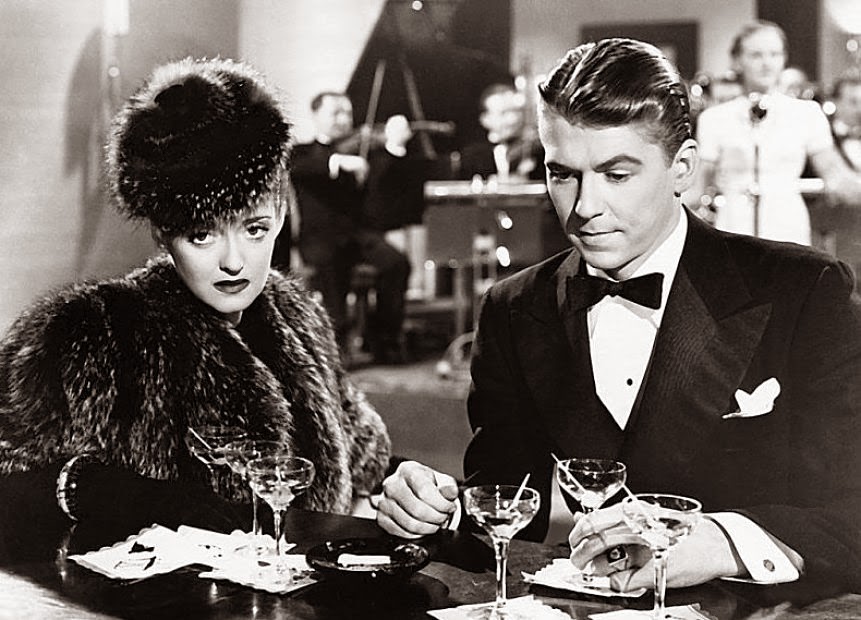
"Dark Victory," the Hal Wallis–directed movie that premiered 75 years ago today, had a star–studded cast — but anyone who comes across it while channel surfing and hopes to see a lot of Humphrey Bogart or Ronald Reagan or George Brent or Geraldine Fitzgerald will be disappointed.

Well, I suppose Brent had more screen time than the others. Not only was he Davis' doctor, but they got married as well. Still, this was purely a Bette Davis vehicle. The others were there, I suppose, because it couldn't be a one–woman show. They had their parts to play, and they played them well.

But make no mistake about it: "Dark Victory" was Davis' movie.

It was a bit melodramatic for my taste. Davis played a young heiress who likes horses, fast cars and partying. She's been ignoring headaches and dizzy spells, but when her vision is affected, she goes to see a doctor (Brent).

It is determined that Davis' character has an inoperable brain tumor. The diagnosis is confirmed by experts.

It is at this point that one sees a big difference between the way patients were handled in the 1930s and the way they are treated today.

In "Dark Victory," the option of deliberately concealing Davis' terminal condition from her is openly discussed by her doctor and best friend (Fitzgerald). It is even the strategy that is used for a time — until Davis' character learns the truth on her own.

I have to think that, in the 21st century, doctors would advocate being honest with their patients, even when the truth is unpleasant, and most patients probably want to play active roles in their treatment, to make choices as long as possible.

Still, it was consistent with a general theme of denial. Early in the movie, Davis' character ignores warning signs; it is never mentioned whether she might have been saved if a doctor had been aware of those symptoms earlier. Perhaps medical science had not found a preventive measure for that condition — perhaps it still hasn't — and medical personnel of that time believed it was kinder to ignore a terminal condition than confront it with the patient.

In the end, Davis' character clung to her denial strategy, sending her husband off knowing that she would soon be dead but never acknowledging the gravity of her condition. (You'd think that, being a physician, especially the one who made the original diagnosis, her husband would be aware of her declining condition. But he never showed any sign of that in the movie.)

I suppose that is in keeping with a long–standing American tradition of suffering in silence.

Frank Nugent wrote in the New York Times that "[a] completely cynical appraisal would dismiss it all as emotional flim–flam ... But it is impossible to be that cynical about it."

Perhaps that makes me cynical then. I found the story to be, as I have said, melodramatic. Davis was nominated for Best Actress, but when I first watched "Dark Victory," I felt she was guilty of overacting — and, in hindsight, I am glad Vivien Leigh won for "Gone With the Wind."

Leigh's was a better performance, anyway.

Sunday, April 13, 2014

What If ...?


"If he loved you with all the power of his soul for a whole lifetime, he couldn't love you as much as I do in a single day."

Heathcliff (Laurence Olivier)

(1939 is widely regarded as the greatest year ever for the motion picture. Ten movies were nominated for Best Picture that year, and today I take a look at the third of those 10 movies to hit the theaters.)
Emily Brontë would have been a terrific writer for Twilight Zone if such a thing had existed in the 19th century. Her book "Wuthering Heights" and the first of four movie adaptations based on it are perfect examples.

Of course, the William Wyler–directed movie, which premiered 75 years ago today, differs from the book. It told the story of the romance of Heathcliff and Cathy, to be sure, but it said nothing about their children, who play significant roles in the end of the book. In fact, in the movie, Heathcliff and Cathy have no children.

Having read the novel many years ago, I am inclined to think the book really was the Gothic romance it is said to be, but the movie was something different, largely because it left out that second generation stuff.

It was useful as a cautionary tale, I suppose, about jealousy and hostility.

There was also a certainly element of dishonesty — I suppose filmmakers would call it creative license. Although the story was set in the Yorkshire moors of northern England, the filming was done in California. That is the sort of thing that is done all the time, I guess, and is easily excusable, but, given the location of Yorkshire, I would have expected to hear more of a Scottish accent than I heard from the cast. All British accents are not the same.

Another thing: When I saw "Wuthering Heights" for the first time on some movie channel, I felt that there wasn't the kind of chemistry — perhaps passion is a better word for it — between Heathcliff (Laurence Olivier) and Cathy (Merle Oberon) that would be expected.

If I didn't simply imagine that, perhaps it was because Olivier had wanted Vivien Leigh, his lover and future wife, to be his co–star. But Leigh was not yet a major star — she became one when "Gone With the Wind" came out later that year — and producer Samuel Goldwyn opted for Oberon.

Or was that the reason?

If legend is to be believed, Olivier and Oberon did not like each other, to put it mildly, and I'm kind of inclined to wonder whether Oberon was more of a star than Leigh at that point, but I'm also inclined to think that star power wasn't the driving force. Hungarian producer Alexander Korda had sold half of Oberon's contract to Goldwyn so casting her in the role of Cathy may have been purely a financial decision.

Frankly, Oberon never matched the mental image I had of Cathy when I read the book. If I could have chosen, I probably would have chosen Leigh to play the role. She came much closer to being the Cathy I imagined.

It's intriguing, isn't it, to think of how different movie history might have been.

If Oberon had not been cast in the role of Cathy, if the part had gone instead to Leigh, who would have played Scarlett in "Gone With the Wind?"

"Wuthering Heights" almost certainly would have had more passion — and might well have won Best Picture and/or other Oscars it lost, too. It was nominated for eight Oscars as it was — and actually won one, for black–and–white cinematography.

But it lost Best Picture, Best Director, Best Actor and Best Supporting Actress (Geraldine Fitzgerald) as well as nominations for screenplay, score and art direction. Five of those awards went to "Gone With the Wind."

Some still recognize "Wuthering Heights" as one of the great movies of its type. The American Film Institute ranked it 15th on its all–time list of romance movies.

1939 was a banner year for movies, half a dozen of which made AFI's Top 100 romance list, but only one — "Gone With the Wind" — rated higher than "Wuthering Heights."

If Leigh, not Oberon, had co–starred with Olivier, would their screen passion have changed movie history? Or, at least, the order of some of AFI's lists?